Frontpage of AIWS City

On December 24, 2020, Michael Dukakis Institute finished the frontpage of AIWS City.

It includes first parts of the AIWS City – as concepts: collect and engage the most noble and valuable of human being, styles of icons:

The AIWS Palace is inspired by the Hungarian Parliament in Budapest.

The AIWS University is inspired by Harvard Business School.

The AIWS City Hall is inspired by Vienna City Hall.

The AIWS House of Honor is inspired Neuschwanstein Castle.

The AIWS Home is inspired by Frederik Palace in Denmark.

The History of AI House is inspired by MIT.

The AIWS Concert Hall is inspired Musikverein in Vienna.

The AIWS Innovation is an eagle.

From the frontpage, visitor can click to Next at ship akin to the Mayflower to see the second part of AIWS City.

The homepage of AIWS City will be officially opened at AIWS.city on January 9, 2021.

CAIDP – 2020: The Year in Review

February 20 – Setting a foundation for future legislation, the European Commission launches a public consultation on ethical and legal requirements for artificial intelligence. The initiative produces wide-ranging responses from member states, trade groups, academics, and civil society. In December 2019, incoming President von der Leyen called for “new rules on Artificial Intelligence that respect human safety and rights.” [CAIDP 1.3]

June – Hong Kong’s Chief Executive, appointed by China’s Communist Party, deploys AI-enabled face surveillance, communications tracking, and transit record analysis to suppress opponents of a security law. China has pursued “secure cities” as part of the Belt and Road Initiative

July 22 – OECD Secretary General Angel Gurria told the G-20 Digital Economy Ministers “AI’s full potential is still to come. To achieve this potential we must advance a human-centred and trustworthy AI, that respects the rule of law, human rights, democratic values and diversity, and that includes appropriate safeguards to ensure a fair and just society.” In June 2019, the G20 adopted AI Guidelines based on the 2019 OECD AI Principles.  [CAIDP 1.2]

August – The UK government withdraws biased algorithm after widespread public protest. Researchers determined that the AI-generated scores favored students enrolled at elite schools over actual test results. This disadvantaged high-performing students at underperforming schools.

September 9 – The Boston Global Forum and the Michael Dukakis Institute announce the Social Contract for the AI Age.  The Social Contract sets out a vision for a new society, based on innovation, creativity, and mutual respect.

September 7 – The European consumer association BEUC finds widespread public concerns about reliable AI. In comments to the European Commission, BEUC wrote “a strong regulatory framework is necessary” to guarantee consumers are protected against the risks posed by AI.

September 16-18 – The Boston Global Forum and the Club de Madrid, the world’s largest forum of former heads of democratic governments, organize a global policy dialogue on “A New Social Contract for the Age of AI.”

October 13 – Access Now resigns from Partnership on AI, citing a lack of influence with companies that established the “multi-stakeholder” process. Access Now said, “we support human rights impact assessments and red lines around use of these technologies, rather than an ethics, risk-based, or sandboxing approach.”

October – The Global Privacy Assembly, the worldwide conference of privacy commissioners, establishes accountability measures for AI, including human rights impact assessments. The Privacy Assembly also said that changes to data protection law are necessary for accountability in the development and use of AI. [CAIDP 1.15]

October 21 – The European Council adopts a resolution on protecting fundamental rights in the era of AI. Alone among EU countries, Poland objected to the resolution, citing the inclusion of the phrase “gender equality” among the fundamental rights.

November 3 – California passes Proposition 24, updating the state privacy law and creating new rights for algorithmic transparency. California residents also reject a ballot proposal to establish AI-based predictive policing.

November 5 – The Pope warns that AI could exacerbate economic inequalities around the world if a common good is not pursued. “Artificial intelligence is at the heart of the epochal change we are experiencing.” Earlier in the year, the Pope endorsed the Rome Call for AI Ethics  to “promote a sense of responsibility among organizations, governments and institutions.” [CAIDP 1.19]

December 10 – In a joint report, Transatlantic Approaches on Digital Governance, the Boston Global Forum and the Club de Madrid proposed global policies for a better management of digital technologies and Artificial Intelligence. The groups also urged world leaders to adopt and implement the Social Contract for the AI Age

December 12 – The Center for AI and Digital Policy (CAIDP) releases  “Artificial Intelligence and Democratic Values,” the first comprehensive review of national AI policies and practices. The CAIDP Report followed an extensive review of 30 countries and government organizations, undertaken by a team of international experts. [CAIDP 1.23]

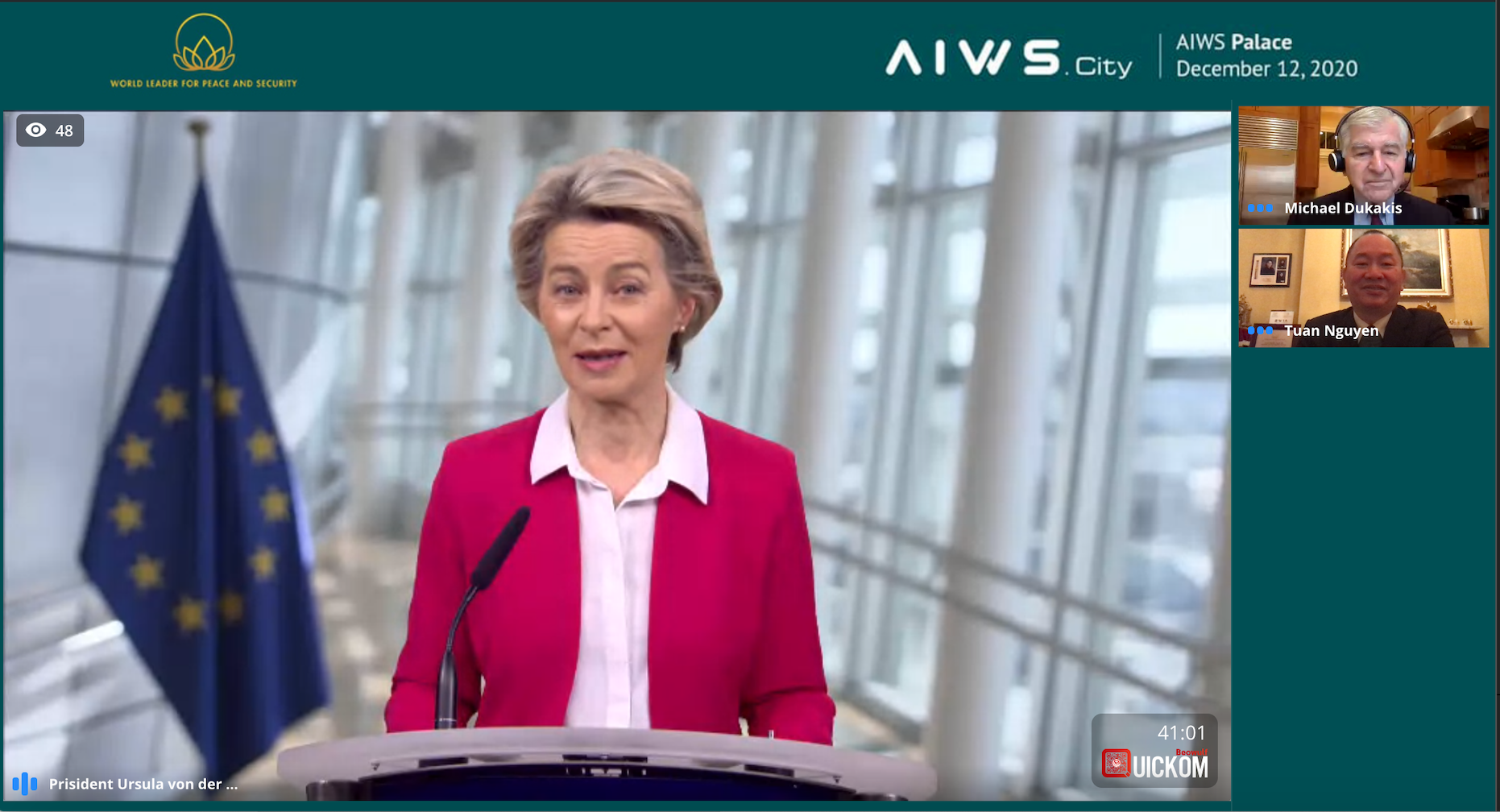
December 12 – Speaking to the Boston Global Forum, President Ursula von der Leyen proposes a Transatlantic Agreement on Artificial Intelligence.  “We want to set a blueprint for regional and global standards aligned with our values: Human rights, and pluralism, inclusion and the protection of privacy,” said von der Leyen. Professor Nazi Choucri, on behalf of the Michael Dukakis Institute, proposed an International Accord on AI in 2021.[CAIDP 1.24]


Marc Rotenberg, Director

Center for AI and Digital Policy at Michael Dukakis Institute

The Center for AI and Digital Policy, founded in 2020, advises governments on technology policy

Why Covid Will Make AI Go Mainstream In 2021: Top 3 Trends For Enterprises

What were the golden periods of innovation in modern history? Significant innovation did not occur during phases of economic prosperity or when business was conducted peacefully.

Contrary to expectations, innovation has always flourished during times of deep economic turmoil or prolonged world conflicts. For example, if we look at the patents filed in the past 250 years, the biggest surge in inventions came during the Great Depression.

Economic historian Alexander Field considers the 1930s to be the most technologically progressive decade of the 20th century. The Great Depression produced several important inventions such as the analog computer, jet engine, frozen food process, the electron microscope, radio telescope, and even the car radio.

Artificial intelligence will transform 2021 by accelerating pharmaceutical drug discovery beyond Covid. It will change the face of telecommuting and will make devices around us truly intelligent through edge computing. Before we look at these trends, we must first recognize three critical changes in how business was done in 2020. This created the foundation for next year’s trends.

  1. AI will transform drug discovery and development well beyond Covid-19

AI helped fast-track the Coronavirus vaccine tremendously, cutting timelines from 10 years to 10 months. Moderna has used a digital-first approach since its inception in 2010. It accumulated a wealth of drug discovery data and applied algorithms to fast-track its mRNA vaccine. However, this use of artificial intelligence for drug discovery was just a pilot. We will see more significant advances in 2021.

  1. AI will transform telecommuting and unlock the future of work

We spent a sizable portion of our work time this year on Zoom, Microsoft Teams, or Google Meet. The battle for supremacy will continue amongst these top players into 2021. Startups that aren’t burdened by legacy product features will reinvent this space. For example, Vowel is a venture-funded video conferencing tool that lets you transcribe, search, and share your meetings.

  1. AI will transform edge computing and make devices around us truly intelligent

We are seeing an explosion of smart devices and IoT (Internet of Things) sensors. Over 35 billion devices are expected to be in use worldwide in 2021. Most of these devices aren’t smart. They depend on a centralized server for their intelligence. Data continuously travels between the devices and the cloud, where all the computing happens. This introduces latency and makes the devices expensive.

The original article can be found here.

To support for AI technology and development for social impact, Michael Dukakis Institute for Leadership and Innovation (MDI) and Boston Global Forum (BGF) has established Artificial Intelligence World Society Innovation Network (AIWS.net). In this effort, MDI and BGF invite participation and collaboration with governments, think tanks, universities, non-profits, firms, and other entities that share its commitment to the constructive and development of full-scale AI for world society. This initiative is to develop positive AI for helping people achieve well-being and happiness, relieve them of resource constraints and arbitrary/inflexible rules and processes, and solve important issues, such as SDGs.

CAIDP – CAHAI Approves Feasibility Study for AI Legal Standards

The third plenary session of the CAHAI, an expert group on AI policy, took place this week. [Meeting report.] The CAHAI (the “Ad Hoc Committee on Artificial Intelligence”) was established by the Committee of Ministers in 2019 to examine the feasibility of a new legal instrument based on the Council of Europe’s (COE) standards on human rights, democracy and the rule of law.

This week the CAHAI published Toward Regulation of AI Systems and convened a panel to discuss Democratic Governance of AI. The CAHAI report explored global perspectives on the development of AI legal frameworks, and highlighted recent developments in Israel, Mexico, and Japan. The report emphasized that the COE has “a crucial role to play to ensure that Artificial Intelligence (AI) complies with the Organisation’s standards on human rights, democracy and the rule of law.”

The Council of Europe is a leader in the realm of international legal instruments and human rights. All Council of Europe member states have signed up to the European Convention on Human Rights. And Article 8 of that Convention has done much to shape modern privacy law. COE Conventions are also open for ratification by non-member state. The original COE Convention on Privacy (Convention 108) was ratified by 56 countries.

A key outcome from the December 2020 meeting of the CAHAI was the approval of the Feasibility Study on AI Legal Standards. The Feasibility Study will soon be published online.

The COE also announced an online event on 20 January 2021 “Human Rights in the Age of AI – Europe as an International Standard Setter for AI,” organised with the support of the Council of Europe.

In CAIDP Update 1.17 (Oct. 31, 2020) we reported that the COE Parliamentary Assembly adopted a Resolution on the Need for Democratic Governance of Artificial Intelligence.  The Assembly called for “strong and swift action” by the Council of Europe. The parliamentarians warned that “soft-law instruments and self-regulation have proven so far not sufficient in addressing these challenges and in protecting human rights, democracy and rule of law.”

Marc Rotenberg, Director

Center for AI and Digital Policy at the Michael Dukakis Institute

The Center for AI and Digital Policy, founded in 2020, advises governments on technology policy.

Predictions for AI in 2021

Artificial intelligence has expanded its grip on our lives throughout the past year. Even as a global pandemic forced many data scientists to work from their homes, AI-driven innovations continued to pour from the smartest minds everywhere.

AI is a centerpiece of the coming “new normal” in all our lives. Going forward, AI will be the intelligent nucleus of automated, robotic, and contactless processes that will protect us all from future outbreaks. With the COVID-19 crisis still in full sway, here are my predictions for the specific AI techniques, tooling, platforms, and apps that will come to the forefront in the year to come:

  • Automated governance will become key for controlling AI applications
  • Adversarial attacks will require countermeasures to protect the AI-driven economy
  • Edge-based AI will crunch neural networks down to their essence:
  • Facial recognition will become a dominant AI-based contactless authentication technology: Authenticated AI is imperative. In 2021, enterprises will implement facial recognition for strong authentication in a growing range of internal and customer-facing applications. By the same token, business will increasingly avoid using the technology to inference identity, race, gender, and other attributes that might be sensitive from a privacy, bias, or surveillance standpoint. To the extent that businesses incorporate facial recognition in image/video auto-tagging, query-by-image, and other such applications, it will only be after extensive review by legal counsel. The regulatory sensitivity of this technology, and the legal risks, will only grow for the foreseeable future.
  • Robotics will bring reinforcement learning into AI’s mainstream
  • Deepfake technology will infuse a new generation of AI-based media-prep tools
  • Quantum computing will find its first compelling AI application:

As we turn the corner into 2021, we’ll also have a new administration in place at the White House, a fact that will shape these AI-industry trends that we can’t yet fully foresee.

Early indications are that online content authenticity, especially in election campaigns, will become a key priority for the Biden administration, and this may drive further private sector investment in the AI needed to ensure this. Beyond that, it’s unclear how, if at all, the next administration will deviate from the AI regulation principles proposed by the outgoing administration, or how all of this will drive the federal government’s fiscal, regulatory, or legislative initiatives relevant to this technology.

The original article was posted here.

To support AI positive development for society, the Michael Dukakis Institute for Leadership and Innovation (MDI) established the Artificial Intelligence World Society (AIWS.net) for the purpose of promoting ethical norms and practices in the development and use of AI. To support for AI technology and application development, MDI and AIWS.net has developed AIWS Ethics and Practice Index to measure the ethical values and help people achieve well-being and happiness, as well as solve important issues, such as SDGs. In this effort, Michael Dukakis Institute for Leadership and Innovation (MDI) invites participation and collaboration with think tanks, universities, non-profits, firms, and other entities that share its commitment to the constructive and development of full-scale AI for world society.

AIWS City, the city of AI Age

Nguyễn Anh Tuấn, Boston Global Forum

AI and Democratic Values, December 12, 2020

AIWS City is an online digital city that brings together the cultural, historical, creative, innovative, and artistic values ​​of humanity. AIWS City is built on the foundation of AI technology and blockchain. AIWS City will bring together world leaders, including thinkers, political leaders, creators, innovators, and educators, to help them promote a more civilized and prosperous world, one based on fundamental human values.  AIWS City will be guided by the principles of the Social Contract for the AI ​​Age. It will be a platform to exchange ideas and promote values.

AIWS City will connect with cities that are centers of science, technology, culture, history, architecture, art, and economic vitality and that epitomize the best of civilization, including Boston, New York, Athens, Rome, Paris, Tokyo, and Saint Petersburg. It will connect with and draw upon the knowledge of the preeminent figures in these cities. It will also draw from major thinkers in top universities in the Boston area and elsewhere.

AIWS City will connect with UNESCO World Heritage scenic areas like Yellowstone and Victoria Falls; museums like the Louvre and the Hermitage; leading symphony orchestras like the Vienna Philharmonic and Boston Symphony Orchestra; AIWS Palace will connect with historic palaces such as Versailles and Windsor, and host prestigious events. Today, AIWS Palace is hosting the AI and Democratic Values Forum and the Ceremony to honor World Leader for Peace and Security Award 2020 to President of the European Commission Ursula von der Leyen.

AIWS City will have pioneering initiatives in higher education in the application of AI and Blockchain. The AIWS University will be a place of lifelong learning, deep reflection, and personal growth and recognition, while providing the opportunity to study with the world’s great professors.  As part of AIWS University, there will be AIWS Innovation Labs dedicated to fostering values and ideas, drawing from the world’s leading technology and cultural innovation centers. 

Each resident of AIWS City citizen will have a Digital Home for storing and processing personal data, and will work with others to build the AI World Society, a society dedicated to improving the lives of all through innovative and prudent applications of AI.  At the start, the leadership of AIWS City will come from the Boston Global Forum, the Michael Dukakis Institute and Mentors of AIWS Innovation Network, expanding later to thought leaders from around the world.

The technology partners for AIWS City are Google and Beowulf Blockchain. In fact, today’s conference is being conducted using Beowulf Blockchain’s Quickom technology platform.

I want to thank Beowulf for its support and for its work in constructing AIWS City.


Timing:

January 9, 2021: AIWS Palace, AIWS University will officially operate.

September 1, 2021 Digital Home will officially serve all AIWS City citizens to build their own digital homes. On this day, the houses of honor of Michael Dukakis, Vint Cerf will be opened also.

Not only creating an advanced living and working environment on the internet, AIWS City also connects and creates a modern smart urban area in NovaWorld Phan Thiet, together with the World Leadership Alliance-Club de Madrid. AIWS City contributes to The United Nations Initiative 2045, a model of the city of human being in 2045.

Beowulf Blockchain Partners with Michael Dukakis Institute to advance AI-based AIWS City Deployment

Michael Dukakis Institute has chosen Beowulf Blockchain (https://beowulfchain.com/), a pioneer of the decentralized cloud network for communication services, to build technical platform for AI World Society (AIWS) City, an online smart city that brings together the cultural, historical, creative, innovative, and artistic values ​​of humanity. AIWS City will bring together world leaders, including thinkers, political leaders, creators, innovators, and educators, to help them promote a more civilized and prosperous world, one based on fundamental human values. AIWS City will be guided by the principles of the Social Contract for the AI ​​Age. It will be a platform to exchange ideas and promote values.

 AIWS City will connect with cities that are centers of science, technology, culture, history, architecture, art, and economic vitality and that epitomize the best of civilization, including Boston, New York, Athens, Rome, Paris, Tokyo, and Saint Petersburg. It will connect with and draw upon the knowledge of the preeminent figures in these cities. It will also draw from major thinkers in top universities in the Boston area and elsewhere.

“The prospect of playing a disrupting part in helping to fundamentally transform the landscape for the development of AI-based virtual smart cities is a huge motivator. I have no doubt that the technological advances at the heart of Beowulf Blockchain can help to address widespread inefficiencies and operational challenges in the implementation of AIWS City. “We are proud of the beginnings of collaboration on December 12, 2020, with the ceremony to honor European Commission President Ursula von der Leyen at the AIWS Palace of AIWS City,” said Dr. William H. Nguyen, CEO and Founder of Beowulf Blockchain.

CAIDP Publishes “Artificial Intelligence and Democratic Values”

The Center for AI and Digital Policy has published the first comprehensive review of national AI policies and practices.  The report “Artificial Intelligence and Democratic Values: the AI Social Contract Index 2020” was released in conjunction with the presentation, by the Boston Global Forum and the Michael Dukakis Institute, of the World Leader Peace and Security Award to European Commission President Ursula von der Leyen.

The CAIDP Report is based on an extensive review of AI policies and practices in 30 countries, undertaken by a team of international experts. The CAIDP Report found that (1) the OECD/G20 AI Principles have shaped global policies, (2) AI safeguards build on data protection law, (3) there are “red lines” for certain AI applications, such as facial surveillance and criminal sentencing, and (4) AI policy is in the early days but the pace is accelerating.

The CAIDP Report set out five recommendations: (1) Countries must establish national policies for AI that implement democratic values; (2) Countries must ensure public participation in AI policymaking and also create robust mechanisms for independent oversight of AI systems; (3) Countries must guarantee fairness, accountability, and transparency in all AI systems; (4) Countries must commit to these principles in the development, procurement, and implementation of AI systems for public services; and (5) Countries must halt the use of facial recognition for mass surveillance.

Among the countries reviewed, Germany was at the top. The experts cited Germany’s high level of public participation in AI policy making, strong data protection infrastructure, multiple independent agencies focused on AI, and leadership on AI policy within the European Union and globally.

Leading AI policy experts participated in a discussion of the AI Social Contract Index, including Amb. Karen Kornbluh (ret.), Wonki Min, Merve Hickok and Prof. Frank Pasquale. Representative Robin Kelly (D-IL), cosponsor of the House Resolution on a National AI Strategy, also spoke at the event.

The CAIDP plans updates of AI policy throughout 2021 and the release of a new AISCI-2021 in December 2021. Additional information about the report is available at caidp.dukakis.org/aisci-2020.


Marc Rotenberg, Director

Center for AI and Digital Policy at the Michael Dukakis Institute

The Center for AI and Digital Policy, founded in 2020, advises governments on technology policy.