
Anthropic Gives Claude a Voice. Not Every Model Gets to Speak
The interface is quietly becoming a governance boundary
BGF Weekly Shaping Futures • July 26, 2026
On July 23, Anthropic rebuilt the way people talk to Claude. Spoken conversations, which had run for months on the company’s smallest and fastest model, now run on its more capable ones. Voice can switch models mid-sentence. It can reach the tools a user has connected—email, calendar—without leaving the conversation. It speaks eleven languages and moves between them without being restarted. And it is available on every plan, including the free one.
Most of the coverage treated this as a product catching up with itself. That reading is fair, and it misses the more interesting detail.
THE MODEL THAT STAYED BEHIND
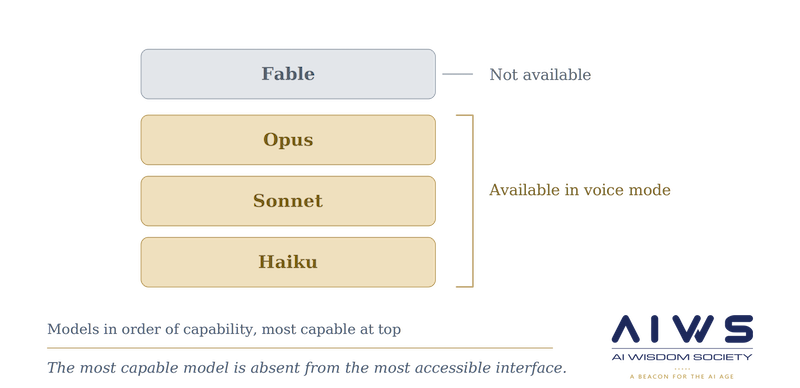
Anthropic’s most capable model is not in voice mode. According to the company’s own help documentation, Claude Fable—the model that sits above Opus in the range—is not currently available there. A day after the voice release, Anthropic launched Claude Opus 5 and described it as approaching Fable’s frontier intelligence at half the price. Opus is in voice. Fable is not.
Anthropic has not explained the absence. It could reflect latency, cost, infrastructure, evaluations not yet completed for a spoken setting, or a deliberate limit on deployment. The reason is not public. The result is: the company’s most capable model has not been placed on its most immediately human interface.
Voice is probably not Claude’s largest surface today; text almost certainly is. It may well become its most intimate. It is free. It requires no typing, no reading, and no prior interest in artificial intelligence. It works in eleven languages, which reaches people no English-language product ever reached. And it can act on a person’s live accounts while their hands are busy with something else.
THE INTERFACE AS A BOUNDARY
The public debate about AI safety has concentrated almost entirely on two questions: what capabilities should be built, and when a model should be released. A third question has been operating quietly beneath both, and it may now matter more than either. Once a model exists and has been released, which surfaces does it reach?
A model available only through an API reaches developers who went looking for it. The same model placed in a free voice assistant reaches a retiree asking it to read her mail aloud. The underlying model may be the same. The exposure, the authority it is granted, and the human consequences are not. Release is not a single event; it is a sequence of decisions about surfaces, and each one changes who bears the results.
Whether by intention or not, Anthropic’s model selection makes the interface function as a boundary capability entering the narrow surfaces first and not, so far, the most accessible one. The effect is the same either way, which is precisely what makes it worth examining. A boundary that holds by circumstance holds only as long as the circumstance does.
It is also, and this is the whole of the point, a private decision. It was made inside one company, against criteria that were never published, reviewed by no one outside, and subject to no standard that would survive a change of strategy. It can be reversed on any ordinary Tuesday, and the reversal would be announced the same way the decision was: not at all. Naming this is not an accusation. A good judgment made privately is still a private judgment, and the next company to face the same choice is under no obligation to reach the same answer.
Interfaces are about to multiply. Voice this year; wearables, ambient assistants, and agents acting unattended after that. Each new surface is another decision about which capability meets which population, made by whoever happens to own the surface.
Verification, as the field currently practices it, asks what a model can do. It does not yet ask where it may do it, for whom, with what tools within reach, and under whose authority. Those are different questions, and they fall due after a model has passed every test anyone currently administers.
Which model is the most capable will remain the headline question. Which model reaches your mother is the one that will decide what this technology actually does to people—and no one, so far, has been given the job of answering it.
Download the file pdf here: https://bostonglobalforum.org/wp-content/uploads/BGF-Weekly-Shaping-Futures-Claude-Voice.pdf