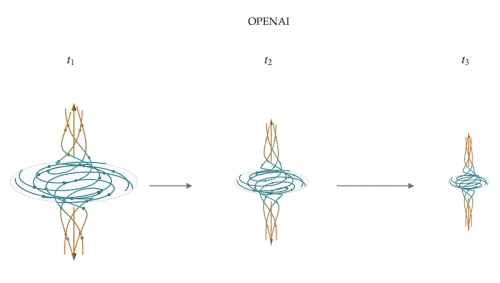
On October 6, OpenAI posted 722 mathematical manuscripts produced by an unreleased internal model, which the company says represent progress on 372 open problems. Only 162 came with main results checked in the Lean proof assistant. Within a day, three were withdrawn after a sign error broke one argument and two that depended on it. OpenAI acknowledged that many of the results are not yet understood by its own mathematicians.
A month earlier, on September 4, Anthropic reported that Claude, working largely autonomously for 11 days by the company’s account, had formalized Fermat’s Last Theorem in about 13 million lines of Lean. The code was released for inspection; it is machine-checkable, not a proof a human can read.
Two releases, two answers to the same new fact: machines can now produce mathematics faster than humans can referee it. One released claims ahead of verification; the other released verification that no person can read through.
The deeper question concerns humanity, not the machines. A result proven by a machine becomes humanity’s knowledge only when people can understand it, explain it, and build on it. This is the principle of Beacon Papers No. 15, The Human Advancement Test: better output does not, by itself, demonstrate human advancement. As discovery accelerates, the measure of progress is not how many theorems machines produce, but how much human understanding grows with them.
→ Read: Beacon Papers No. 15 — The Human Advancement Test