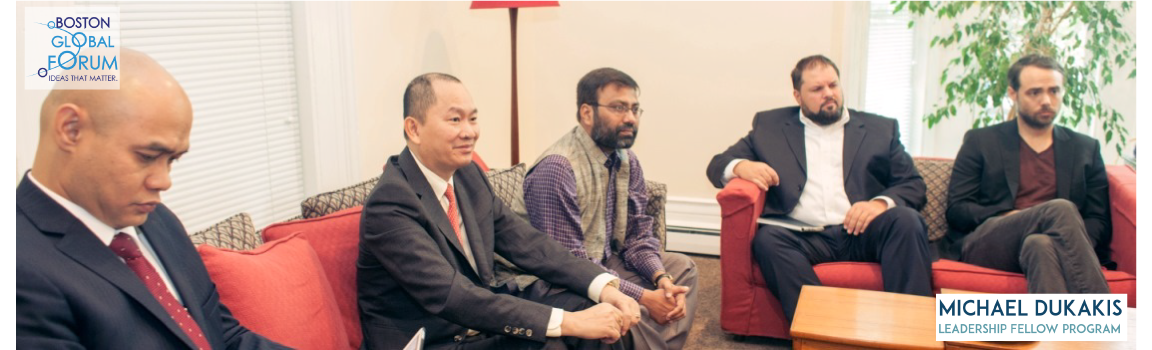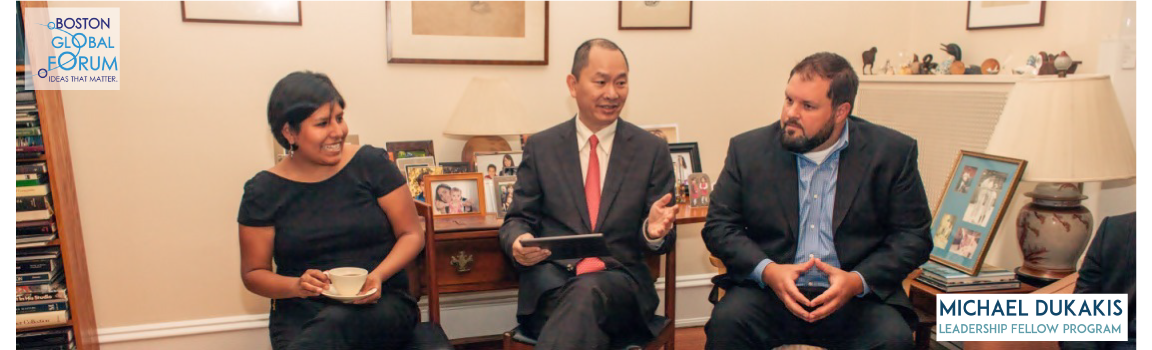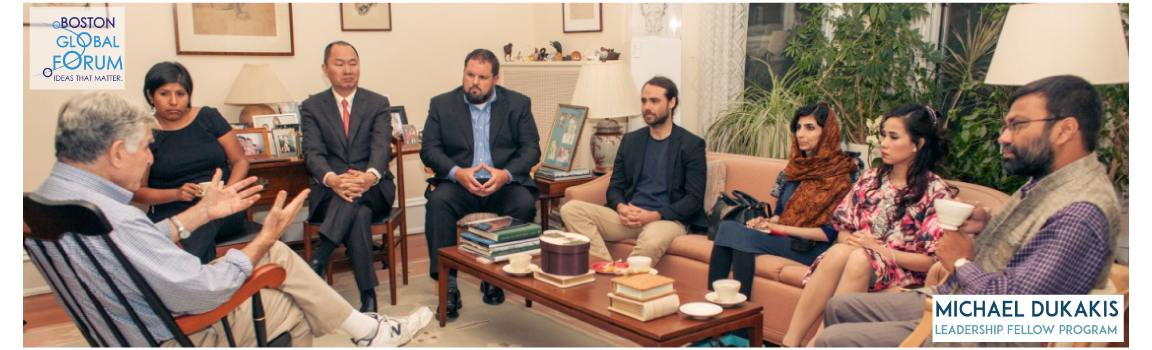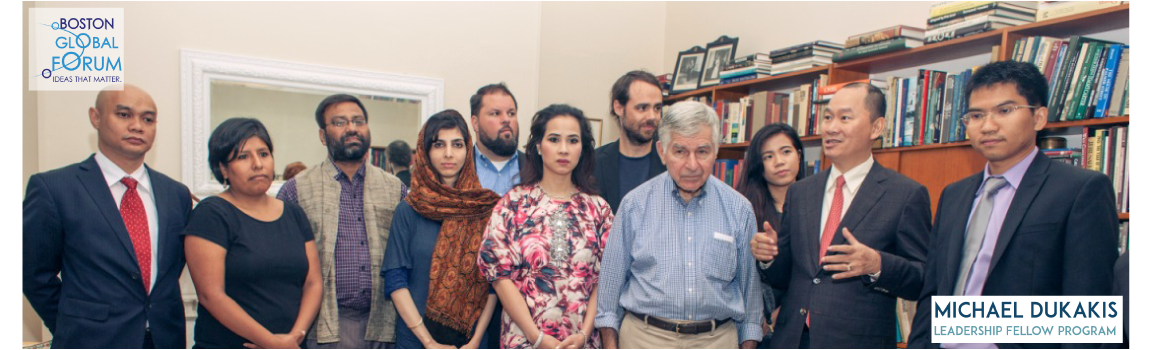
Setting the Stage for Global Harmony: First Official Discussion on the AIWS Music for Humanity Movement

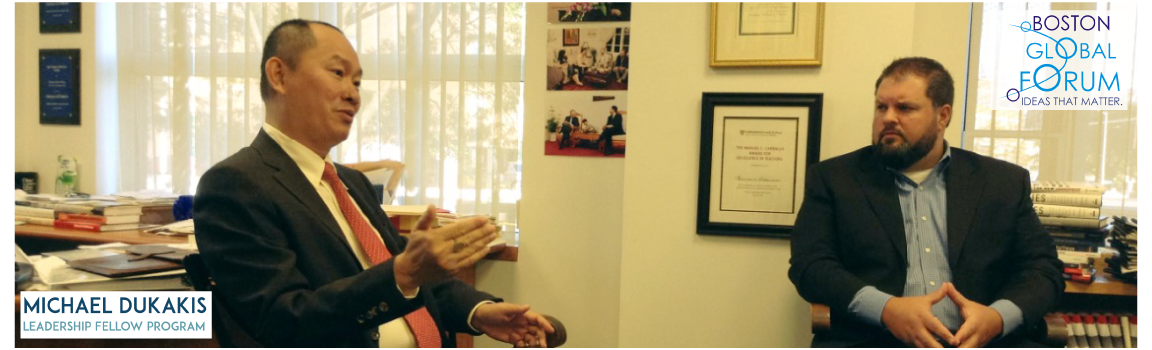
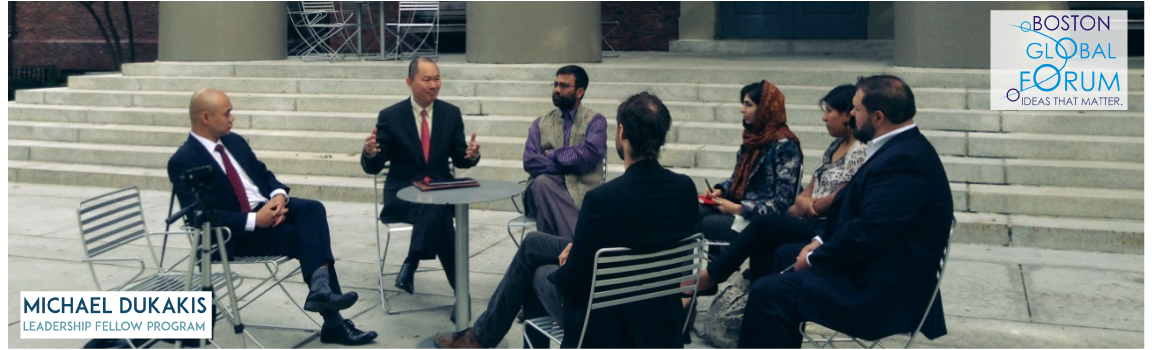
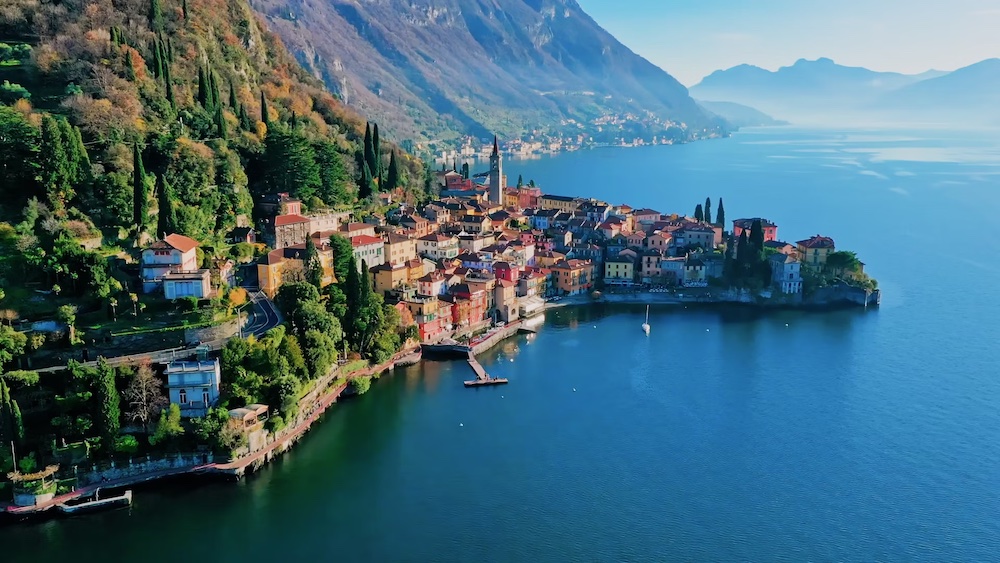
On July 4, 2025, a landmark discussion will officially launch the vibrant AIWS Music for Humanity Movement. Bridging continents and cultures, this inaugural discussion will connect leaders and artists across diverse locations, including Boston, Nha Trang, Tokyo, Lake Como, Paris, and Tromsø (Northern Norway).

At the heart of this global conversation will be Governor Michael Dukakis and Mr. Nguyen Anh Tuan, alongside an esteemed group of musicians and newly appointed Ambassadors for the AIWS Music for Humanity. Their collective dialogue will lay the groundwork for the upcoming AIWS Music for Humanity Forum, exploring how the universal language of music, amplified by the ethical advancements of AI, can foster peace, compassion, and understanding in our world. One key topic for discussion will be precisely how the AIWS Music for Humanity will contribute to shaping a better world in the AI Age. This session marks a pivotal step in harnessing artistic expression to advance the human-centered vision of the AI World Society.

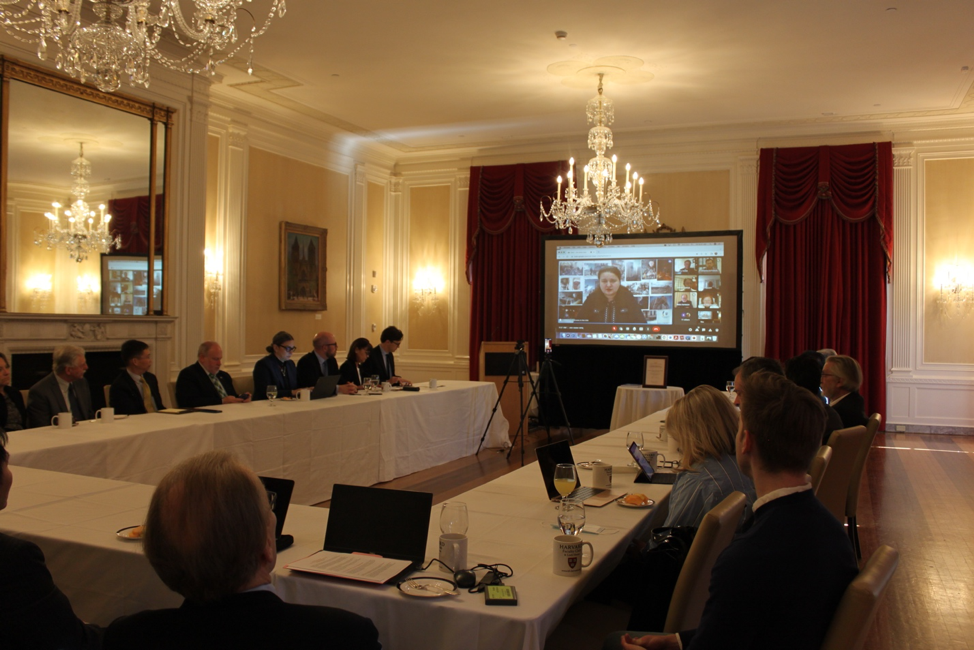
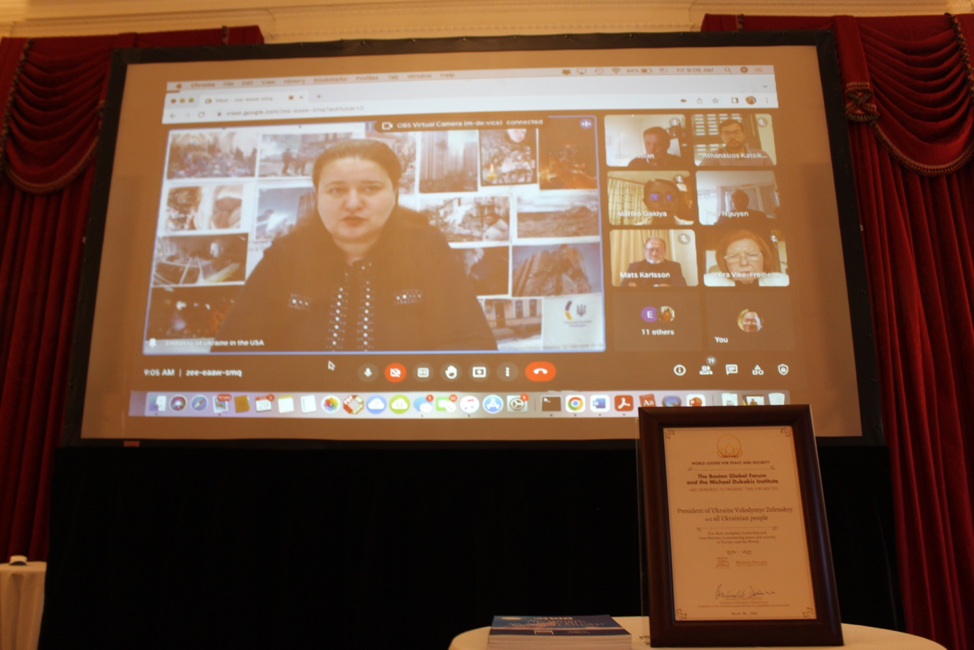
Keynote Speech of Ambassador of Ukraine to USA Oksana Markarova at Ceremony Honoring President Zelensky and all Ukraine people with the World Leader for Peace and Security Award

April 29, 2022

Dear Governor Dukakis, dear President Levits, dear Speaker Norlen, and all the distinguished guests. I’m so honored and happy to be here today, and to address to the Boston Global Forum. For 65 days, you see how Ukraine is defending itself from a brutal enemy. For 65 days Ukraine fights for our houses, for our homes, for our people, for our lands, but also for freedom and democracy. We fight for their rights to be who we are, to live peacefully in our country, and to decide how we want to live in our country.

For 65 days, we have seen unbelievable destruction of our country. We have seen ceaseless attacks from the sky, from east, north, and from south. We have seen some of the cities like Mariupol and Kharkiv and Tserkva destroyed to the ground. We have seen attacks on civilian orchards and hospitals and schools. We have seen destruction of universities which were there, some of them for more than 200 years, and even the World War II did not destroy them. We experience unimaginable losses. More than 4.5 million people had to flee Ukraine, and many are women and children, to save their lives. More than 7 million people are internally displaced in Ukraine. More than 10 million people, as we speak today, live under brutal conditions under occupation, without water, without food, without the basic needs for medical supplies.

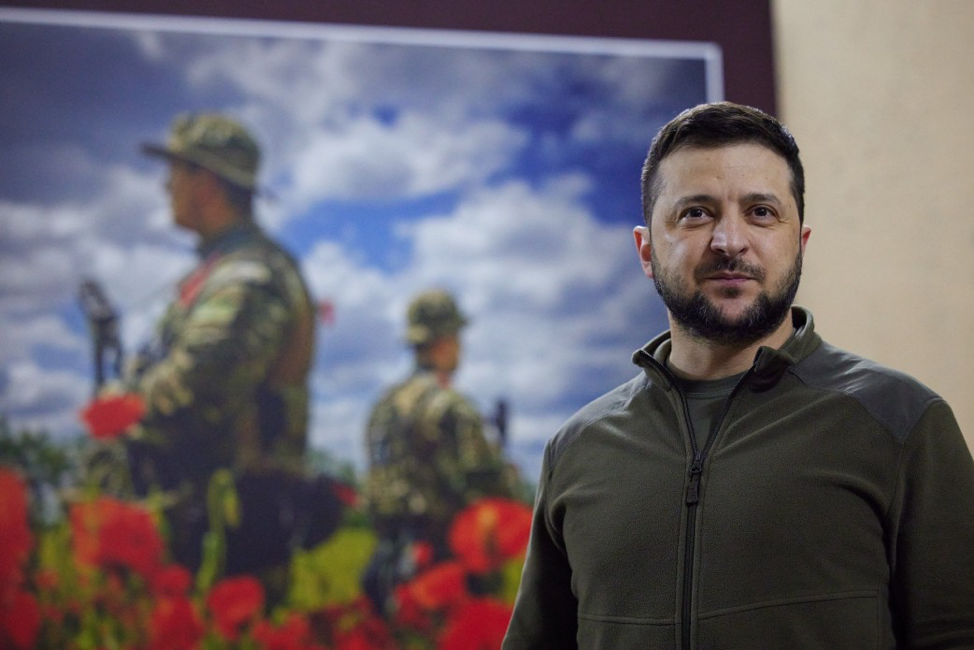
But also for the 65 days, we have shown to the world an example of bravery, starting with our unbelievably great president, Volodymyr Zelensky, not only when this phase of the war started, and I want to remind you that this war is in Ukraine for the past eight years. Russia attacked us in 2014. But during the first 65 days, as soon as Russia started its full-fledged attack and invasion in this phase of the war, President Zelenskyy came out, and he said, “The president is here. I’m here, and stay in Kyiv. We will not surrender. We will not give up. We will defend what we love and what we believe in. And this is what we are doing. And this is the whole nation fighting: Our brave armed forces, our National Guard, our rescuers. But every Ukrainian center is doing what our president has said we would do, and we will not give up. Ukrainians love [to] build things. We love [to] grow wheat. We love to initiate startups. But today we all had to postpone what we were doing in our ordinary lives, and we all have to defend our country. And we’re very grateful to all of our strategic friends and allies and especially to the United States for all the support, with weapon, with sanctions, with financial and energy support to Ukraine. Because this fight is so much more than you think. This fight is about the global situation. This fight is about whether Europe and in general the democratic world can feel safe, whether you can make the civilisational choice to be democratic, to be free, to be sovereign and not be attacked by the brutal enemy.

On behalf of my president and all Ukrainians, firstly, great thank you. And our deepest gratitude for this act of support and for the World Leaders Award for Peace and Security. I agree with you that nobody deserves it better than our president, who has shown an outstanding example of leadership under the dire circumstances. I would like to also thank you for this event and for the efforts that all of your professors and all of the distinguished guests have taken in order to help us to already brainstorm and say, how are we going to deal with things? Because for us, the number one goal, of course, is to win in this war. And as we are certain not to surrender, we are certain that with the help of all of our friends and allies, we will win this war, and peace will return to Ukraine, and then we will build back Ukraine better. We will build a new innovative Ukraine 2022.0., which will be the most efficient, the most democratic, the most innovative. And we would be able to see all of our friends and allies to participate in this new endeavor. So with that, let me again thank you for this award. Thank you for inviting me to speak at the beginning of this conference. I wish you very fruitful discussions today. And we need all the prayers and all the weapons that anyone can provide to us and present all of us, democratic people. People who love freedom and who are ready to fight for it will win.


Thank you very much, and you all have a good day.

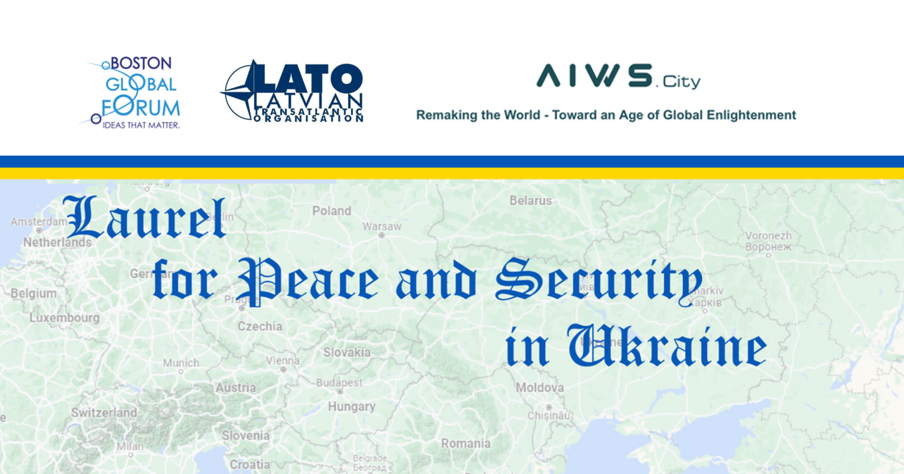
Boston Global Forum and LATO to Host Laurel for Peace and Security in Ukraine Conference

Remaking Ukraine – Toward an Age of Global Enlightenment

What: The conference will address the situation in Ukraine, and work to provide solutions for Peace, Security, Territory Integrity and Rebuilding Ukraine.

At the event, the Boston Global Forum (BGF) will honor President Zelensky and all Ukrainian people as the 2022 World Leader for Peace and Security.

BGF will be honoring President Zelensky and all Ukrainian people through assistance and application of the concepts from “Remaking the World – Toward an Age of Global Enlightenment” to rebuild Ukraine in becoming an exemplary nation.

In this event, BGF will present ideas and suggestions from BGF World Leader for Peace and Security Award’s recipients to Laurel for Peace and Security in Ukraine Initiative.

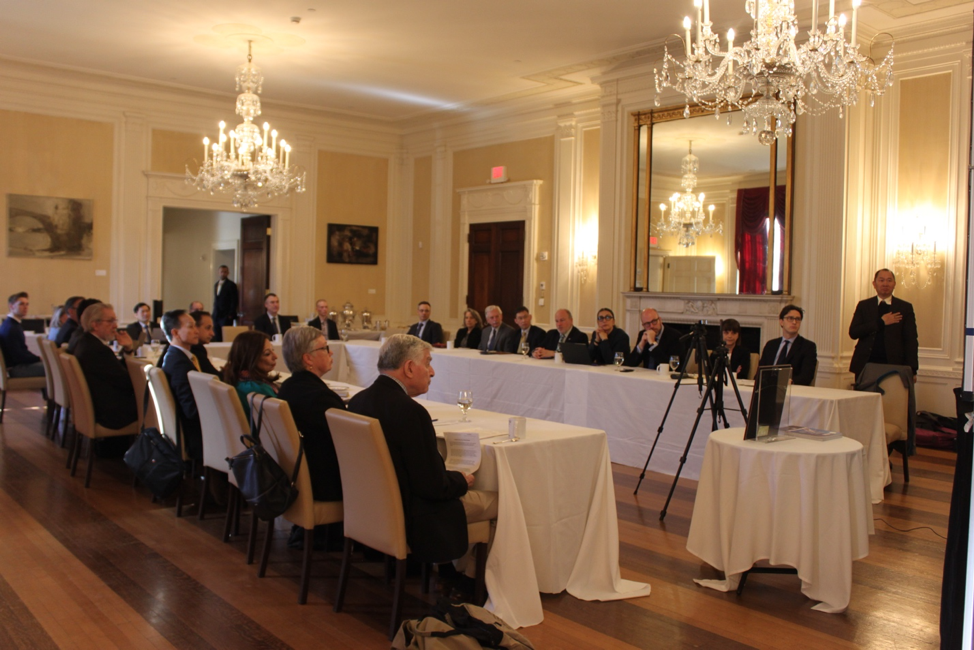
Where:           Loeb House, Harvard University

When:            8:30 am – 11:30 am Boston / 15:30 – 18:30 Riga and Kyiv, April 29, 2022

Who:              World Leaders, Scholars of Harvard University and MIT, Members of

                        Boston Global Forum

Co-organizers: Boston Global Forum and Latvian Transatlantic Organization

                                     Agenda

Session 1, 8:30 am – 10:00 am Boston, 15:30 – 17:00 Riga, Kyiv

            Honor President of Ukraine Volodymyr Zelenskyy and Ukrainian People as 

            2022 World Leader for Peace and Security and Solutions for Peace, Security and

            Territory Integrity of Ukraine         

8:30 a.m. Introduction, Harvard professor, Co-founder of Boston Global Forum, Thomas Patterson

Remarks to honor President Volodymyr Zelenskyy by Governor Michael Dukakis, Co-founder and Chair of the Boston Global Forum

Message of President Volodymyr Zelenskyy (pre-recorded video of text)                

Keynote Speech of Ambassador of Ukraine to USA Oksana Markarova (online)

Latvian President Egils Levits (online)

Riksdag Speaker Andreas Norlen (online)

A leader of US State Department (online)

Senior Fellow of Harvard Kennedy School Belfer Center, Brigadier General Kevin Ryan

MIT professor Nazli Choucri (online)

            Discussion:

            Moderator: Chairwoman of the Latvian Transatlantic Organization (LATO),

Professor of International Relations, University of Latvia, Zaneta Ozolina


Session 2, 10:00 am – 11:25 am Boston / 17:00 – 18:25 Riga, Kyiv 

Rebuild Ukraine: From devastation by War to an Exemplary Nation with Remaking the World – Toward an Age of Global Enlightenment


Leaders of Boston Global Forum: Governor Michael Dukakis, CEO Nguyen Anh Tuan, MIT Professor Alex Sandy PentlandHarvard professors Thomas Patterson, David Silbersweig

Ukrainian former Prime Minister Arseniy Yatsenuyk (online)

    Discussion: Strategies to rebuild Ukraine 

            Moderator: Governor Michael Dukakis 

            Chairman of the Council of Economic Advisers to President Obama, Harvard professor

Jason Furman

Latvian former President Vaira Vike-Freiberga (online)

Bosnian-Herzegovina former Prime Minister Zlatko Lagumdzija (online)

Former Vice President of the World Bank, Representative of BGF in London and Stockholm Mats Karlsson (online)

Assistant Secretary of Business Development and International Trade, Government of Massachusetts, Nam Pham

            EY Global Tax Innovator, Jeffrey Saviano

11:30 am: Closing Remarks, Governor Michael Dukakis

      Delegates and Discussants: Consuls-General in Boston: Arnaud Mentré (France),

Peter Abbott OBE (UK), Nicole Menzenbach (Germany), Stratos Efthymiou (Greece), Leonard Kopelman (Finland), Jonathan Sun (Taiwan), Marek Leśniewski-Laas (Poland), Elizabeth T Lesniewski-laas (Romania) and Distinguished Scholars, Innovators who are members of AIWS.net supporting Ukraine, and honor guests.

Download Agenda in PDF format here 

Registration Form

LAUREL FOR PEACE AND SECURITY IN UKRAINE CONFERENCE

Where: Loeb House, Harvard University

When: April 29, 2022

8:30 am – 11:30 am Boston time or 15:30 – 18:30 Riga and Kyiv time

REGISTRATION INFORMATION

CONTACT INFORMATION :

For further inquiries or special assistance, please contact the organizers via email.

[email protected]

THANK YOU FOR REGISTERING!

We look forward to seeing you at the conference.

The Boston Globe Letters – Globe Opinion: AI, a means of progress, can do harm if in the wrong hands

The Russian invasion of Ukraine throws into sharp focus many urgent global problems that have been neglected for decades, including cybersecurity, disinformation, trade disparities, and dependence on unreliable and environmentally damaging fossil fuels (“Hey Congress, blue and yellow ribbons won’t save Ukrainian lives,” Editorial, March 4). They are all related and all need immediate attention.

An overarching concern that touches on all of these challenges: artificial intelligence technology. This technology can make positive contributions to health care, commerce, and communications. However, in the wrong hands, AI can be used to distort reality, invade individuals’ personal space, and undermine democracy.

Through the Boston Global Forum and the Dukakis Institute, a global effort is underway to create an international accord on AI and digital rights. This accord would establish guardrails for the use and abuse of personal information to drive policy decisions that generate positive pressure and counteract efforts by malignant governments and private entities.

Dozens of heads of state and other world leaders are sharing ideas and recommending solutions to address growing concerns about AI. Without such protections, we are at the mercy of technologically savvy actors who can cause significant damage to our world.

Michael S. Dukakis

Cofounder and chairman

Nguyen Anh Tuan

Cofounder and CEO

Boston Global Forum

Boston

Dukakis is the former governor of Massachusetts. Tuan is director of the Michael Dukakis Institute for Leadership and Innovation.

https://www.bostonglobe.com/2022/03/10/opinion/ai-means-progress-can-do-harm-if-wrong-hands/

Statement of Boston Global Forum on Russia and Ukraine

Boston, 02/20/2022

We, the Boston Global Forum (BGF), an organization dedicated to promoting a more peaceful world through its World Leader for Peace and Security Award (its recipients have been Prime Minister Shinzo Abe, Chancellor Angela Merkel, UN Secretary-General Ban Ki-moon, President Toomas Hendrik Ilves, President Sauli Niinisto, President Vaira Vike-Freiberga, President Ursula von der Leyen, Riksdag Speaker Andreas Norlen), urgently call upon concerned parties to peacefully resolve the conflict between Russia and Ukraine in a way that upholds the rule of law and the sovereignty, territorial integrity, and legitimate security interests of both nations.

We urge Ukraine to pledge not to join the North Atlantic Treaty Organization (NATO) and not accept offensive military weapons on its soil. We urge Russia to pledge respect for the independence of Ukraine on land, air, sea, and cyberspace and to refrain from acts that threaten the territorial integrity of Ukraine and its people’s right to self-determination. We urge other nations to respect these commitments and refrain from acts disruptive thereof.

We urge the world community to respond to the current crisis by developing binding new international rules and instruments to safeguard the rights, interests, and integrity of countries that are too weak on their own to withstand aggressive hostile actions by more powerful countries. We, the Boston Global Forum, commit to assisting in the development of the new international rules and instruments and to advocating for their adoption.

Michael Dukakis, Co-founder and Chair, Boston Global Forum

Tuan Anh Nguyen, Co-founder and CEO, Boston Global Forum

Thomas Patterson, Co-founder, Boston Global Forum

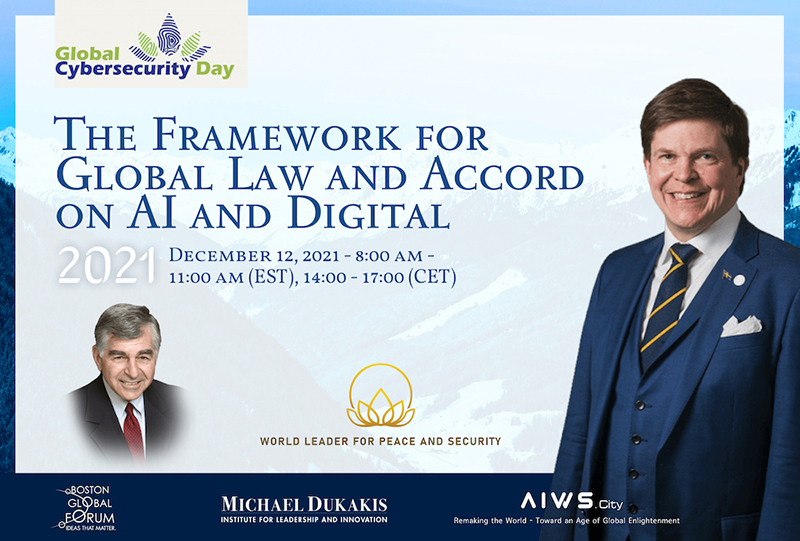
Keynote speech of Speaker of the Swedish Parliament, Andreas Norlén, receiving the 2021 World Leader for Peace and Security Award

Governor Dukakis,

Excellencies,

Ladies and gentlemen,

I want to start by thanking Governor Michael Dukakis and Boston Global Forum for selecting me for the World Leader for Peace and Security Award 2021. I am honoured and proud both for the award and for the opportunity to address you today. Your organisation plays an important role in working for a more peaceful and secure world, for instance by raising both the potentials and risks of artificial intelligence and other digital technologies. Your initiative on Global Law and Accord on AI and Digital is timely and important.

Tomorrow on December 13th we celebrate Lucia in Sweden. Lucia is an ancient mythical figure with a role as a bearer of light in the dark Swedish winters.

If there is one thing most people associate with Christmastime, it must be light. To me, light symbolises both hope and faith in the future; two things we truly need, both as individuals and as a society.

And I believe our need for light and hope is greater than it has been in a long time. The pandemic is not over, even if there might be light at the end of the tunnel, and we will forever carry with us the memories of all that we have lost and everyone we have lost.

***

Ladies and gentlemen,

I feel very humbled when I read the motivation of the award honouring me for my “efforts, in a turbulent political landscape, to enhance transparency, knowledge and public trust in the complicated processes of forming government in Sweden”. I would like to begin by elaborating a bit on this and its connection with global peace and security. I will then move on to talk about issues related to the theme of the symposium – “Global Law and Accord on AI and Digital”.
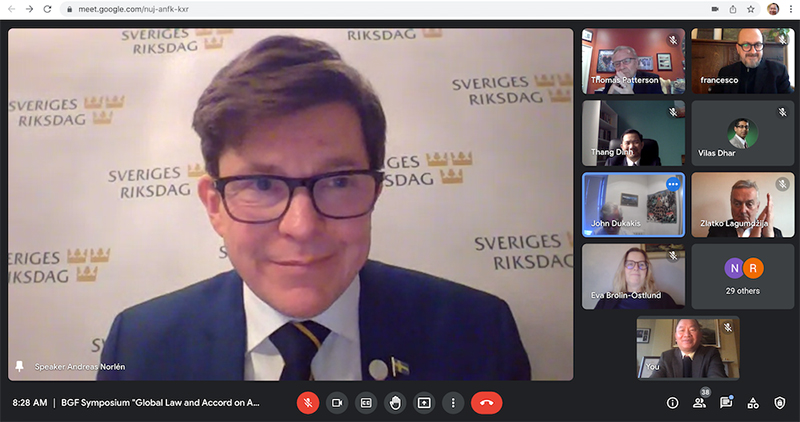
Firstly, let me say that I think it is of great significance that you have presented your distinguished award to a Speaker, a leader of a parliament. Often, in international politics, there is great focus on Governments and Presidents and you have previously honoured representatives of the executive branch in countries and organizations. It is of course very relevant to look for global leaders among heads of states and governments, but by highlighting also the importance of parliaments, I think you send an important signal. In that sense I proudly accept this award not only for myself but on behalf of all leaders of democratically elected parliaments.

Winston Churchill once said: “I am a child of the House of Commons”. I think that is a beautiful way of underscoring the importance of parliaments also for a famous head of government. Parliaments are at the heart of democracy. The Swedish constitution states that the Parliament is the foremost representative of the people in our democracy. Of course, in democratic countries also Governments and Presidents have democratic legitimacy, but there is a special bond between the Parliament and the people, forged not least through direct elections.

Secondly, I believe that democracy is a prerequisite for lasting global peace and security. Many of the tensions and conflicts we can see in the world today within countries and between countries originate from a lack of democracy – a lack of respect for freedom of speech, for minority rights, for rule of law and for other fundamental parts of a democratic society.

From that perspective I think that by giving the leader of a parliament your award, you recognize the importance parliaments have for democracy and the importance democracy has for global peace and security. For this, I truly commend you.

Moving on to the specific events you allude to in the motivation, we have in Sweden experienced an electoral period like no other. When a prime minister resigns and a new government is formed, it is in Sweden the task of the Speaker – not, as in most other countries, the Head of State – to prepare a proposal for a new prime minister who can gain sufficient support in the parliament. We have now had three such governmental formations since the last election in 2018.

This period started with a record-long process of formation of government in 2018-2019, a process that took a total of 134 days. This was followed by a government crisis in June to July this year, and then in November, I received the application from Prime Minister Stefan Löfven of the Social Democratic Party, to be discharged from office.

Thus, in November we had the third formation of government of this electoral period, and on 30 November, a new Government took office with Ms Magdalena Andersson from the same party as Prime Minister.

During these many twists and turns, I have worked hard to explain the processes to the Swedish people and demonstrate that the many formations of government have not meant a crisis for democracy.

Swedish democracy stands strong. All the actors taking part in these processes have used the various tools available to them in the parliamentary toolbox. Certain events may have been rather turbulent, but they are all a result of the rules of democracy. As a Speaker, I may not act in a partisan way and I have tried my very best to be a neutral broker and a representative of the Parliament as an institution, not of any particular party. In order to maintain public trust in the political processes I think it is important that there are representatives who are not embroiled in fights but who try to calm the situation. I am humbled and grateful that you, Governor Dukakis, and the BGF, have chosen to give me your award because of these efforts.

***

Ladies and gentlemen,

I think it is important to take note of the fact that since around 1980, we witnessed a positive trend with more and more states moving from authoritarian to democratic rule.  However, since a few years back, that positive trend has been reversed, and a larger proportion of citizens on this planet are now living in authoritarian countries. It is clear that the pandemic has accentuated this negative trend.

It is alarming how leaders in different parts of the world are using the COVID-19 crisis for authoritarian purposes such as silencing independent media and obstructing the ability of civil society to make its voice heard.

Current developments with regard to the rule of law also require attention. Basically, the rule of law is a system that restricts arbitrary exercise of power, a system where laws are applied equally for all – I believe that a strong sense of this crucial principle is a prerequisite in sustaining basic rights and freedoms. I believe there is reason for concern in this regard.

Sweden supports efforts to defend and promote this principle and to improve the tools needed by the institutions and member states of the European Union to strengthen the rule of law, within the Union and globally.

For the rule of law to be a ruling principle, it also needs to be enforced by the legal system. Protecting the security and integrity of judges, prosecutors and civil servants must therefore be a key issue in any discussions on how to promote democracy.

Sweden is very active on the global stage to promote peace, security and democracy, and this is supported by both the Government and the Parliament.

***

Ladies and gentlemen,

The Boston Global Forum has worked a lot with important issues regarding AI and other matters relating to digitalisation. Let me now give som perspectives on those issues.

The pandemic has served as a catalyst for an accelerating digitalisation. Digitalisation and artificial intelligence raises questions that need to be addressed. When and how to share data and information is for instance a central question for all companies and government agencies working with data driven methods. It is now more important than ever that we all work for technology that is trustworthy, secure and human-centric.

I would like to mention a couple of examples of issues that are topical in Sweden and that concern rule of law and inclusivity, in a time when more and more of the activities of our public agencies are being digitalised.

The Swedish National Audit Office has examined whether automated decision-making by government agencies is effective and efficient, without jeopardising legal certainty in decision-making.

The overall conclusion is that automated decision-making by government agencies has led to increased effectiveness and efficiency and that fundamental legal certainty aspects have improved to some extent. However, there are shortcomings in the agencies’ processing of cases with a high risk of fraud and error. In addition, there is far too limited follow-up of the correctness of automated decisions. There is therefore a risk that resources for manual control and follow-up have too frequently been accorded too low a priority.

Another audit shows that the accessibility of government agencies has deteriorated in non-digital channels. Digitalisation of government agencies’ activities contributes to more efficient and improved service for citizens. But for many people, being able to access services by phone or by visiting in person is still important.

The audit shows that many public agencies have become less accessible in non-digital channels in the past ten years.

Agencies’ customer contacts in digital channels have increased significantly, but despite this, the number of phone calls has not decreased. Simpler cases are now often managed online, at the same time as more phone calls come from people needing guidance on how to use such online services.

The conclusion is that digitalisation of the public agencies’ services represents good management of central government resources. Nevertheless, the opportunity to contact agencies by phone and at a physical office is still important.

These are examples of questions that need to be taken into account in the continued digitalisation process.

***

Ladies and gentlemen,

Martin Luther King said “Only in the darkness can you see the stars”.

Right now, our need for hope and light is perhaps greater than usual, as well with regard to the pandemic as with regard to democracy. But we can all take comfort in the fact that the light will return to our societies. In the long run, light is always more powerful than darkness.

Democracy is facing challenges, but we all have to do our utmost to defend it. I am hopeful that we will succeed. Let us, together continue to develop our countries and the global society along a path built on the cornerstones of democracy.

Because in unsettled times, democracy is the beacon of light that can guide us through the darkness.

Thank you.

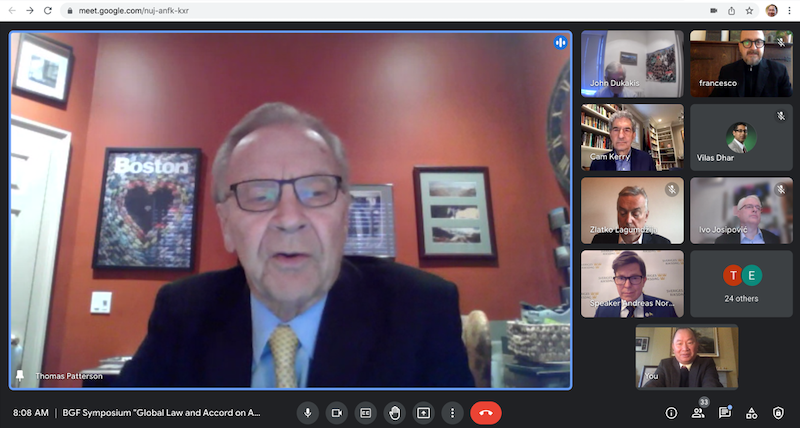
Opening Remarks of Professor Thomas Patterson at Global Cybersecurity Day “Framework for Global Law and Accord on AI and Digital”

Boston, December 12, 2021

Welcome.

I’m Tom Patterson, co-founder of the Boston Global Forum.

It was on this day nine years ago that Mike DukakisJohn QuelchNguyen Anh Tuan, and I founded the Boston Global Forum. Every year since then, we’ve marked December 12th with a conference and a new initiative.

The 2015 conference, for example, marked the announcement and creation of Global Cybersecurity Day, a conference at which we recognized and honored Japanese Prime Minister Shinzo Abe, and German Chancellor Angela Merkel, and in the 2016 conference we recognized and honored UN Secretary General Ban Ki-Moon.

And December 12th is when we present our annual World Leader for Peace and Security Award. This year’s recipient is Andreas Norlen, Speaker of Sweden’s Riksdag – that nation’s national Parliament. Speaker Norlen is with us today.

Before introducing Boston Global Forum’s chairman, Mike Dukakis, I want to say a few words about some things that the Boston Global Forum has done during the past year.

We’ve been working closely with the Club de Madrid, which is the organization whose members are former presidents and prime ministers of democratic nations. Across several conferences, we’ve been looking at the challenges and opportunities presented by the digital revolution, and particularly by Artificial Intelligence.

Together, we’ve promoted the need for a new social contract, one that can advance AI’s potential for good while mitigating the threats that it poses. A social contract that would, for example, protect the right of individuals to their privacy and from exploitation by those who would use their personal data to manipulate their consumer or political choices. A social contract that would also prohibit governments from using AI as a tool for repressing dissent. The social contract would extend beyond what’s prohibited to what must be done to empower ordinary citizens, such as guarantees of digital literacy and access.

The agenda for today’s discussion is an extension of that work – the need for an International Accord on the use of AI and Digital.

The past year has also been marked by publication of the book, “Remaking the World: Toward an Age of Global Enlightenment.”

Edited by the Boston Global Forum’s CEO, Nguyen Anh Tuan, and including chapters by more than two dozen prominent leaders and thinkers, it was developed in collaboration with Ramu Damodaran, founding director of the United Nations Academic Impact Program.

The book is a visionary look forward to the year 2045, the centennial of the United Nations, and asks what must be done between now and then to fulfill the UN’s founding vision.

In a conference this past Thursday, the leaders of Vietnam’s Khánh Hòa Province pledged to implement many of the programs contained in the book, in order to create a model that can be emulated by governments elsewhere.

Finally, I’d like to give a special word of thanks to Tuan, who as those associated with this organization know, is its driving force.

Tuan is our organizer, our networker, and our leading thinker. Many of the initiatives that have marked the Boston Global Forum’s work these past nine years have come from the mind and dedication of Tuan. And most of you who are with us today were brought into the Boston Global Forum by Tuan’s efforts.

On behalf of everyone here, Tuan, I want to thank you for all that you do for the Boston Global Forum.

Let me now hand the floor over to Michael Dukakis, Boston Global Forum’s chairman. Mike has been part of the Boston Global Forum since its founding and has guided not only our December 12th conferences but the others that we hold each year.

Mike was three times elected as governor of Massachusetts, was the 1988 Democratic Party presidential nominee, and is currently Distinguished Professor Emeritus at Northeastern University.

Mike, the floor is yours.