Theme: AI World Society Standards
Time: 4:30pm – 6:30pm, March 26, 2019
Venue: Hitachi Central Laboratory in Kokubunji, Tokyo
AI World Society Distinguished Lecturer: Dr.Kazuo Yano, PhD, Fellow, Corporate Officer, Hitachi, Ltd., Member of AI World
Society Standards and Practice Committee
Agenda:
4:30 pm: Introduction, Ms. Nobue Mita, Representative of the Boston Global Forum
in Japan
Opening Remarks, Mr. Nguyen Anh Tuan, Co-Founder and CEO of the Boston Global
Forum, Director of Michael Dukakis Institute for Leadership and Innovation.
4:40 pm: AI World Society Standards, Mr. Kazuo Yano, PhD, Fellow, Corporate
Officer, Hitachi, Ltd., Member of AI World Society Standards and Practice
Committee.
5:40 pm: Discussion: Dr.Kazuo Yano, Ph.D., fellow, cooperate officer from Hitachi, Mr.Yuichi Iwata, senior researcher from Nakasone Peace Institute, Mr.Kei Yamamoto, the president of D-Ocean and Mr.Yuji Ukai, the president of FFRI.
6:25 pm: Present Certificate of AI World Society Distinguished Lecturer to Dr.Kazuo Yano by Mr. Nguyen Anh Tuan
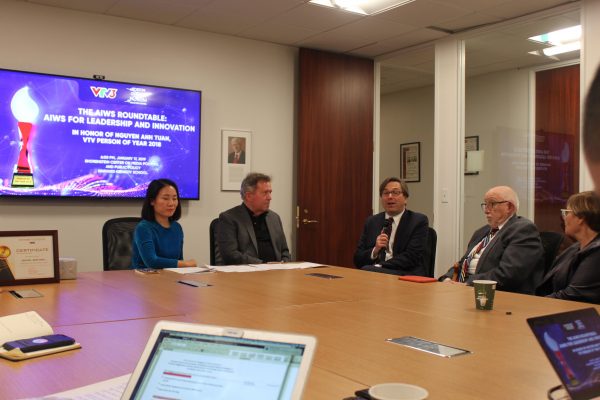
On January 17, 2019 Professor Jason Furman – Chairman of the Council of Economic Advisers and chief economist of former POTUS Obama, and professor at Harvard University’s Kennedy School of Government – gave a talk about AI issues in AIWS Roundtable, which was held by Vietnam National Television (VTV) and Boston Global Forum (BGF).
On January 17, 2019 Professor Jason Furman – Chairman of the Council of Economic Advisers and chief economist of former POTUS Obama, and professor at Harvard University’s Kennedy School of Government – gave a talk about AI issues in AIWS Roundtable, which was held by Vietnam National Television (VTV) and Boston Global Forum (BGF).
Prof. Furman thinks the most important thing to understand is that technology is not a destiny. “It doesn’t tell us what is going to happen to jobs, it doesn’t tell us what is going to happen to wages, what is going to happen to our economy and our society,” said Furman.
“Technology can give us new choices and new opportunities so that sense can make everything better, but only if we are the user,” Furman noted.
“Literally, in Switzerland have very similar technology, there’s a lot of people who are unemployed, literally, Switzerland has a very high level of employment. There’s nothing to do with the terminators. There’s nothing to do with the killer robots. Everything to do with are the economic policy, institutions and the culture…”
About unemployment question, he gave an example: “we have had technology replace humanity for a long time, we can work for 4 hours/week and earn the same amount that we earn in 1900 working 50 hours/week. We want to be richer!”
According to Prof. Furman, there are new types of jobs, there are more demand for all types of jobs and our jobs have changed. Technology will replace certain tasks, but not entire jobs. That is likely what is going to happen in the future.
“But the question is: are you going to prepare people for those jobs, give them the skills and the training? …Robots got a lot of quality. They got a lot of people being disappointed and left down. The way to come about that is education, training, having a system that helps place people in jobs. But the most important in all of this is the more innovation we have, the better sets of options and choices we have as long as we are willing to do what we need to take advantage of,” he explained.
Furman said one of the advantages that machine have is that some of these problems may actually be solvable on the machine side than the human side, but only we put an effort into it.
“The reason we should worry about is not that they are worse than people, but we might be able to solve their problems more easily than we solve the problems of people.”
Artificial Intelligence in the Age of Disinformation and Fake News
♦ ♦ ♦ ♦ ♦
TIME: 8:30 am – Noon, Wednesday, December 12, 2018
VENUE: Loeb House, Harvard University – 17 Quincy Street, Cambridge, MA 02138
MODERATOR: Governor Michael Dukakis, Chairman of Boston Global Forum (BGF) and Michael Dukakis Institute (MDI), former Governor of Massachusetts
AGENDA:
Introduction by Professor Thomas Patterson, Harvard
Opening Remarks by Governor Michael Dukakis, Chairman of BGF and MDI
Global Cybersecurity Day 2018
Announce Recipient and Present Awards for 2018: World Leader for Peace and Cybersecurity – President Sauli Niinistö, President of the Republic of Finland
Remarks of Governor Michael Dukakis
Keynote address of President Sauli Niinistö
Speech of Minister Taro Kono, Ministry of Foreign Affairs of Japan
Conference Theme: AI solutions solve disinformation
The AIWS Distinguished Lecture, Rt. Hon. Liam Byrne MP, the Member of Parliament for Birmingham, Hodge Hill, Shadow Digital Minister, chair of the All-Party Parliamentary Group on Inclusive Growth
PresentationCam Hickey, Information Disorder Lab, Shorenstein Center for Media, Politics and Public Policy, Kennedy School of Government, Harvard University
PresentationProfessor Pradeep K. Atrey, Co-Director, Albany Lab for Privacy and Security, University at Albany, State University of New York
Presentation Professor Thomas Creely, U.S. Naval War College
Discussion moderated by Governor Michael Dukakis
Introduction about AI World Government Conference 2019 by Eliot Weinman, GM & Founder of AI World, Executive Editor of AI Trends
Thomas Patterson, Thomas Creely, Nazli Choucri, Paul Nemitz, Derek Reveron, Hiroshi Ishiguro, Eliot Weinman, and Kazuo Yano
Governments of large countries have significant influences over the development of the world. Therefore, the lack of consistency and consensus in concepts, values and systems as well as the lack of mutual trust and cooperation between governments would likely endanger humanity in the Artificial Intelligence era.
AI can be a useful tool for humanity, helping humans develop better and overcoming the weaknesses of existing political systems. Some political systems, though being shown with greater efficiency and better results, still possess limitations and shortcomings that need correction or examination. So what should be done to ensure cooperation between major governments given the conditions of uncertainty and complexity in the
AI ecosystem? In this case, a unified vision of building ethical AI is needed so that governments can use AI as an effective tool to create better political systems to the benefits of their citizens.
Concepts and principles to create standards needed to follow the ultimate goals: for the people, for the human race, for the civilization and happiness of humanity. There must be common standards for an AI society around the world, from technology, laws, conventions, etc. to guarantee the interoperability among different frameworks and approaches between countries. It is the openness among countries that create beliefs, which are based on unified values, laws and conventions, which cannot be explained in its own way nor can it be assumed that each country has its own particularity to deny respect for common standards. If we do not reach a common accord of respect for the norms, laws, and conventions in the AI world, there will be no sustainable peace and security for humanity in the future. That is also the core content for an AI Accord between governments that Governor Michael Dukakis told the Associated Press on August 9, 2018.
The AIWS Report about AI Ethics, therefore, proposes the model of Government AIWS Ethics and Practices Index and looks at the strategies, activities and progresses of major governments (including G7 countries: Canada, France, Germany, Italy, Japan, the United Kingdom, and the United States and other influential countries such as Russia, China, India) in the field of AI.
From December 3rd to 5th, AI World Conference and Expo 2018 will take place in Boston, the three-day conference will discuss AI strategy and applications involved with several concerns such as Implementing Enterprise AI, AI in Healthcare, Pharma or Cognitive Computing, etc.
As AI becomes an essential part of our daily lives, it is important to keep track of the changes and developments of emerging technology. This year, expanding the collaboration with key international hosts and sponsors such as the Canadian government, the Michael Dukakis Institute, XPRIZE, MIT CSAIL, IDC, MIT Sloan Management Review, and many others, AI World Conference and Expo will be held for the third time with the aim of implementing and developing AI for businesses and leaders.
The conference is set out to inform business executives about AI innovations with its implementation, enabling leaders to build strategies for their companies, as well as optimize costs and grasp new opportunities.
The three-days conference is expected to give attendees the opportunity to explore various angles of AI implementation in healthcare, pharma, medicine, and specific business strategies.
Governor Michael Dukakis, Chairman of the Michael Dukakis Institute for Leadership and Innovation (MDI) and the Boston Global Forum will attend this special event and give an opening remark at AI World Conference and Expo 2018. Currently, MDI is collaborating with AI World to publish reports and programs on AI-Government, including AIWS Index and AIWS Products.