A paradigm shift in culture and routine of public servant was highlighted as an inclusive approach to SDGs implementation

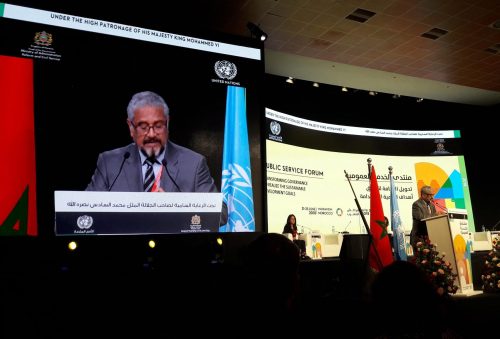
In the UN Public Service Forum 2018, held in Marrakech, the former President of Mauritius, Cassam Uteem, presented ideas about how the World Leadership Alliance- Club de Madrid ‘s project- Shared Societies can inspire the implementation of Agenda 2030.

World Leadership Alliance-Club de Madrid (WLA-CdM) is an organization which has been working closely with BGF and MDI in developing the AIWS 7-Layer Model to build the Next Generation Democracy. Recently, President Uteem – Member of the WLA-CdM, took part in the debate about Public Service. In the opening of the UN Service Forum 2018, he shared his view about the role of public servants under the title “What governance for the Sustainable Development Goals (SDGs)?”

Around 600 to 800 participants – Ministers, senior government officials, mayors, representatives from civil society and those from international as well as regional organizations, etc. participated in this forum to discuss paths for transformation and innovations of governments and institutions. President Uteem put special emphasis on the diversity of cultures in public service – the key to foster an implementation of SDGs.

Governor Michael Dukakis: Global agreement on the use of AI is necessary

The former Massachusetts governor is engaged in the global debate over AI, and is interested in pursinge an international accord to assure AI is used for the good of humanity.

According to Bob Salsberg’s article in the Associated Press, the 84-year-old Dukakis – Co-founder of Artificial Intelligence World Society and Michael Dukakis Institute (MDI) for Leadership and Innovation is encouraging the United Nations to pursue an International Agreement regarding constructive uses of AI.

His project has brought many scientists, government officials, and leaders together to create an initiative to help AI to serve humanity’s best interests—and to address concerns of industry leaders that AI might evolve superhuman powers, establishing control over humans, including its creators. Recently, the organization held an international conference at Harvard in April, proposing the establishment of a body along with International Atomic Energy Agency. The goal of such a body would be to pursue agreement amongst governments about how AI should be used to assure “We don’t have more hacking of elections and a few thousand other things that seem to be cropping up” said Dukakis.

Nguyen Anh Tuan, Co-founder of MDI also announced an initiative – the 7-Layer Model on AI ethical standards, which is designed to serve as an ethical framework for the development technology.

Additionally in this talk, Dukakis made the case against allowing AI to run governments. AI should only help humans increase productivity, he said, we must be wary about it replacing human governance or taking away jobs.

Top newspapers in US such as The New York Times, The Washington Post, The Boston Globe, and The Miami Herald also covered Salzburg’s article.

Governor Michael Dukakis: Global accord needed on use of AI by governments

BY BOB SALSBERG / Associated Press

Is self-driving government in the future?

Michael Dukakis, the former Massachusetts governor and erstwhile presidential candidate, doesn’t think so. But he’s jumping into the debate over artificial intelligence in an effort to ensure the rapidly growing technology is used responsibly by governments around the world.

“My concern is what happens to these technologies and whether or not we use them for good reasons and make sure they are internationally controlled,” said Dukakis, who since leaving politics in 1991 has taught at universities in Massachusetts and California and advocated for causes ranging from passenger rail to childhood autism. This is his first foray into artificial intelligence.

The new organization held an international conference at Harvard in April and is proposing that the United Nations establish a body, along the lines of the International Atomic Energy Agency, to pursue global agreements among governments that AI be used for constructive purposes only. Such accords, Dukakis said, would help assure “we don’t have more hacking of elections and a few thousand other things that seem to be cropping up.”

The organization’s co-founder is Nguyen Anh Tuan, a prominent Vietnamese mathematician credited with founding that country’s first internet provider and first online newspaper before moving to the U.S. in 2007. He said in announcing the initiative with Dukakis that he hoped to examine AI in a “humanistic context” and build an “ethical framework” for developing the technology.

Artificial intelligence broadly refers to computers capable of learning and developing cognitive skills by accumulating massive amounts of data. The technology behind driverless cars and chatbots like Alexa and Siri already has widespread consumer and private industry applications.

The public sector, however, has been far slower to embrace AI even as some highlight its potential benefits.

A 2017 study by the Deloitte Center for Government Insights said a significant investment in AI could free up 1.2 billion hours of time spent by federal workers, saving more than $41 billion annually.

The authors predicted “massive changes” spawned by artificial intelligence in the public sector over time. Smart machines could help slice through government red tape, for example, ease chronic backlogs in everything from patent applications to Medicare appeals, and even assess the gravity of terrorism threats.

But there are obstacles as well, said Thomas Patterson, a professor of government at the Harvard Kennedy School and a board member of the Boston Global Forum, a think tank chaired by Dukakis. While government certainly generates plenty of data, it’s not always easy for AI to access.

“It’s really hard to talk across the various data sets simply because it’s not being collected and put in the same form from one agency to the next, and some of the (software) programs are very old,” said Patterson, noting the potential costs involved in upgrading systems.

The effort to delve into the AI debate seems fitting for Dukakis, who was often labeled a “technocrat” during his years in political office. It was both a compliment and a criticism. Admired for his near obsessive attention to the nuts and bolts of government, a perception among some voters that he lacked sufficient passion or emotion likely contributed to his lopsided defeat by Republican George H.W. Bush in the 1988 presidential election.

Dukakis is intrigued by AI’s potential to help with government decision-making, but doesn’t believe it will ever supplant human governance or take away the jobs of civil servants.

“You can make it more efficient, you can do some things with technology that maybe you couldn’t do without it in the best sense, but you’re not going to have machines running the government,” he said. “There are too many judgments you have to make in this world that involve values, ethics and morality.”

Can you teach AI to be ethical? Not likely, Dukakis said with a laugh.

“Machines aren’t going to deal with that kind of thing,” he said.

In this Thursday, Aug. 2, 2018 photo former Massachusetts governor and onetime Democratic presidential candidate Michael Dukakis sits for a photograph at his home, in Brookline, Mass. The 84-year-old Dukakis recently co-founded the Boston-based Artificial Intelligence World Society. The organization is pushing to have the United Nations pursue an international agreement to assure AI is used for constructive purposes only. (Steven Senne/Associated Press)

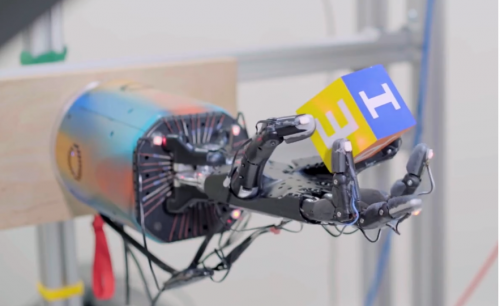
An AI robot hand teaches itself to rotate a cube by creating a virtual-reality environment

Researchers have developed an algorithm that gives robots the ability to teach themselves physical tasks, and practices in a few days—the equivalent of a hundred years inside a computer simulation.

MIT Technology Review introduced brand-new technology, an AI-driven robot hand, dubbed Dactyl, capable of executing physical tasks. The technology comes from a UK company called Shadow combined with a robotic system developed by OpenAI.

A machine-learning technique known as reinforcement learning helped accomplish the physical tasks. Reinforcement learning originated from the way animals learn through positive or negative feedback. OpenAI approached this measure by introducing random variations in the learning environment, which speeds up the programming and training process. It is nowhere near as agile as a human at the moment, but increasing the processing power and introducing more randomization might improve its capabilities in the future.

For now, a measure to enhance its ability is being worked out. But in the near future, when machines have the agility of humans, many fields will see huge advancements. We will need a strategy where humans can still benefit, even as more jobs are replaced by machines. That is what organizations like MDI are working on—indeed, MDI, an offshoot of BGF, is currently developing standards that will help to ensure AI benefits humanity.

Professor Jason Furman: “AI is not perfect, it can make mistakes; it is important to learn how AI can work with humans”

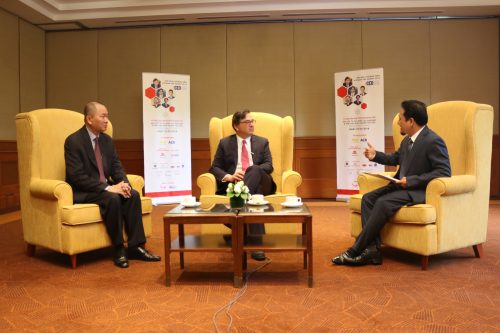
On his visit to Vietnam for the Vietnam CEO Summit 2018, Prof. Jason Furman – Harvard Kennedy School, Chairman of the Council of Economic Advisers for President Barack Obama, member of AIWS Standards and Practice Committee and Mr. Nguyen Anh Tuan – Director of The Michael Dukakis Institute for Leadership and Innovation (MDI) participated in a Talk show with Mr. Vu Dang Vinh – General Director of Vietnam Report Jsc. about the AI strategy for Vietnam’s economy.

In the talk show, Prof. Jason Furman and Mr. Nguyen Anh Tuan discussed the strategy by emphasizing the current situation of Vietnam and how the strategy would be feasible. They also discussed the challenges and opportunities that AI would bring to Vietnam’s economy.

It was said that, even though Vietnam has already fallen behind in the age of AI and Industry 4.0 in general, but it still has great potential. The country needs innovation, and citizens should open their minds to global trends.

Prof. Jason Furman suggested that Vietnam should take advantage of being a follower in the field of AI. The nation needs to act quickly, and learn from developed countries like the U.S, China, etc. to figure it out how Vietnam can use AI for its development (He also shared his experiences when he chaired the AI Strategy Report for the U.S, published in December, 2016). Furthermore, the cost of equipment to develop AI is a lot cheaper now than it was 5 years ago. Vietnam also has the help of many foreign companies, organizations, and MDI. Representative of MDI, Mr. Nguyen Anh Tuan, stated that the breakthrough strategy for Vietnam to become an advanced country in the field of AI is to build the AI-Government and the AI Age Culture owned by the Government of Vietnam.

AI can bring about prosperity and productivity for the Vietnamese if they can learn how to use it properly. “It is not perfect, it can make mistakes, but it is important that we can learn how AI can work with humans.” said Prof. Jason Furman.

In sum, whether Vietnam makes it to the forefront of AI depends on its commitment and effort in implementing breakthrough strategies.

Elon Musk confirmed the newest chips for automated driving

Tesla officially brought out its own computer chips for autonomous car. “We’ve been in semi-stealth mode on this basically for the last 2-3 years,” Musk said, “I think it’s probably time to let the cat out of the bag.”

They created their own hardware for machine learning. This gives Tesla a competitive advantage over creators that rely on available technologies, and distinguishes Tesla distinguished from other car-makers. Moreover, the new hardware would improve significantly over Nvidia’s hardware, and it can also be installed in older models.

Despite the convenience and safety brought by automated cars, there are also possible dangers if the technology is not adequately developed and tested. It is important as well to follow ethical standards, and this is the reason why MDI developed the AIWS 7-layer Model to ensure human safety when it comes to AI.

In order to control AI, AI itself might be the solution

According to  World Economic Forum, by collecting data, AI is making our choices easier and more convenient. Most of us welcome these advances, though in the near future, we might not be able to understand when AI is influencing our options. But here again, AI might be a solution.

Our lives now are controlled by data. It can help us remember and differerentiate what we want. AI is collecting data on us and recommending options that meet our demand based on our behaviours. For example, data on how we engage with our interests is collected and used to make suggestions. However, cnot only can companies know your behaviours but can also predict your interests, to the point where they may be able to influence the choices we make. This might result in us not knowing what we are looking for as AI is giving us options itself.

To tackle with this issue, we might need to use another kind of AI. This AI will not only know when we are being influenced, but also know the ways in which companies can leverage the micro-understanding of our behavior. This is a problem that needs further discussion, and MDI’s experts are working to create strategies and solutions.

Bruce Schneier warned people of the cybersecurity problem

In June 2018, in Israel Cyber Week, a large annual international cybersecurity conference, Mr. Bruce Schneier warned the delegates of a serious security problem regarding automated tech.

Mr. Bruce emphasized that there is the feasibility of integrity and availability attacks in healthcare and transportation. To be more specific, “What might happen if your pacemaker is hacked and it delivers a lethal charge, but what if I took over some inter-connected robot toy and tripped you in your house,” he asked.

He called for people’s awareness about the problems that we might encounter as technology is becoming autonomous. It is essential to enhance security so as to keep technology under control.

Mr. Bruce is an internationally renowned security technologist, named a “security guru” by The Economist. In 2015, he was honored by BGF as the Business Leader in the Cybersecurity for dedicating his career to the betterment of technology, security, privacy and Internet.

Shared Societies – a tool to overcome the fear of globalization at Symi conference

The Symi Symposium took place from July 1st to 4th, 2018, in Rodhes, focused on concepts and proposal of The Shared Societies.

World Leadership Alliance-Club de Madrid (WLA-CdM), which has been working closely with BGF and MDI in developing the AIWS 7-Layer Model to build the Next Generation Democracy, recently convened a symposium called the Symi Symposium. It is an annual meeting of leaders and experts by WLA-CdM. The issues of this year are some most pressing worldwide. One session was on Globalization and the Role of Shared Societies, chaired by South African Human Rights.

According to WLA- CdM’s report, the discussion demonstrated the significant relevance of Shared Societies in the world’s worry overglobalization which has inspired activist, nationalist’s movement on the idea of a Shared Society. In addition, the session came up with a concept of the Shared Societies, playing a role of a roadmap to sustainability in the future.