


Ten Workforce Skills For Finance Employees To Complement AI

AI is here and will be an increasingly prominent tool for many companies, big and small. For those working in financial positions, AI will take over manual data entry tasks and do financial forecasting using predictive analytics. AI will help you discover patterns in your financial data that you can use to take action. Your auditors will use an AI tool to compare transactions from prior periods to look for data irregularities. A finance person might first be introduced to machine learning by adopting an intelligent automation solution using a bot to vouch for supplier invoices in accounts payable. At first, bots will be able to take over tasks that can be easily automated. In the not-so-distant future, people will have coworking relationships with AI applications.

The following workforce skills will help you stay valuable in the era of AI:

  1. Complex problem solving: Technology will solve our simple problems. I saw early career success by proposing solutions for company problems. I hire people who put a high emphasis on problem-solving. AI will support human problem-solving efforts.
  2. Creativity: This helps employees find solutions when problem-solving.
  3. Openness to change: People will need to adapt to change, especially as technology advances at an ever faster pace.
  4. Collaboration: Working with other departments will require collaboration. This may be done by working with AI, as well as by working with people.
  5. Emotional intelligence: This is becoming a more recognized skill. Employees with high emotional intelligence use empathy and have an understanding of the emotional dynamics of a team. AI will have difficulty with this skill.
  6. Enthusiasm for diversity: Diversity needs to be authentic inclusion. It is not a checkbox but the recognition that your team will be stronger with various life experiences, cultural norms and experiences, thinking patterns, and approaches to problem-solving.
  7. Empathy: This is a key servant leadership principle, and it helps people cope with difficult situations and contributes to the concept of fairness. AI will not likely have the ability to empathize anytime soon.
  8. Good judgment: AI will be programmed by humans. You want employees to have good judgment to help guide ethical behavior of AI. Good judgment is a broad term that applies to many areas.
  9. Integrity: Integrity means being honest and having a strong moral character. As technology advances, there will be greater ethical challenges to come, and this skill helps prevent dishonest behavior in the workplace.
  10. People management: This is a critical skill as people are the heart of a company and good managers have an active interest in people. It is a talent that can be lacking in people who get promoted into management. AI will lack the ability to manage people effectively.

There are certainly more than 10 skills that complement AI, but this is a good list to get you to start preparing for the future. At this point, AI is really an advanced calculator that is dependent on lots of data to provide value. It will not easily acquire the skills listed above, and this is where humans provide value in the human-AI partnership.

The original article can be found here.

To support for AI technology and development for human-centric values, Michael Dukakis Institute for Leadership and Innovation (MDI) and Artificial Intelligence World Society (AIWS.net) has developed AIWS Ethics and Practice Index to measure the ethical values and help people achieve well-being and happiness, as well as solve important issues, such as SDGs. In this effort, Michael Dukakis Institute for Leadership and Innovation (MDI) invites participation and collaboration with think tanks, universities, non-profits, firms, and other entities that share its commitment to the constructive and development of full-scale AI for world society.

Spain Launches Digital Charter for AI

The Spanish government has proposed a new Charter on Digital Rights. The aim, according to Secretary of State for Digitalization and AI, Carme Artigas is to “transfer the rights that we already have in the analog world to the digital world and to be able to add some new ones, such as those related to the impact of artificial intelligence and neurotechnologies.” At a press conference in mid-November, Artigas said the Charter is a “prescriptive document, not regulatory. The Charter proposes a framework that allows navigating in the current digital environment, taking advantage of all its potentialities and minimizing its risks.”

The Spanish Charter on Digital Rights follows from a recommendation of the Spanish AI Advisory Council, established earlier this year by the Spanish government. The AI Advisory Council is comprised of distinguished experts in science, economics, and education.

Article 23 of the proposed Charter guarantees that no citizen is discriminated against based on algorithms and requires “transparency, auditability, explicability and traceability.”  People have the right not to be subject to an AI decision, unless authorized by law and with the guarantee to “request human supervision and intervention” and to  challenge algorithmic decisions. The Charter states that citizens must be informed when they are talking to an AI. A provision concerning disinformation states that the use of AI systems “aimed at manipulating or disturbing the will of the people, in any aspects that affect fundamental rights, is prohibited.”

Concerning public services, the Charter sets out rights for citizens in relation to Artificial Intelligence “within the framework of administrative action, particularly in aspects related to the design and use of algorithms.” Impact assessments will be required and algorithmic systems will be “subject to prior approval, with determination of their specific scope of application and operating structure.”  Rights are also set out regarding the use of AI in the workplace and for healthcare.

The Spanish government is receiving public comment on the Digital Rights Charter. Comments are  open until December 4, 2020 and should be sent to [email protected].

Spain is one of several countries that have set out new rights frameworks for Artificial Intelligence. The Center for AI and Digital Policy will provide an extensive review of these developments on December 12, 2020 with publication of the AI Social Contract Index, the first comparative study of national AI policies and practices.


Marc Rotenberg, Director

Center for AI and Digital Policy at Michael Dukakis Institute

The Center for AI and Digital Policy, founded in 2020, advises governments on technology policy.

The Multicore Era Is Over — We Need A New Architecture For AI

Multicore chip making bought us two decades of performance gains, but now it’s reaching the end of its useful life.

Regardless of how “multi” they are, traditional CPU cores are not nearly efficient enough at running the massive data models researchers are now building, especially in intensive, artificial intelligence (AI)-enabled applications like natural language processing (NLP), image processing and recommender systems.

We need a new architecture better suited to current and future artificial intelligence and machine learning applications — and we need it now.

AI is steadily but surely eating software. ML applications are developed to achieve outcomes that are probabilistic rather than deterministic. They don’t need the nth degree of high precision — they need high-enough probability certainty to determine that an image of a car is indeed a car. The reduced need for precision means far more of a chip’s transistors can be used for the important work of computation rather than keeping multiple cores in sync.

High-performance, flexible solutions will be necessary for continual disruption and an important democratizing factor, allowing unexpected underdogs to become the AI heroes of the future without having to go head-to-head with a FAANG or tech-savvy nation-state. Multicore kept the industry afloat for many years, and it will still be important in many applications. But for a future dominated by compute-hungry, probabilistic, AI-powered applications, we’ll need some truly clever solutions. RDA is one answer, and chances are we’ll need even more.

The original article can be found here.

According to Artificial Intelligence World Society Innovation Network (AIWS.net), AI can be an important tool tfor helping people achieve well-being and happiness, relieve them of resource constraints and arbitrary/inflexible rules and processes. In this effort, Michael Dukakis Institute for Leadership and Innovation (MDI) invites participation and collaboration with think tanks, universities, non-profits, firms, and other entities that share its commitment to the constructive and development of full-scale AI for world society.

Pope Francis Prays that AI “Always Serve Humankind”

Pope Francis has emerged as a leading world figure the field of AI policy. In the November intentions, an opportunity for Catholics to deepen their prayers, the Pope warned that AI could exacerbate economic inequalities around the world if a common good is not pursued.  “Artificial intelligence is at the heart of the epochal change we are experiencing.  Robotics can make a better world possible if it is joined to the common good.  Indeed, if technological progress increases inequalities, it is not true progress.  Future advances should be oriented towards respecting the dignity of the person and of Creation,” in the words of the November 2020 prayer intention. The Pope asked that followers, “pray that the progress of robotics and artificial intelligence may always serve humankind.”

The Pope’s November intention is his most recent comment on AI. Earlier this year, the Pope endorsed the Rome Call for AI Ethics. The goal of the Rome Call is to “support an ethical approach to Artificial Intelligence and promote a sense of responsibility among organizations, governments and institutions.”

The key principles of the Rome Call are 1) Transparency: AI systems must be explainable; 2) Inclusion: the needs of all human beings must be taken into consideration so that everyone can benefit and all individuals can be offered the best possible conditions to express themselves and develop; 3) Responsibility: those who design and deploy the use of AI must proceed with responsibility and transparency; 4) Impartiality: do not create or act according to bias, thus safeguarding fairness and human dignity; 5) Reliability: AI systems must be able to work reliably;  6) Security and privacy: AI systems must work securely and respect the privacy of users.  These principles are described as “fundamental elements of good innovation.” The Rome Call for AI Ethics was endorsed by Private companies, and representatives of the Italian government, and the European Parliament at an event, organized by the Pontifical Academy for Life, held at the Vatican earlier this year.

Pope Francis said at the time, “The Call’s intention is to create a movement that will widen and involve other players: public institutions, NGOs, industries and groups to set a course for developing and using technologies derived from AI.” The Pope also said that the Rome Call for Ethics is the “first attempt to formulate a set of ethical criteria with common reference points and values, offering a contribution to the development of a common language to interpret what is human.”

Pope Francis is one of several world leaders who has raised concern about AI. Several years ago, the world-renowned physicist Stephen Hawking warned that AI posed an existential threat to humanity. He told the BBC, “The development of full artificial intelligence could spell the end of the human race.” The inventor Elon Musk told a MIT conference in 2014 that A.I. was probably humanity’s “biggest existential threat.” Bill Gates and Jeff Bezos have also raised concerns about AI, particularly autonomous weapons.

Many world leaders have called for regulatory oversight of AI.


Marc Rotenberg, Director

Center for AI and Digital Policy at Michael Dukakis Institute

The Center for AI and Digital Policy, founded in 2020, advises governments on technology policy

How IBM Is Working Toward a Fairer AI

Humans have many kinds of biases. To name just a few, we suffer from confirmation bias, which means that we tend to focus on information that confirms our preconceptions about a topic; from anchoring bias, where we make decisions mostly relying on the first piece of information we receive on that subject; and from gender bias, where we tend to associate women with certain traits, activities, or professions, and men with others. When we make decisions, these types of biases often creep in unconsciously, resulting in decisions that are ultimately unfair and unobjective.

These same types of bias can show up in artificial intelligence (AI), especially when using machine learning techniques to program an AI system. A commonly-used technique called “supervised machine learning” requires that AI systems be trained with a large number of examples of problems and solutions. For example, if we want to build an AI system that can decide when to accept or reject a loan application, we would train it with many examples of loan applications, and for each application, we would give it the correct decision (either accept or reject the application).

The AI system would find useful correlations in such examples and use them to make (hopefully correct) decisions on new loan applications. After the training phase, a test phase on another set of examples checks that the system is accurate enough and ready for deployment. However, if the training dataset is not balanced, inclusive, or representative enough of the dimensions of the problem we want to solve, the AI system may become biased. For example, if all accepted loan applications in the training dataset are related to men and all rejected ones are related to women, then the system will pick up the correlation between gender and acceptability as a form of bias and will use this bias when making decisions on new applications going forward.

The original article can be found here.

To support for AI Ethics, Michael Dukakis Institute for Leadership and Innovation (MDI) and Artificial Intelligence World Society (AIWS.net) has developed AIWS Ethics and Practice Index to measure the ethical values and help people achieve well-being and happiness, as well as solve important issues, such as SDGs. Regarding to AI Ethics, AI World Society (AIWS.net) initiated and promoted to design AIWS Ethics framework within four components including transparency, regulation, promotion and implementation for constructive use of AI. In this effort, Michael Dukakis Institute for Leadership and Innovation (MDI) invites participation and collaboration with think tanks, universities, non-profits, firms, and other entities that share its commitment to the constructive and development of full-scale AI for world society.

The Quad Group was a great success at the Riga Conference 2020

With more than 2 hours of discussion, panelists Governor Michael Dukakis, Japanese State Minister of Defense Yasuhide Nakayama, Australian Senator Kimberley Kitching, Chair, Senate Foreign Affairs, Defence and Trade References Committee, Ambassador P.S Raghavan, Chair of the National Security Advisory Board, India, with moderator Sandis Šrāders, Member of the Board of the Latvian Transatlantic Organisation spoke about various issues relating to the Quad.

This was the first Quad Roundtable, co-organized by LATO at the Riga Conference 2020 with attendance of the President and Executive Vice-President of European Commission, Presidents of Baltic countries, Secretary General of NATO, Ministers of Defense from the UK, Canada, France, Japan, and Baltic countries.

The outcome of the Quad Roundtable is a Special Report with recommendations to President of the United Nations, PMs of Japan, Australia, and India, and also to leaders of the EU, UK, Germany, France, Canada and Latvia.

Suggestion Solutions from this Quad Roundtable:

+ Using the Social Contract for the AI Age as standards in international relations, as TCP/IP in political connection between countries, governments, and companies. Democratic governments implement the Social Contract for the AI Age.

+ Alliance between Quad and NATO to maintain world peace and security.

+ Alliance between the Quad Group and the EU in maintaining democracy values.

+ Building International Accord in AI and Digital to protect digital and AI democracy

From this Quad Roundtable, the Boston Global Forum established the Quad Roundtable Board include panelists of the Quad Roundtable at the Riga Conference 2020, and Mr. Nguyen Anh Tuan, CEO of the Boston Global Forum. The executive team is Mr. Nguyen Anh Tuan, Dr. Sandis Šrāders, Member of the Board of the Latvian Transatlantic Organisation, Ambassador Ichiro Fujisaki, Professor Nazli Choucri, MIT, Board Member of the Boston Global Forum, Marc Rotenberg, Director of Center for AI and Digital Policy at Michael Dukakis Institute.

Video of the Quad Roundtable: https://www.youtube.com/watch?v=9hfThoG8L-w

Novaland cooperates with Michael Dukakis Institute to add AIWS City to NovaWorld Phan Thiet

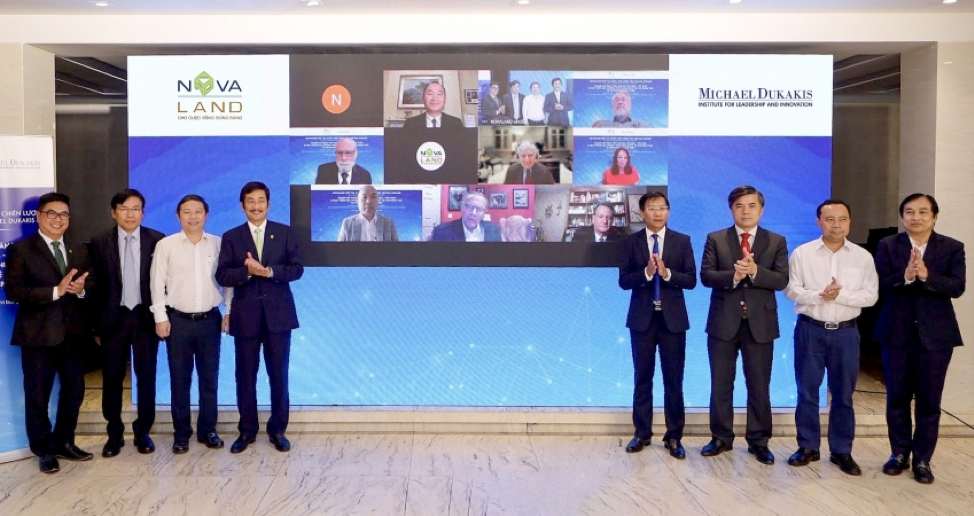
Vietnam Investment Review- Novaland Group and Michael Dukakis Institute (MDI) for Leadership and Innovation on November 11 held an online meeting to update upcoming plans more than a month after signing a strategic partnership contract.

According to the contract, both sides will establish the Michael Dukakis Institute-Vietnam in NovaWorld Phan Thiet (Binh Thuan province) to organize leadership and creative training programs in the era of AI at NovaWorld Phan Thiet.

The programme will be taught online by professors, scholars, and leaders from the US and other member countries of the Artificial Intelligence World Society Innovation Network (AIWS.net).

At the same time, MDI will support the implementation of a series of AI World Society programmes at NovaWorld Phan Thiet such as building the world’s first the History of AI house, the Vint Cerf House, the Michael Dukakis House, programmes of AI summer camps for students of all ages, and annual AIWS award events (World Leader in AIWS ).

The Michael Dukakis Institute – Vietnam will start organizing events in Phan Thiet, Binh Thuan from 2021.

According to Bui Thanh Nhon, chairman of Novaland Group, this cooperation will further increase the value of NovaWorld Phan Thiet, a new destination for the world, where people will come to live, work, relax, or travel and feel like they are living in one of the great centres and have access to the elites of the world.

“With favourable climatic conditions and natural beauty, transportation infrastructure, and facilities that meet the standards of major international events, NovaWorld Phan Thiet will make Phan Thiet an attractive and favourite destination for tourism, resorts, conferences – seminars in the world,” Nhon said at the meeting.

According to Michael Dukakis, president of MDI, the institute is ready to cooperate with Novaland to build NovaWorld Phan Thiet into an innovative centre for both technologies and culture in the AI century. “Together we can contribute to a better world,” Dukakis said.

Vin Cerf, one of the fathers of the internet believed that the cooperation between Novaland and MDI will bring benefit to all people. “I myself and many other colleagues from famous universities in the world will share information and hand over innovative ideas, as well as new and advanced solutions to Vietnam,” said Cerf.

Professor Alex Sandy Pentland from Massachusets Institute of Technology (MIT) shared his experiences on building a city with advanced infrastructure system, bringing many benefits to global communications.

“The MIT has worked with many partners from Singapore, Australia, and Taiwan to develop those countries and now we are heading for this good cooperation in Vietnam,” Pentland said.

AI is a crucial technology in Vietnam and globally, serving digital transformation, providing solutions for products and services to develop smart urban models.

Nazli Choucri from MIT also commented, “This cooperation is a testament to promoting AI development among countries around the world, that collaboration from many units will be more effective than each individual working individually. We all hope the future will reach new things that we have never experienced,” Chourci said.

Apart from these key speakers, the online discussion also featured a range of other distinguished guests, including Thomas Patterson (Harvard University), Marc Rotenberg (director of the Center for AI and Digital Policy of MDI), Nguyen Anh Tuan (director of MDI, co-founder of The AI World Society Innovation Network – AIWS.net), John Quelch (Harvard Business School, co-founder of Boston Global Forum), as well as leaders from Novaland Group and leaders of the Binh Thuan Provincial Party Committee.

NovaWorld Phan Thiet has a strategic location in Phan Thiet city, Binh Thuan province – a famous region for its blue seas, white sand, golden sunshine, and stable year-round climate. The project is conveniently connected to Ho Chi Minh City, a massive metropolis of 15 million people, and other big cities via international airports, seaports, railways, and highways.

Across 1,000 hectares with 7km of coastline, McKinsey-consulted NovaWorld Phan Thiet is set to become an attractive destination of premier resorts, shopping malls, dining, entertainment, as well as education, health, and sports. The project master plan was created by leading design consultants including Aedas and Nikken Sekkei.

With a total investment of nearly $5 billion, NovaWorld Phan Thiet has hundreds of outstanding facilities.

Being one of the first-ever megaprojects applying AI technology in Vietnam, NovaWorld will host a long list of international events all year round such as golf tournaments, professional tennis tournaments, Olympic sports competitions, kite surfing, beauty contests, fashion, music festivals, and more.

Tournaments and events will take place continuously, creating a bustling, fantastic environment and ensuring that NovaWorld Phan Thiet is an exciting and attractive destination, a remarkable take on Novaland Group’s mission: creating “destinations”

The Michael Dukakis Institute for Leadership and Innovation was founded and is led by Michael Dukakis, with the participation of top professors from Harvard University and MIT.

Governor Michael Dukakis and leaders of MDI will support Novaland to build NovaWorld Phan Thiet to become a bright spot of technological and cultural innovation in the AI era; a gathering place for leaders, innovators, and the elite of the world.

This will link NovaWorld Phan Thiet to AIWS City and AIWS University and make NovaWorld Phan Thiet a destination for the AI community around the world.

Novaland Group has been a leading, prestigious brand in the property investment and development industry in Vietnam during the past 28 years.

The group’s total landbank is approximately 5,000ha, which is used for three key product suites, including real estate in central Ho Chi Minh City, satellite urban areas in Dong Nai province, and second-home projects and integrated resorts in major tourism destination provinces.

Novaland is willing to cooperate with world-class professional advisors and management companies to promote sustainable tourism development in accordance with the National Tourism Development Strategy, build smart ecological urban cities and high-class tourist destinations, and contribute to Vietnam’s imprint on the world tourism map.

https://www.vir.com.vn/novaland-cooperates-with-michael-dukakis-institute-to-add-ai-to-novaworld-phan-thiet-80687.html