
Europe’s AI laws will cost companies a small fortune – but the payoff is trust

Artificial intelligence isn’t tomorrow’s technology — it’s already here. Now too is the legislation proposing to regulate it.

Earlier this year, the European Union outlined its proposed artificial intelligence legislation and gathered feedback from hundreds of companies and organizations. The European Commission closed the consultation period in August, and next comes further debate in the European Parliament.

As well as banning some uses outright (facial recognition for identification in public spaces and social “scoring,” for instance), its focus is on regulation and review, especially for AI systems deemed “high risk” — those used in education or employment decisions, say.

Any company with a software product deemed high risk will require a Conformité Européenne (CE) badge to enter the market. The product must be designed to be overseen by humans, avoid automation bias, and be accurate to a level proportionate to its use.

Some are concerned about the knock-on effects of this. They argue that it could stifle European innovation as talent is lured to regions where restrictions aren’t as strict — such as the US. And the anticipated compliance costs high-risk AI products will incur in the region – perhaps as much as €400,000 ($452,000) for high risk systems, according to one US think tank — could prevent initial investment too.

EU General Data Protection Regulation (GDPR) laws required just about every company with a website either side of the Atlantic to react and adapt to them when they were rolled out in 2016. It would be naive to think that any company with an international outlook won’t run up against these proposed rules too. If you want to do business in Europe, you will still have to adhere to them from outside it.

The original article was posted at VentureBeat.

The Boston Global Forum (BGF), in collaboration with the United Nations Centennial Initiative, released a major work entitled Remaking the World – Toward an Age of Global Enlightenment.   More than twenty distinguished leaders, scholars, analysts, and thinkers put forth unprecedented approaches to the challenges before us. These include President of the European Commission Ursula von der Leyen, Governor Michael Dukakis, Father of Internet Vint Cerf, Former Secretary of Defense Ash Carter, Harvard University Professors Joseph Nye and Thomas Patterson, MIT Professors Nazli Choucri and Alex ‘Sandy’ Pentland, and European Parliament Member Eva Kaili.  The BGF introduced core concepts shaping pathbreaking international initiatives, notably, the Social Contract for the AI Age, an AI International Accord, the Global Alliance for Digital Governance, the AI World Society (AIWS) Ecosystem, and AIWS City.


White House A.I. director says U.S. should model Europe’s approach to regulation

Since August 2018, Lynne Parker has worked in the White House Office of Science and Technology Policy, helping steer the executive branch’s approach to research, innovation, policy, and investment in artificial intelligence. Under the Biden administration, she was promoted to director of the National Artificial Intelligence Initiative Office in early 2021, a role that puts her at the forefront of the country’s domestic and international investments and education in the A.I. space.

As the final speaker at the Fortune Brainstorm A.I. conference in Boston this week, Parker discussed this relatively new position and shared the initiative’s three main goals. “The first one is all about research. The innovations that we’re being able to take advantage of today, many of them are due to decades of investments by the federal government and research, so there’s a recognition that the advances for the next decade need to have that research underpinning as well,” she said. “A second goal is in making sure that the U.S. leads the world in the development and use of trustworthy A.I. in both the public and private sectors. That means the federal government itself, and its use of trustworthy A.I., as well as the private sector. Obviously, there are many things that need to happen for that to take place. And then the third [goal] is to make sure that we’re educating people to have the skills and the talents and the opportunities to learn about the A.I.-enabled jobs of both today and the future.”

Parker revealed that her office is currently in the process of forming a national A.I. advisory committee that will consist of members of the academic and business community “to make sure that we democratize access to the cyber infrastructure and the data that’s needed to enable anyone to engage in A.I. research.” She also said it’s key that the government is invested in long-term fundamental research while businesses are working more on the product side, making it a public-private partnership that covers all of the A.I. bases.

The original article was published at Fortune.

The Boston Global Forum (BGF), in collaboration with the United Nations Centennial Initiative, released a major work entitled Remaking the World – Toward an Age of Global Enlightenment.   More than twenty distinguished leaders, scholars, analysts, and thinkers put forth unprecedented approaches to the challenges before us. These include President of the European Commission Ursula von der Leyen, Governor Michael Dukakis, Father of Internet Vint Cerf, Former Secretary of Defense Ash Carter, Harvard University Professors Joseph Nye and Thomas Patterson, MIT Professors Nazli Choucri and Alex ‘Sandy’ Pentland, and European Parliament Member Eva Kaili.  The BGF introduced core concepts shaping pathbreaking international initiatives, notably, the Social Contract for the AI Age, an AI International Accord, the Global Alliance for Digital Governance, the AI World Society (AIWS) Ecosystem, and AIWS City.

Google Wants to Work With the Pentagon Again, Despite Employee Concerns

Three years after an employee revolt forced Google to abandon work on a Pentagon program that used artificial intelligence, the company is aggressively pursuing a major contract to provide its technology to the military.

The company’s plan to land the potentially lucrative contract, known as the Joint Warfighting Cloud Capability, could raise a furor among its outspoken work force and test the resolve of management to resist employee demands.

In 2018, thousands of Google employees signed a letter protesting the company’s involvement in Project Maven, a military program that uses artificial intelligence to interpret video images and could be used to refine the targeting of drone strikes. Google management caved and agreed to not renew the contract once it expired.

The outcry led Google to create guidelines for the ethical use of artificial intelligence, which prohibit the use of its technology for weapons or surveillance, and hastened a shake-up of its cloud computing business. Now, as Google positions cloud computing as a key part of its future, the bid for the new Pentagon contract could test the boundaries of those A.I. principles, which have set it apart from other tech giants that routinely seek military and intelligence work.

The military’s initiative, which aims to modernize the Pentagon’s cloud technology and support the use of artificial intelligence to gain an advantage on the battlefield, is a replacement for a contract with Microsoft that was canceled this summer amid a lengthy legal battle with Amazon. Google did not compete against Microsoft for that contract after the uproar over Project Maven.

The Pentagon’s restart of its cloud computing project has given Google a chance to jump back into the bidding, and the company has raced to prepare a proposal to present to Defense officials, according to four people familiar with the matter who were not authorized to speak publicly. In September, Google’s cloud unit made it a priority, declaring an emergency “Code Yellow,” an internal designation of importance that allowed the company to pull engineers off other assignments and focus them on the military project, two of those people said.

The Boston Global Forum (BGF), in collaboration with the United Nations Centennial Initiative, released a major work entitled Remaking the World – Toward an Age of Global Enlightenment.   More than twenty distinguished leaders, scholars, analysts, and thinkers put forth unprecedented approaches to the challenges before us. These include President of the European Commission Ursula von der Leyen, Governor Michael Dukakis, Father of Internet Vint Cerf, Former Secretary of Defense Ash Carter, Harvard University Professors Joseph Nye and Thomas Patterson, MIT Professors Nazli Choucri and Alex ‘Sandy’ Pentland, and European Parliament Member Eva Kaili.  The BGF introduced core concepts shaping pathbreaking international initiatives, notably, the Social Contract for the AI Age, an AI International Accord, the Global Alliance for Digital Governance, the AI World Society (AIWS) Ecosystem, and AIWS City.
‘Yeah, we’re spooked’: AI starting to have big real-world impact, says expert

A scientist who wrote a leading textbook on artificial intelligence has said experts are “spooked” by their own success in the field, comparing the advance of AI to the development of the atom bomb.

Prof Stuart Russell, the founder of the Center for Human-Compatible Artificial Intelligence at the University of California, Berkeley, said most experts believed that machines more intelligent than humans would be developed this century, and he called for international treaties to regulate the development of the technology.

“The AI community has not yet adjusted to the fact that we are now starting to have a really big impact in the real world,” he told the Guardian. “That simply wasn’t the case for most of the history of the field – we were just in the lab, developing things, trying to get stuff to work, mostly failing to get stuff to work. So the question of real-world impact was just not germane at all. And we have to grow up very quickly to catch up.”

Artificial intelligence underpins many aspects of modern life, from search engines to banking, and advances in image recognition and machine translation are among the key developments in recent years.

Russell believes the future for AI lies in developing machines that know the true objective is uncertain, as are our preferences, meaning they must check in with humans – rather like a butler – on any decision. But the idea is complex, not least because different people have different – and sometimes conflicting – preferences, and those preferences are not fixed.

Russell called for measures including a code of conduct for researchers, legislation and treaties to ensure the safety of AI systems in use, and training of researchers to ensure AI is not susceptible to problems such as racial bias. He said EU legislation that would ban impersonation of humans by machines should be adopted around the world.

The article was originally published at The Guardian.

The Boston Global Forum (BGF), in collaboration with the United Nations Centennial Initiative, released a major work entitled Remaking the World – Toward an Age of Global Enlightenment.   More than twenty distinguished leaders, scholars, analysts, and thinkers put forth unprecedented approaches to the challenges before us. These include President of the European Commission Ursula von der Leyen, Governor Michael Dukakis, Father of Internet Vint Cerf, Former Secretary of Defense Ash Carter, Harvard University Professors Joseph Nye and Thomas Patterson, MIT Professors Nazli Choucri and Alex ‘Sandy’ Pentland, and European Parliament Member Eva Kaili.  The BGF introduced core concepts shaping pathbreaking international initiatives, notably, the Social Contract for the AI Age, an AI International Accord, the Global Alliance for Digital Governance, the AI World Society (AIWS) Ecosystem, and AIWS City.

How AI is reinventing what computers are

Google’s latest offering, the Pixel 6, is the first phone to have a separate chip dedicated to AI that sits alongside its standard processor. And the chip that runs the iPhone has for the last couple of years contained what Apple calls a “neural engine,” also dedicated to AI. Both chips are better suited to the types of computations involved in training and running machine-learning models on our devices, such as the AI that powers your camera. Almost without our noticing, AI has become part of our day-to-day lives. And it’s changing how we think about computing.

What does that mean? Well, computers haven’t changed much in 40 or 50 years. They’re smaller and faster, but they’re still boxes with processors that run instructions from humans. AI changes that on at least three fronts: how computers are made, how they’re programmed, and how they’re used. Ultimately, it will change what they are for.

“The core of computing is changing from number-crunching to decision-­making,” says Pradeep Dubey, director of the parallel computing lab at Intel. Or, as MIT CSAIL director Daniela Rus puts it, AI is freeing computers from their boxes.

Machines no longer need a keyboard or screen for humans to interact with. Anything can become a computer. Indeed, most household objects, from toothbrushes to light switches to doorbells, already come in a smart version. But as they proliferate, we are going to want to spend less time telling them what to do. They should be able to work out what we need without being told

This is the shift from number-­crunching to decision-making that Dubey sees as defining the new era of computing.

The article was originally posted at MIT Technology Review.

The Boston Global Forum (BGF), in collaboration with the United Nations Centennial Initiative, released a major work entitled Remaking the World – Toward an Age of Global Enlightenment.   More than twenty distinguished leaders, scholars, analysts, and thinkers put forth unprecedented approaches to the challenges before us. These include President of the European Commission Ursula von der Leyen, Governor Michael Dukakis, Father of Internet Vint Cerf, Former Secretary of Defense Ash Carter, Harvard University Professors Joseph Nye and Thomas Patterson, MIT Professors Nazli Choucri and Alex ‘Sandy’ Pentland, and European Parliament Member Eva Kaili.  The BGF introduced core concepts shaping pathbreaking international initiatives, notably, the Social Contract for the AI Age, an AI International Accord, the Global Alliance for Digital Governance, the AI World Society (AIWS) Ecosystem, and AIWS City.

The Security and Foreign Policy Forum the Rīga Conference 2021

The conference provides an opportunity for stakeholders to identify the current security and foreign policy issues in the Baltic Sea region and beyond. The opening day will offer topics such as Europe’s global role and influence, the future strategies of NATO and its responses to security threats, and the EU Green Deal. The discussions will welcome speakers like the ex-president of Latvia Dr Vaira Vīķe- Freiberga, Director of the European Council on Foreign Relations Mark Leonard, Assistant Secretary-General of NATO for Public Diplomacy Baiba Braže and many others. An additional side event discussing the security of the Baltic Sea region will be hosted alongside the main programme.

The Minister of Foreign Affairs of the Republic of Latvia Edgars Rinkēvičs says: “the Rīga Conference will offer a look at the current events and challenges, which influence international politics. The participants of the conference will discuss the potential of Europe as a global actor, the strategic future of NATO, Russian revisionism-oriented foreign policy direction, the situation in Belarus, the change of power in Afghanistan, and the importance of the Three Sea region in the transatlantic relations. They will also discuss the new forms of competition between centres of power, the growth of risks to the international rule of law and democratic values, climate change, the impact of new technologies on international processes, and the different hybrid threats. We expect a vast scope of topics, saturated and high-quality exchange of opinions, and discussions, which result in an opportunity to answer international challenges.” Due to the health condition of the President of Latvia Egils Levits, the planned discussion with the President of Romania Klaus Iohanni will not take place. Instead, a discussion between the Heads of Foreign Affairs Committees of the Parliaments of Latvia, Lithuania and Estonia will take place.

The Rīga Conference is organised jointly by the Latvian Transatlantic Organisation, the Ministry of Foreign Affairs of the Republic of Latvia, and the Ministry of Defence of the Republic of Latvia in close cooperation with NATO Public Diplomacy Division and Konrad Adenauer Foundation in the Baltic States. The conference is supported by Microsoft, the United States Embassy in Latvia, the Embassy of Canada in Latvia, European Commission Representation in Latvia, the Embassy of Georgia in Latvia, the Embassy of Germany in Latvia, the Embassy of Turkey in Latvia, Swedbank, the Nordic Council of Ministers, Seal, Riga City Council, Visegrad Insight, Boston Global Forum and Oxford Analytica.

Other contributions to the conference have been made AIWS.net, Riga International Airport, Narvesen, Caffeine, Pupuchi, Lauvas Tēja, RicBerry, Cannelle Bakery, Maple, BALTA, B’More, Askaneli Brothers, Amber Distribution, AUDI, and the National Library of Latvia.

The Boston Global Forum (BGF), in collaboration with the United Nations Centennial Initiative, released a major work entitled Remaking the World – Toward an Age of Global Enlightenment.   More than twenty distinguished leaders, scholars, analysts, and thinkers put forth unprecedented approaches to the challenges before us. These include President of the European Commission Ursula von der Leyen, Governor Michael Dukakis, Father of Internet Vint Cerf, Former Secretary of Defense Ash Carter, Harvard University Professors Joseph Nye and Thomas Patterson, MIT Professors Nazli Choucri and Alex ‘Sandy’ Pentland, and European Parliament Member Eva Kaili.  The BGF introduced core concepts shaping pathbreaking international initiatives, notably, the Social Contract for the AI Age, an AI International Accord, the Global Alliance for Digital Governance, the AI World Society (AIWS) Ecosystem, and AIWS City.

Link: https://www.rigaconference.lv/

AIWS City at the Riga Conference 2021

The AIWS Value System is innovative and, as such, untested for its utility. AIWS will test the concept by creating the AIWS City, which will be a virtual digital city dedicated to promoting the values associated AIWS.

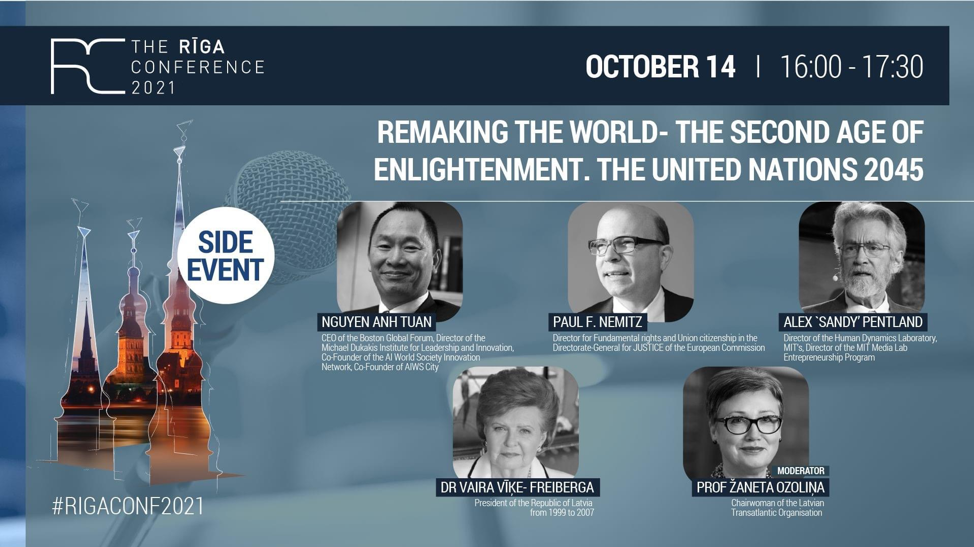
Professor Thomas Patterson introduced AIWS City as a practical model for the Age of Global Enlightenment and discuss about it with Moderator Zaneta Ozolina at the session “REMAKING THE WORLD – THE SECOND AGE OF ENLIGHTENMENT. THE UNITED NATIONS 2045”, the Riga Conference 2021, October 14, 2021.

The United Nations Centennial initiative was launched by the Boston Global Forum (BGF) and the United Nations Academic Impact (UNAI) in 2019 as the United Nations planned to mark the 75th anniversary the following year. It brought into its fold some of the finest minds of our times as they sought to anticipate the world, and the United Nations, in 2045, the year of the world organization’s centennial. The core concepts of the initiative are reflected in the book “Remaking the World: Toward an Age of Global Enlightenment”; these include the idea of a social contract for the Artificial Intelligence (AI) age, a framework for an AI international accord, an ecosystem for the “AI World Society” (AIWS) and a community innovation economy. Some of these ideas have already begun to be put into practice, including a Global Alliance for Digital Governance and the evolution of AIWS City, a virtual digital city dedicated to promoting the values associated with AIWS.

This session discussed concepts of the book to build the Age of Global Enlightenment, and the particular role of the Baltic States – who celebrate thirty years of United Nations membership this year-in this regard.


Speakers:

Dr Vaira Vīķe- Freiberga, President of the Republic of Latvia from 1999 to 2007

Nguyen Anh Tuan, CEO of the Boston Global Forum, Director of the Michael Dukakis Institute for Leadership and Innovation, Co-Founder of the AI World Society Innovation Network, Co-Founder of AIWS City

Paul F. Nemitz, Director for Fundamental rights and Union citizenship in the Directorate-General for JUSTICE of the European Commission

Alex `Sandy’ Pentland, Director of the Human Dynamics Laboratory, MIT’s, Director of the MIT Media Lab Entrepreneurship Program, Co-Leader of The World Economic Forum Big Data and Personal Data Initiatives, Founding Member of The Advisory Boards for Nissan, Motorola Mobility, Telefonica

Thomas Patterson, Research Director of The Michael Dukakis Institute for Leadership and Innovation, Professor of Government and the Press of Harvard Kennedy School, Distinguished Contributor to the Book “Remaking the World – Toward an Age of Global Enlightenment”

Moderator: Prof Žaneta Ozoliņa, Chairwoman of the Latvian Transatlantic Organisation.

Link:

https://fb.watch/8IdvBeUlYR/

and:

https://www.youtube.com/watch?v=Cu-2r7qzYZo&t=20490s

“Remaking the World – Toward an Age of Global Enlightenment” at the Riga Conference 2021

With Moderator Zaneta Ozolina, Chair Woman of LATO, speakers President Vaira Vike-Freiberga, Professor Alex Sandy Pentland, Professor Thomas Patterson, Paul Nemitz, and Nguyen Anh Tuan presented and discussed about the book Remaking the World – Toward an Age of Global Enlightenment with ideas to solve questions at the session “REMAKING THE WORLD – THE SECOND AGE OF ENLIGHTENMENT. THE UNITED NATIONS 2045”, the Riga Conference 2021, October 14, 2021.

The age where the impact of AI is only growing, the social contract for the AI Age could be one of the tools which could create a cooperative framework for advancing, managing and monitoring AI and its impact. The authors emphasize the particular role of international organizations. In the last few years, we have been observing the diminishing role of multilateralism. To what extent is the creation of such a Social Contract achievable when it requires commitment from so many parties, the role of education and information in the Age of Global Enlightenment.

The book addresses many issues related to the future of AI. One of the main themes is related to governance- particularly to AI and democratic governance. Concepts such as the next generation democracy are introduced. What makes the next generation democracy different from the present one? What kind of governance is needed for an age of global enlightenment and what is the role of AI?

The foundations of the Social Contract are based on the principle of inclusiveness, to take on the broad range of stakeholders. Have any policy solutions been considered for the containment of actors who violate the agreed principles?

The new concept “Community Innovation Economy” as a fundamental part of the economy in the Age of Global Enlightenment. What are the difficulties in applying it?

What are key factors for world success in building the Age of Global Enlightenment?

AIWS City as a practical model for the Age of Global Enlightenment.


Link:

https://fb.watch/8IdvBeUlYR/

and:

https://www.youtube.com/watch?v=Cu-2r7qzYZo&t=20490s