Global Enlightenment Community introduces the Declaration of Action of Global Law and Accord on AI and Digital

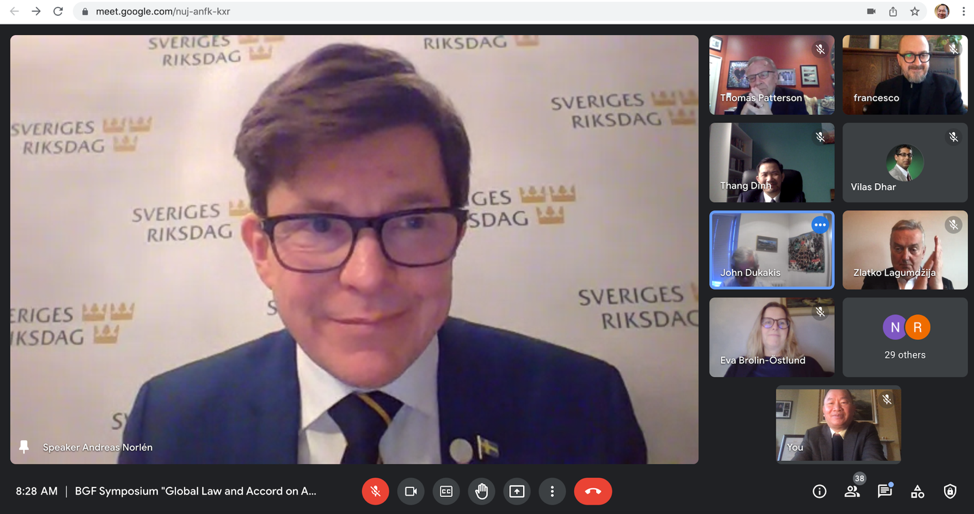
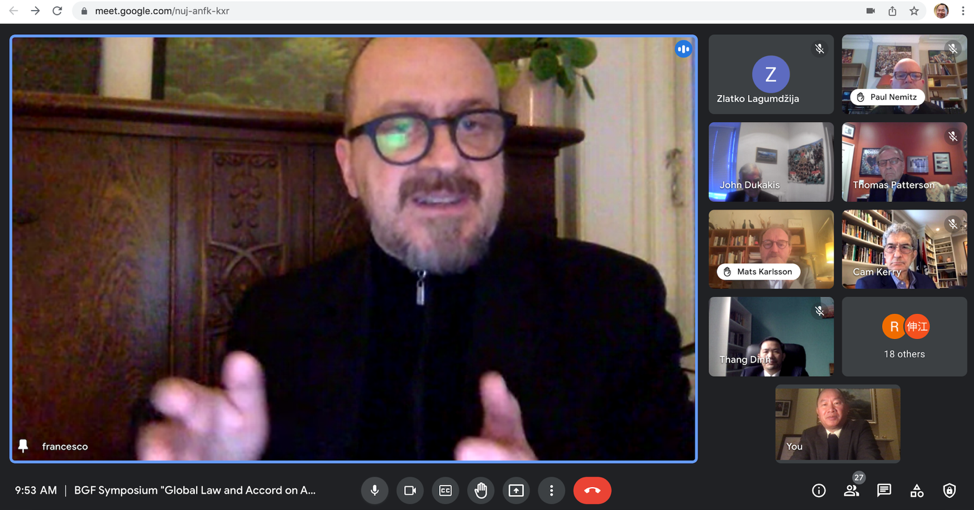
On December 12, 2021, at BGF Symposium “The Framework for Global Law and Accord on AI and Digital”, some Pillars of the Global Enlightenment introduced the “Declaration of Action of Global Law and Accord on AI and Digital”. The Global Enlightenment Community is a core value of the AIWS City to practice principles, anchors of the Age of Global Enlightenment. This community is formed by its pillars, who are 25 distinguished contributors of the book Remaking the World – Toward an Age of Global Enlightenment:


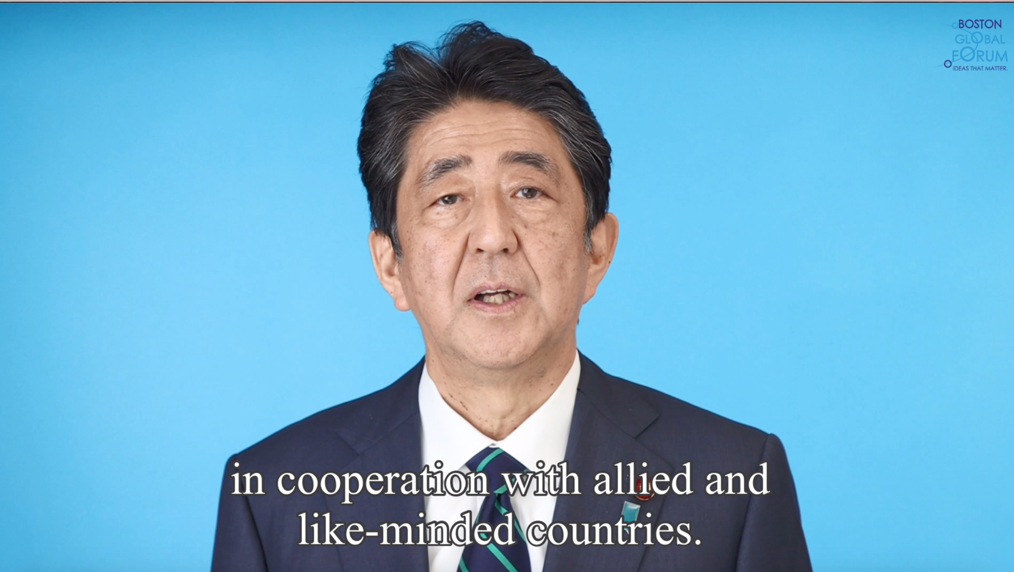
Shinzō Abe, Prime Minister of Japan (9/2006-9/2007, 12/2012-9/2020), 2015 World Leader for Peace and Security Award.

Ashton Carter, Former U.S. Secretary of Defense, Director of the Belfer Center for Science and International Affairs, Belfer Professor of Technology and Global Affairs, Harvard University.

Vint Cerf, “Father of the Internet”, Vice President and Chief Internet Evangelist for Google, Co-author of Social Contract for the AI Age, 2019 World Leader in AI Society Award.

Nazli Choucri, Professor of Political Science, MIT, Boston Global Forum Board Member.

Ramu Damodaran, Chief of the United Nations Academic Impact (UNAI), Co-Chair of the United Nations Centennial – BGF and UNAI Initiative in Honor of the United Nations 2045 Centenary.

Michael Dukakis, Former Governor of Massachusetts, Chairman of the Michael Dukakis Institute for Leadership and Innovation, Co-Founder and Chairman of the Boston Global Forum, Co-Founder of the AI World Society.

Eva Kaili, Member of the European Parliament, Chair of the European Parliament’s Science and Technology Options Assessment Panel (STOA), Chair of the Centre for Artificial Intelligence (C4AI), Head of the Hellenic S&D delegation.

Robin Kelly, U.S. Representative (D-IL 2nd District), Vice Chair of the House Energy and Commerce Committee, Member of the House Committee on Oversight and Reform.

Ban Ki-Moon, Secretary-General of the United Nations (1/1/2007 – 31/12/2016), Lead the UNESCO Global Education First Initiative, 2016 World Leader for Peace and Security Award.

Didzis Kļaviņš, Senior Researcher, University of Latvia.

Taro Kono, Japanese Minister of Defense (9/2019 – 9/2020), Member of the House of Representatives, Japan.

Zlatko Lagumdžija, Former Prime Minister and Former Foreign Minister of Bosnia-Herzegovina, World Leadership Alliance – Club de Madrid (WLA-CdM) Member, Member of the History of AI Board, AIWS.

Stavros Lambrinidis, Ambassador of the European Union to the United States, 2021 World Leader in AI World Society Award.

Ursula von der Leyen, President of the European Commission, 2020 World Leader for Peace and Security Award.

Yasuhide Nakayama, Japanese Defense State Minister, Member of the House of Representatives, Japan, Head of Japan’s Liberal Democratic Party’s Foreign Affairs Division, Mentor of AIWS.net.

Paul Nemitz, Director for Fundamental Rights and Union citizenship in the Directorate-General for JUSTICE of the European Commission, co-author of the AIWS-G7 Summit Initiative 2019.

Nguyn Anh Tun, CEO of the Boston Global Forum, Director of the Michael Dukakis Institute for Leadership and Innovation, Co-Founder of the AI World Society, Founder and former Editor in Chief of VietNamNet.

Andreas Norlén, Speaker of the Swedish Parliament.

Joseph Nye, Harvard University Distinguished Service Professor, Emeritus and former Dean of the Harvard’s Kennedy School of Government, Former Assistant Secretary of Defense for International Security Affairs, Member of Boston Global Forum’s Board of Thinkers.

Žaneta Ozoliņa, Professor at the Department of Political Science at the University of Latvia and the Director at the Centre for International Politics, Chairwoman of the Latvian Transatlantic Organization.

Thomas Patterson, Bradlee Professor of Government and the Press, Harvard University, Research Director of The Michael Dukakis Institute for Leadership and Innovation, Co-founder of the Boston Global Forum.

Judea Pearl, Professor of Computer Science and Director of the Cognitive Systems Lab at the University of California, Los Angeles, recipient of the A.M. Turing Award, 2020 World Leader in AI World Society Award.

Alex Pentland, the Toshiba Professor at MIT, Director, MIT Connection Science and Human Dynamics lab, Co-author of Social Contract for the AI Age.

Iain Duncan Smith, Conservative Member of the Parliament of the United Kingdom.

Vaira Vīķe-Freiberga, 6th President of Latvia (1999-2007), President of World Leadership Alliance – Club de Madrid (WLA-CdM) 2013-2019; 2019 World Leader for Peace and Security Award.

Creating a Global Model for Data Sharing and AI-Driven Sustainable Development as a top priority

Francesco Lapenta, the Founding Director of the John Cabot University Institute of Future and Innovation Studies (Rome, Italy), a member of the History of AI Board of AIWS Innovation Network (AIWS.net), comments at the “Framework for Global Law and Accord on AI and Digital” of December 12, 2021:

“We must begin taking critical first steps toward global collaboration and safe AI innovation. One that stands out above the rest is:

  • Data and Diplomacy based on Open and FAIR Data Principles and Tools, (Data Stewardship and Data Trusts).

Regulation of data sharing is a critical issue that requires immediate international and national coordination, and with data serving as the only energy source for future AI applications, it is one of the most pressing areas of intervention. In medicine, 85 percent of research data is allegedly “wasted” and never used again. There are quantifiable scientific, social, and economic costs to “data waste” and “reproducing overlapping and duplicate data.” From this perspective, I consider “Open Data as Sustainable Data,” data that can significantly contribute to data waste reduction, the optimization and expediting of scientific discovery, increased social benefits, and contribute to economic growth. I consider creating a Global Model for Data Sharing and AI-Driven Sustainable Development a top priority.”

An AI fair lending policy agenda for the federal financial regulators

Algorithms, including artificial intelligence and machine learning models (AI/ML), increasingly dictate many core aspects of everyday life. Whether applying for a job or a loan, renting an apartment, or seeking insurance coverage, AI-powered statistical models decide who will have access to the foundational drivers of opportunity and equality.

These models present both great promise and great risk. They can minimize human subjectivity and bias, facilitate more consistent outcomes, increase efficiencies, and generate more accurate decisions. Properly conceived and managed, algorithmic, and AI-based systems can be opportunity-expanding. At the same time, a variety of factors—including data limitations, lack of diversity in the technology field, and a long history of systemic inequality in America—mean that algorithmic decisions can perpetuate discrimination against historically underserved groups, such as people of color and women.

In light of the growing adoption of AI/ML, federal regulators—including the Consumer Financial Protection Bureau (CFPB), Federal Trade Commission (FTC), the Department of Housing and Urban Development (HUD), Office of the Comptroller of the Currency (OCC), Board of Governors of the Federal Reserve (Federal Reserve), Federal Deposit Insurance Corporation (FDIC), and National Credit Union Administration (NCUA)—have been evaluating how existing laws, regulations, and guidance should be updated to account for the advent of AI in consumer finance. Earlier this year some of these regulators issued a request for information on financial institutions’ use of AI and machine learning in the areas of fair lending, cybersecurity, risk management, credit decisions, and other areas.

The adoption of responsible AI/ML policies will continue to receive serious attention from regulators. This paper proposes policy and enforcement steps regulators can take to ensure AI/ML is harnessed to advance financial inclusion and fairness. As many other papers have already focused on methods for embracing the benefits of AI, we focus here on providing recommendations to regulators on how to identify and control for the risks in order to build an equitable market.

The article was originally posted at the Brookings Institute.

The Boston Global Forum (BGF), in collaboration with the United Nations Centennial Initiative, released a major work entitled Remaking the World – Toward an Age of Global Enlightenment.   More than twenty distinguished leaders, scholars, analysts, and thinkers put forth unprecedented approaches to the challenges before us. These include President of the European Commission Ursula von der Leyen, Governor Michael Dukakis, Father of Internet Vint Cerf, Former Secretary of Defense Ash Carter, Harvard University Professors Joseph Nye and Thomas Patterson, MIT Professors Nazli Choucri and Alex ‘Sandy’ Pentland, and European Parliament Member Eva Kaili.  The BGF introduced core concepts shaping pathbreaking international initiatives, notably, the Social Contract for the AI Age, an AI International Accord, the Global Alliance for Digital Governance, the AI World Society (AIWS) Ecosystem, and AIWS City.

The Speech of Prime Minister Abe at the “The Framework for Global Law and Accord on A.I. and Digital”

The full text could be read here.

I would like to express my sincere gratitude for the invitation to speak today. I made a visit to Boston in 2015 as then Prime Minister and have good memories of visiting the Kennedy Library, Harvard University and MIT. How I wish today that I could revisit Boston and make a real participation in the forum instead of a virtual one.

If we look at the world, we see drastic change in balance of power in recent years, as a result of the rise of nations with state views and values different from our own. In addition, the development of advanced technology is blurring the boundaries between “civilian and military” and “peacetime and contingency.

Cyber-attacks are a prime example of this, with malicious attacks in various forms threatening our peaceful daily lives. Moreover, in some cases, A.I. technology, which is supposed to enrich society, is misused for cyber-attacks.

The security environment surrounding us is undergoing significant changes along with the substantial progress in the “Fourth Industrial Revolution.

Let’s take cyberattacks as an example. Ransomware has become a major threat worldwide in recent years.

Here in Japan, people’s lives and safety are practically at stake, after some hospital facilities have become the target of Ransomware attacks and forced the suspend new medical consultations.

In addition, several cyber-attacks are large-scaled, shrewd, and strongly suspected of state involvement.

In recent years, critical infrastructures and software companies have been targeted, and therefore the damage tends to increase.

Japan, led by our intelligence bureau, is committed to attribution of such malicious attacks in cooperation with allied and comrade countries.  At the same time, our government is determined and collaborating together to promote a legal system that could overcome the vulnerability of critical infrastructure in light of national security.

In recent years, A.I. has been used in a variety of fields.

While sophistication of A.I. enriches and makes our daily lives increasingly convenient, it poses some risks.

There are nations that plan to spread disinformation through deep fakes and to incite and brainwash their citizens.

This is a obvious challenge to universal values of freedom and democracy that we should uphold.

Also, A.I. technology can also be used in actual weapons, and the nature of AI-based autonomous weapons has become the subject of international debate.

As I have just described, traditional approaches to realize security are not sufficient to deal with the various contemporary issues and challenges.

We need to think outside the box.

How AI Is Enabling Self-Learning Factories

The comprehensive automation of production steps allows machines to perform hundreds of thousands of repetitive tasks extremely efficiently, reliably, and economically. But when the manufactured products and their packaging are subject to frequent changes, current production concepts are pushed to their limits.

This is where new technologies come into play, especially autonomous self-learning systems that can immediately respond to changes and individual specifications with the help of artificial intelligence (AI). These systems depend on consistent data, sensors, connectivity that includes Industrial 5G, and the integration of shop-floor technologies in corporate information technology (IT).

The methods for acquiring and evaluating data, including on the shop floor, have had tremendous advances. Many plants, machines, and products and workpieces are generating their own data. To optimize production, this data is evaluated either in the cloud or, increasingly, on-site with edge computing.

In manufacturing, a number of AI applications can recognize and categorize specific patterns to improve productivity.

AI projects also depend on intensive collaborations between AI experts, automation specialists, and industry experts. The only way for industry to use the potential of the new manufacturing environment and make AI the enabler of new business models is by getting highly qualified experts from different sectors working together, including through partnerships with customers, suppliers, service providers, companies outside the industry, scientists, startups, and even competitors.

The article was originally posted at the Harvard Business Review.

The Boston Global Forum (BGF), in collaboration with the United Nations Centennial Initiative, released a major work entitled Remaking the World – Toward an Age of Global Enlightenment.   More than twenty distinguished leaders, scholars, analysts, and thinkers put forth unprecedented approaches to the challenges before us. These include President of the European Commission Ursula von der Leyen, Governor Michael Dukakis, Father of Internet Vint Cerf, Former Secretary of Defense Ash Carter, Harvard University Professors Joseph Nye and Thomas Patterson, MIT Professors Nazli Choucri and Alex ‘Sandy’ Pentland, and European Parliament Member Eva Kaili.  The BGF introduced core concepts shaping pathbreaking international initiatives, notably, the Social Contract for the AI Age, an AI International Accord, the Global Alliance for Digital Governance, the AI World Society (AIWS) Ecosystem, and AIWS City.

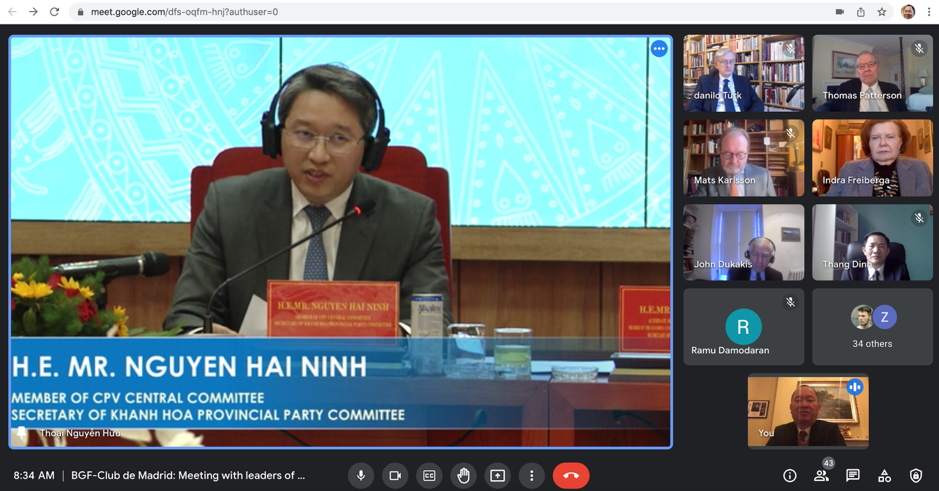
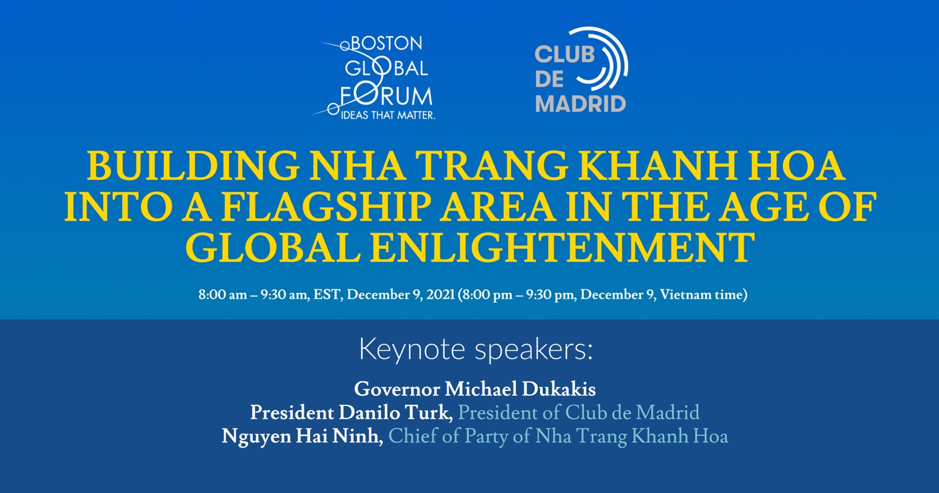
REMARKS BY H.E. Mr. Nguyen Hai Ninh IN “BUILDING NHA TRANG – KHANH HOA INTO A FLAGSHIP AREA OF THE AGE OF GLOBAL ENLIGHTENMENT”

Your Excellency Mr. Michael Dukakis, the (former) Governor of Massachusetts, Chairman of Boston Global Forum (BGF)!

Your Excellency Mr. Danilo Turk, the (former) Slovenian President, President of Club de Madrid!

Mr. Nguyen Anh Tuan, co-founder and CEO of the Boston Global Forum!

Ladies and gentlemen, international friends, attend the dialog today.

First of all, allow me, on behalf of the Khanh Hoa leadership, send respectful greetings, and express sincere and deep gratitude to: Governor Michael Dukakis, Chairman of the Boston Global Forum; the President Slovenia Danilo Turk, President of Club de Madrid; Mr. Nguyen Anh Tuan, co-founder and CEO of the Boston Global Forum; and the leaders, strategists, scholars those brought about Initiative “Viet Nam Spark” and organizations special event today with the theme “Building Nha Trang Khanh Hoa into a flagship area in the age of global enlightenment.” Your presence here shows great attention, appreciation, and affection for Viet Nam in general and the city of Nha Trang, Khanh Hoa province in particular. On behalf of the leadership of Khanh Hoa province, I am very honored to be invited and speak at this exceptional event.

Ladies and gentlemen,

Khanh Hoa Province is located in the South Central Coast of Viet Nam, 1,280 km from Hanoi to the north (about 1-hour 30-minute flight) and 443 km from Ho Chi Minh City, the most prominent urban Viet Nam, to the south (50-minute flight); in which Nha Trang is the capital of Khanh Hoa Province.

Khanh Hoa is known for its beautiful and romantic beaches, the world-class best famous sea bays, with many resorts, world-class resorts; wonders, natural landscapes, historical sites, traditional culture imbued with the national identity of Viet Nam. And the wild produce gifted for Khanh Hoa, with two leading quality agarwood and nests which the poet, writer Quach Tan put in Vietnamese poetic verses with sweet, earnest sentences: “Khanh Hoa is land of Agarwood. Over high mounts, and wide oceans do lovers go on. Salanganes’Nest bears the countryside traits. Deep river and stone carved with the country’s oath”. The famous Khanh Hoa Agarwood – spirit of sky and land – known as merchants from all over the world have come here to hunt for spices rare especially in Agarwood tree products is Aquilaria Crassna Pierre (Kỳ Nam) then set going around the silk route across the East-West antiquity. Besides, Salanganes’Nest Khanh Hoa, with 31 trace elements, 18 higher-order amino acids, is considered the nest king, is nutritious food for royal banquets  in the past, really is a gift from the Nature given to this province.

The story highlights the historic journey to Nha Trang – Khanh Hoa’s international friends. So in today’s era, Nha Trang – Khanh Hoa will leave any mark on anyone?

The era we live in is and will witness more and more challenges, and to solve those challenges, wisdom and products of wisdom play a vital role. The Resolution of the XIII Congress of the Communist Party of Viet Nam has set a steering view that must have a breakthrough mechanism to attract and appreciate talents for promoting innovation, vigorous application of science and technology, creating strong motivation for the country’s fast and sustainable development. And we see, Nha Trang – Khanh Hoa has fully converged the potentials, strengths to become a national, regional, and global intellectual destination and creativity.

About the geographical location, Khanh Hoa has an important strategic position for Viet Nam, Southeast Asia, even for the Asia-Pacific region. Located in the easternmost on the mainland of Viet Nam, Khanh Hoa is a place to welcome the first sunray of the country, the gateway to the Pacific Ocean, located on the vibrant and most resourceful waters in the world; In which Truong Sa island district with a lot of precious resources. This only region in Viet Nam owns the seas with a considerable depth. The average temperature is 26.5 ℃ / year and has a mild climate, ideal for high-end tourism.

Khanh Hoa coast is also the interference of the hot sea from the equatorial and the cold sea from the north.

Looking on the map of the South Central Coast, Khanh Hoa, the central intersection among the provinces of Viet Nam, is the eastern bridge point in the East-West economic corridor connecting the Central and Highlands areas, is the convergence of critical roads according to the North-South axis connecting the country’s two political and economic centers of Hanoi capital and Ho Chi Minh City. In terms of economy and connection, Khanh Hoa is between maritime routes and aviation, connecting two leading economic and financial centers in the Asia-Pacific region of Hong Kong (China) and Singapore. As a result, it has a tremendous prospect to become a regional economic link and domestic and international goods circulation. Khanh Hoa also has Cam Ranh International Airport and many deepwater ports, joining other prominent Southeast Asia.

About culture and history, Nha Trang City – Khanh Hoa used to be one of the cultural and religious centers from ancient times with national relics and typical cultural and religious works. Such as Ponagar tower relics – symbols for the convergence of traditional cultural values ​​and traditional beliefs of native Vietnamese and Cham people, annually attracting tens of thousands of followers to pilgrimage. Long Son Pagoda – an ancient temple over 120 years old, where the enormous outdoor Buddha statue is placed in Viet Nam, is also one of the most important temples of Vietnamese Buddhism; Nha Trang Cathedral so far has nearly 100 years old, with ancient Götich architectural design in Europe, …

Through many historical ups and downs of Nha Trang – Khanh Hoa, there have been exchanges, continues and harmony between Asian culture and Western culture to integrate and develop, continue to hold one Central role in Viet Nam’s innovative research. Indochina Oceanography was in 1930 (now Nha Trang Oceanographic Institute); Pasteur Institute, the leading research institute for vaccine and medical bio-products. In particular, this land is where Dr. Alexandre Yersin, an excellent Swiss-original French, found the plague bacillus in 1894 to help humankind prevent the evil epidemic, like the case of Covid-19 today. He went to many parts of the world but chose Khanh Hoa as the second home and spent more than half a century working, researching, and inventing. He once said that “I can’t leave here (Nha Trang – Khanh Hoa), only here is my soul open.”

In terms of characteristics of Nha Trang – Khanh Hoa people, from the past so far, Khanh Hoa people always keep gentle, friendly, open, and humble qualities; Especially we are ready to dedicate, share with a carefree soul. New thoughts, new knowledge are humanity, aiming to become better and beautiful society will be well received and spread.

I believe you will see this feature most clearly at the co-founder and CEO of the Global Forum Boston, Mr. Nguyen Anh Tuan, a son of Nha Trang – Khanh Hoa’s hometown. He co-authored the book “Remaking the World – Toward an Age of Global Enlightenment,” the United Nations Centennial Initiative. We are proud he has very nice things to contribute to the general initiative for humanity, and still don’t forget to confirm the position of the homeland on the future map of the world.

Besides, Nha Trang – Khanh Hoa has hosted a peace and innovation event in 2015, on the 20th anniversary of the normalization of Viet Nam – United States relations; Also organized essential conferences of the Asia-Pacific Economic Cooperation (APEC). These events show the faith and recognition of the world with Nha Trang – Khanh Hoa in particular and with Viet Nam in general as the destination of peace, creativity, and aiming for a promising future.

From those premises, we have enough basis for launching a new journey: “Building Nha Trang – Khanh Hoa into a flagship area of the age of global enlightenment.”

Ladies and gentlemen!

Khanh Hoa identifies that the development strategy in the next ten years will become urban centrally, in which Nha Trang is a nuclear urban and focusing on investing in resources to build Nha Trang. To become an innovative metropolitan area, creativity and sustainability; where convergence and interference of cultures and education; Become a nucleus, the center of innovation, culture – education of the region and the whole country.

Currently, we are actively making and perfecting necessary plans, including adjusting the typical strategy of Nha Trang city to 2040; this is an opportunity to integrate the idea of ​​scientists to maximize the distinctive strengths of the province in the future. We orient the development of green, intelligent, horizontal urban areas. Industrial fields aimed at high-class production, focusing on energy, shipbuilding, food processing, and drinks; developing aquaculture towards high-tech sea farming, responsibility, and sustainability; Diversifying tourism products in the high-end segment, bringing Nha Trang – Khanh Hoa to become a new standard of quality, to work, and to travel. Besides, to realize that vision, we are working closely with many Vietnamese corporations and investors such as Vingroup, Sun Group, FPT, FLC, Hoa Phat, Central South, KDI Holding … and foreign corporations: Sumitomo of Japan; Lotte and Hyundai of Korea… At the same time, the Boston Global Forum and the Club de Madrid introduce significant investors from the US and Europe to survey and invest in Khanh Hoa province.

Ladies and gentlemen!

With such important goals, I look forward to acquiring wisdom, rich experience of the Boston Global Forum and Club de Madrid to expose Nha Trang City – Khanh Hoa’s potentials in the “Age of Global Enlightenment.” Within this dialog, I want to emphasize the following two proposals:

I cherish and welcome delegates from the Boston Global Forum and the World Leadership Alliance-Club de Madrid to contribute initiatives and plans to complete the Nha Trang development strategy in particular, and Khanh Hoa, in general, becomes a global creative center. This cooperation will create opportunities and environments for strategists and world leaders to stick and coordinate with Khanh Hoa province to realize this vital strategy; At the same time, contributing to strengthening and developing the cooperation of Khanh Hoa with the Boston Global Forum from the 2015 “Peace and Innovation” seminar with the attendance of Governor Michael Dukakis, Professor Joseph Nye, Professor John Quelch, Professor Thomas Patterson, Professor Robert Desimone … and many leading professors in Boston, world leaders.

Secondly, from the results of this discussion session, if authorized by a competent authority, Khanh Hoa province, we look forward to hosting a large-scale event in Nha Trang City – Khanh Hoa in 2022. To welcome the Boston Global Forum, the Club de Madrid leaders, delegates, and strategic investors visiting Nha Trang – Khanh Hoa to continue contributing intelligence and experience Helping Nha Trang – Khanh Hoa realizes aspirations to become a creative center in the Age of Global Enlightenment.

Above these are my shares, instead of the opening of the discussion session with the theme “Building Nha Trang – Khanh Hoa into a flagship area of the Age of Global Enlightenment” today. We look forward to listening and talking with you.

Please wish you health, success, and happiness.

Thank you very much!
Artificial intelligence that understands object relationships

When humans look at a scene, they see objects and the relationships between them. On top of your desk, there might be a laptop that is sitting to the left of a phone, which is in front of a computer monitor.

Many deep learning models struggle to see the world this way because they don’t understand the entangled relationships between individual objects. Without knowledge of these relationships, a robot designed to help someone in a kitchen would have difficulty following a command like “pick up the spatula that is to the left of the stove and place it on top of the cutting board.”

In an effort to solve this problem, MIT researchers have developed a model that understands the underlying relationships between objects in a scene. Their model represents individual relationships one at a time, then combines these representations to describe the overall scene. This enables the model to generate more accurate images from text descriptions, even when the scene includes several objects that are arranged in different relationships with one another.

This work could be applied in situations where industrial robots must perform intricate, multistep manipulation tasks, like stacking items in a warehouse or assembling appliances. It also moves the field one step closer to enabling machines that can learn from and interact with their environments more like humans do.

The original article was posted at MIT News.

The Boston Global Forum (BGF), in collaboration with the United Nations Centennial Initiative, released a major work entitled Remaking the World – Toward an Age of Global Enlightenment.   More than twenty distinguished leaders, scholars, analysts, and thinkers put forth unprecedented approaches to the challenges before us. These include President of the European Commission Ursula von der Leyen, Governor Michael Dukakis, Father of Internet Vint Cerf, Former Secretary of Defense Ash Carter, Harvard University Professors Joseph Nye and Thomas Patterson, MIT Professors Nazli Choucri and Alex ‘Sandy’ Pentland, and European Parliament Member Eva Kaili.  The BGF introduced core concepts shaping pathbreaking international initiatives, notably, the Social Contract for the AI Age, an AI International Accord, the Global Alliance for Digital Governance, the AI World Society (AIWS) Ecosystem, and AIWS City.