The new version of GPT-3 is much better behaved (and should be less toxic)

OpenAI has built a new version of GPT-3, its game-changing language model, that it says does away with some of the most toxic issues that plagued its predecessor. The San Francisco-based lab says the updated model, called InstructGPT, is better at following the instructions of people using it—known as “alignment” in AI jargon—and thus produces less offensive language, less misinformation, and fewer mistakes overall—unless explicitly told not to do so.

Large language models like GPT-3 are trained using vast bodies of text, much it taken from the internet, in which they encounter the best and worst of what people put down in words. That is a problem for today’s chatbots and text-generation tools. The models soak up toxic language—from text that is racist and misogynistic or that contains more insidious, baked-in prejudices—as well as falsehoods.

OpenAI has made IntructGPT the default model for users of its application programming interface (API)—a service that gives access to the company’s language models for a fee. GPT-3 will still be available but OpenAI does not recommend using it. “It’s the first time these alignment techniques are being applied to a real product,” says Jan Leike, who co-leads OpenAI’s alignment team.

Previous attempts to tackle the problem included filtering out offensive language from the training set. But that can make models perform less well, especially in cases where the training data is already sparse, such as text from minority groups.

The OpenAI researchers have avoided this problem by starting with a fully trained GPT-3 model. They then added another round of training, using reinforcement learning to teach the model what it should say and when, based on the preferences of human users.

The article was originally posted at MIT Technology Review.

The Boston Global Forum (BGF), in collaboration with the United Nations Centennial Initiative, released a major work entitled Remaking the World – Toward an Age of Global Enlightenment.   More than twenty distinguished leaders, scholars, analysts, and thinkers put forth unprecedented approaches to the challenges before us. These include President of the European Commission Ursula von der Leyen, Governor Michael Dukakis, Father of Internet Vint Cerf, Former Secretary of Defense Ash Carter, Harvard University Professors Joseph Nye and Thomas Patterson, MIT Professors Nazli Choucri and Alex ‘Sandy’ Pentland, and European Parliament Member Eva Kaili.  The BGF introduced core concepts shaping pathbreaking international initiatives, notably, the Social Contract for the AI Age, an AI International Accord, the Global Alliance for Digital Governance, the AI World Society (AIWS) Ecosystem, and AIWS City.

Treasure in the Age of Global Enlightenment at AIWS City

On February 2nd, 2022, Boston Global Forum and Michael Dukakis Institute designed to save treasure of the Age of Global Enlightenment at the AIWS City, it includes historical documents, images of:


World Leader for Peace and Security Award:

Shinzo Abe, Prime Minister of Japan 2015

Angela Merkel, Chancellor of Germany 2015

Ban Ki-moon, Secretary General of United Nations 2016

Toomas Hendrik Ives, President of Estonia 2017

Sauli Niinistö, President of Finland 2018

Vaira Vike-Freiberga, President of Latvia and Club de Madrid, 2019

Ursula von der Leyen, President of European Commission 2020

Andreas Norlén, Speaker of Swedish Parliament 2021


World Leader in AIWS Award:

Angel Gurria, Secretary General of OECD 2018

Vint Cert, Father of Internet 2019

Judea Pearl, Professor of UCLA 2020

Ambassador Stavros Lambrinidis the Head of the Delegation of the European Union to the United States 2021


AIWS Distinguished Lecturer:

Taro Kono, Japanese Minister of Defense

Liam Byrne, Member of UK Parliament

Kazuo Yano, Innovator of Hitachi, Japan

David Bray, Atlantic Council


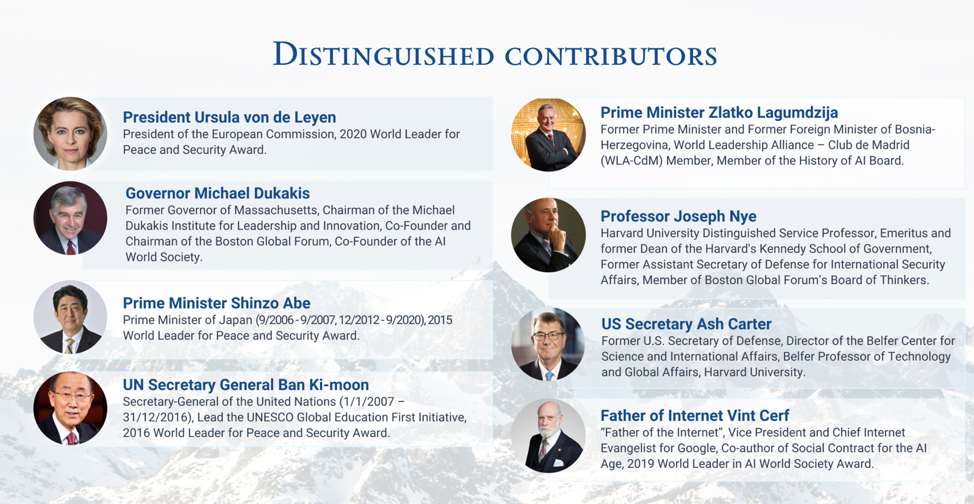
Distinguished Contributors to the book” Remaking the World – Toward an Age of Global Enlightenment”:

Shinzō Abe, Prime Minister of Japan (9/2006-9/2007, 12/2012-9/2020), 2015 World Leader for Peace and Security Award.

Ashton Carter, Former U.S. Secretary of Defense, Director of the Belfer Center for Science and International Affairs, Belfer Professor of Technology and Global Affairs, Harvard University.

Vint Cerf, “Father of the Internet”, Vice President and Chief Internet Evangelist for Google, Co-author of Social Contract for the AI Age, 2019 World Leader in AI Society Award.

Nazli Choucri, Professor of Political Science, MIT, Boston Global Forum Board Member.

Ramu Damodaran, Chief of the United Nations Academic Impact (UNAI), Co-Chair of the United Nations Centennial – BGF and UNAI Initiative in Honor of the United Nations 2045 Centenary.

Michael Dukakis, Former Governor of Massachusetts, Chairman of the Michael Dukakis Institute for Leadership and Innovation, Co-Founder and Chairman of the Boston Global Forum, Co-Founder of the AI World Society.

Eva Kaili, Member of the European Parliament, Chair of the European Parliament’s Science and Technology Options Assessment Panel (STOA), Chair of the Centre for Artificial Intelligence (C4AI), Head of the Hellenic S&D delegation.

Robin Kelly, U.S. Representative (D-IL 2nd District), Vice Chair of the House Energy and Commerce Committee, Member of the House Committee on Oversight and Reform.

Ban Ki-Moon, Secretary-General of the United Nations (1/1/2007 – 31/12/2016), Lead the UNESCO Global Education First Initiative, 2016 World Leader for Peace and Security Award.

Didzis Kļaviņš, Senior Researcher, University of Latvia. 

Taro Kono, Japanese Minister of Defense (9/2019 – 9/2020), Member of the House of Representatives, Japan.

Zlatko Lagumdžija, Former Prime Minister and Former Foreign Minister of Bosnia-Herzegovina, World Leadership Alliance – Club de Madrid (WLA-CdM) Member, Member of the History of AI Board, AIWS.

Stavros Lambrinidis, Ambassador of the European Union to the United States, 2021 World Leader in AI World Society Award.

Ursula von der Leyen, President of the European Commission, 2020 World Leader for Peace and Security Award.

Yasuhide Nakayama, Japanese Defense State Minister, Member of the House of Representatives, Japan, Head of Japan’s Liberal Democratic Party’s Foreign Affairs Division, Mentor of AIWS.net.

Paul Nemitz, Director for Fundamental Rights and Union citizenship in the Directorate-General for JUSTICE of the European Commission, co-author of the AIWS-G7 Summit Initiative 2019.

Nguyn Anh Tun, CEO of the Boston Global Forum, Director of the Michael Dukakis Institute for Leadership and Innovation, Co-Founder of the AI World Society, Founder and former Editor in Chief of VietNamNet.

Andreas Norlén, Speaker of the Swedish Parliament.

Joseph Nye, Harvard University Distinguished Service Professor, Emeritus and former Dean of the Harvard’s Kennedy School of Government, Former Assistant Secretary of Defense for International Security Affairs, Member of Boston Global Forum’s Board of Thinkers.

Žaneta Ozoliņa, Professor at the Department of Political Science at the University of Latvia and the Director at the Centre for International Politics, Chairwoman of the Latvian Transatlantic Organization.

Thomas Patterson, Bradlee Professor of Government and the Press, Harvard University, Research Director of The Michael Dukakis Institute for Leadership and Innovation, Co-founder of the Boston Global Forum.

Judea Pearl, Professor of Computer Science and Director of the Cognitive Systems Lab at the University of California, Los Angeles, recipient of the A.M. Turing Award, 2020 World Leader in AI World Society Award.

Alex Pentland, the Toshiba Professor at MIT, Director, MIT Connection Science and Human Dynamics lab, Co-author of Social Contract for the AI Age.

Iain Duncan Smith, Conservative Member of the Parliament of the United Kingdom.

Vaira Vīķe-Freiberga, 6th President of Latvia (1999-2007), President of World Leadership Alliance – Club de Madrid (WLA-CdM) 2013-2019; 2019 World Leader for Peace and Security Award.


It also includes:

  • Cornerstones and figures in the History of Artificial Intelligence
  • Cornerstones and figures that contribute in building the Age of Global Enlightenment and the United Nations Centennial Initiative

Can China create a world-beating AI industry?

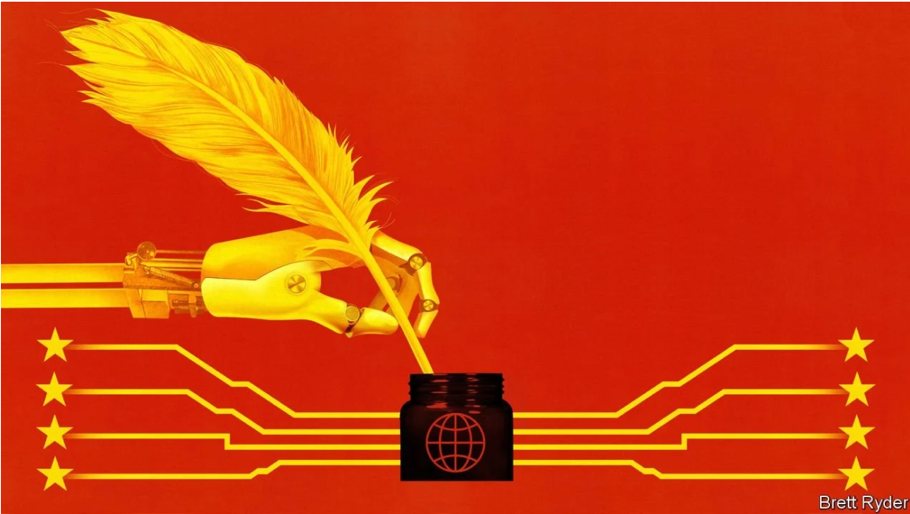
South of the Huai river few geese can be seen through the rain and snow.” In classical Chinese this verse is a breakthrough—not in literature but in computing power. The line, composed by an artificial intelligence (ai) language model called Wu Dao 2.0, is indistinguishable in metre and tone from ancient poetry. The lab that built the software, the Beijing Academy of Artificial Intelligence (baai), challenges visitors to its website to distinguish between Wu Dao and flesh-and-blood 8th-century masters. Anecdotal evidence suggests that it fools most testers.

The system, whose name means “enlightenment” and which can emulate lowlier types of speech, derives its power from a neural network with 1.75trn variables and other inputs. gpt-3, a similar model built a year earlier by a team of researchers in San Francisco and deemed impressive at the time, considered just 175bn parameters. As such Wu Dao represents a leap in this type of machine learning, which tries to emulate the workings of the human brain. That delights fans of classical literature—but not as much as it does the Communist authorities in Beijing, which have put ai at the heart of China’s technological and economic master plan first set out in 2017. It spooks Western governments, which worry about ai’s less benign applications in areas like surveillance and warfighting. And it intrigues investors, who spy a huge business opportunity.

The article was originally published at The Economist.

The Boston Global Forum (BGF), in collaboration with the United Nations Centennial Initiative, released a major work entitled Remaking the World – Toward an Age of Global Enlightenment.   More than twenty distinguished leaders, scholars, analysts, and thinkers put forth unprecedented approaches to the challenges before us. These include President of the European Commission Ursula von der Leyen, Governor Michael Dukakis, Father of Internet Vint Cerf, Former Secretary of Defense Ash Carter, Harvard University Professors Joseph Nye and Thomas Patterson, MIT Professors Nazli Choucri and Alex ‘Sandy’ Pentland, and European Parliament Member Eva Kaili.  The BGF introduced core concepts shaping pathbreaking international initiatives, notably, the Social Contract for the AI Age, an AI International Accord, the Global Alliance for Digital Governance, the AI World Society (AIWS) Ecosystem, and AIWS City.

World Trade Organization: Acknowledging AI applications for a better future

The WTO Public Forum 2018 is considering the future of trade from the perspective of future generations. The WTO has recognized the value of the vision and thoughts of the youth on the technologies of the 4th industrial revolution that will shape the future of trade. With this in mind, the Geneva Hub of the Global Shapers Community has leveraged the opportunity of the WTO Public Forum 2018 to bring the voice of youth to issues of the future of trade in the context of the fourth industrial revolution. Industry 4.0 is rapidly demonstrating that the whole is indeed greater than the sum of its parts. And it is in ensuring that the “whole” does come together that the World Trade Organization (WTO) Agreement on Technical Barriers to Trade (TBT) has a key role to play.

The TBT agreement addresses regulatory interventions that may affect trade-in products. This will be the case for many Industry 4.0-related standards and regulations. The unparalleled speed and breadth of the current “revolution” unfold every day with new digital products being invented ready to fulfill needs we did not even know we had. These developments invariably expose a “dark side” of new technology; of risks that we also did not know could even exist. You may have heard that “IoT toasters” may be misused and turned into “weapons of mass destruction”

Cooperation on technical standards is also especially important when confronting novel regulatory challenges and risks, such as those related to “dual use technologies” (i.e., both for civil and defence purposes) or to the area of AI. Technical standards applying to dual-use technologies, for instance with respect to radio, telecommunication, and network security, or autonomous vehicles and aircraft, are notified by WTO members under the TBT Agreement.

The Boston Global Forum (BGF), in collaboration with the United Nations Centennial Initiative, released a major work entitled Remaking the World – Toward an Age of Global Enlightenment.   More than twenty distinguished leaders, scholars, analysts, and thinkers put forth unprecedented approaches to the challenges before us. These include President of the European Commission Ursula von der Leyen, Governor Michael Dukakis, Father of Internet Vint Cerf, Former Secretary of Defense Ash Carter, Harvard University Professors Joseph Nye and Thomas Patterson, MIT Professors Nazli Choucri and Alex ‘Sandy’ Pentland, and European Parliament Member Eva Kaili.  The BGF introduced core concepts shaping pathbreaking international initiatives, notably, the Social Contract for the AI Age, an AI International Accord, the Global Alliance for Digital Governance, the AI World Society (AIWS) Ecosystem, and AIWS City.

What’s Next for Ethical AI?

In today’s digital age, artificial intelligence (AI) and machine learning (ML) are emerging everywhere: facial recognition algorithms, pandemic outbreak detection and mitigation, access to credit, and healthcare are just a few examples. But, do these technologies that mirror human intelligence and predict real-life outcomes build a consensus with human ethics? Can we create regulatory practices and new norms when it comes to AI? Beyond everything, how can we take out the best of AI and mitigate the potential ill effects? We are in hot pursuit of the answers.

AI/ML technologies come with their share of challenges. Globally leading brands such as Amazon, Apple, Google, and Facebook have been accused of bias in their AI algorithms. For instance, when Apple introduced Apple Card, its users noticed that women were offered smaller lines of credit than men. This bias seriously affected the global reputation of Apple.

In an extreme case with serious repercussions, U.S. judicial systems use AI algorithms to declare prison sentences and parole terms. Unfortunately, these AI systems are built on historically biased crime data, amplifying and perpetuating embedded biases in AI systems. Ultimately, this leads to questioning the fairness offered by the ML algorithms in the criminal justice system.

The original article was published here.

The Boston Global Forum (BGF), in collaboration with the United Nations Centennial Initiative, released a major work entitled Remaking the World – Toward an Age of Global Enlightenment.   More than twenty distinguished leaders, scholars, analysts, and thinkers put forth unprecedented approaches to the challenges before us. These include President of the European Commission Ursula von der Leyen, Governor Michael Dukakis, Father of Internet Vint Cerf, Former Secretary of Defense Ash Carter, Harvard University Professors Joseph Nye and Thomas Patterson, MIT Professors Nazli Choucri and Alex ‘Sandy’ Pentland, and European Parliament Member Eva Kaili.  The BGF introduced core concepts shaping pathbreaking international initiatives, notably, the Social Contract for the AI Age, an AI International Accord, the Global Alliance for Digital Governance, the AI World Society (AIWS) Ecosystem, and AIWS City.

Can AI Virtual Assistants Help Close The Gaps In Cybersecurity?

A digital cybersecurity analyst is a type of virtual assistant — in other words, a smart system built using artificial intelligence. It’s capable of learning, in real time, from the experiences of security analysts and by observing an organization’s data. Its ability to process large amounts of data with speed can help security analysts better defend their organizations against cyberattacks. In addition, the insights that a digital cybersecurity analyst offers can free up time for security analysts to perform more valuable tasks, such as exception handling and enhanced risk suppression.

Many organizations, regardless of their size, type and industry, can utilize digital cybersecurity analysts to save both time and resources. These domain-specific AI virtual assistants can automate certain processes and enforce countermeasures to increase the productivity, effectiveness and efficiency of security teams. This can allow organizations, especially ones with small security teams, to determine the right course of action to counter attacks.

Digital cybersecurity analysts can also help security analysts improve their skills and their decision-making capabilities through the insights they can deliver. Not only does this help bridge their knowledge gap, but it can enable them to deal with more complex and sophisticated types of attacks. That’s why interest in advanced AI virtual assistants for cybersecurity is on the rise.

The original article was posted at Forbes.

The Boston Global Forum (BGF), in collaboration with the United Nations Centennial Initiative, released a major work entitled Remaking the World – Toward an Age of Global Enlightenment.   More than twenty distinguished leaders, scholars, analysts, and thinkers put forth unprecedented approaches to the challenges before us. These include President of the European Commission Ursula von der Leyen, Governor Michael Dukakis, Father of Internet Vint Cerf, Former Secretary of Defense Ash Carter, Harvard University Professors Joseph Nye and Thomas Patterson, MIT Professors Nazli Choucri and Alex ‘Sandy’ Pentland, and European Parliament Member Eva Kaili.  The BGF introduced core concepts shaping pathbreaking international initiatives, notably, the Social Contract for the AI Age, an AI International Accord, the Global Alliance for Digital Governance, the AI World Society (AIWS) Ecosystem, and AIWS City.

Global Enlightenment Program

The digital revolution is reshaping the world. It’s redistributing wealth and power while altering economic, social, and political relationships and systems. The overriding and unanswered question at this point is whether citizens will control the changes yet to come.

The Global Enlightenment Program is designed to give citizens control of their lives for their own sake and that of society. The program seeks to give citizens the understanding and skills that will open their minds to the challenges and opportunities of the digital revolution.

The Global Enlightenment Program recognizes that a new Age of Reason is within reach through the application of digital technology. Just as ideas about human progress, happiness, acceptance, and knowledge fueled the Age of Enlightenment that swept Western Europe in the 17th century, ideas about digital learning and innovation can reshape today’s world and do so for people everywhere, ushering in an Age of Global Enlightenment. Many of today’s problems, including poverty, ignorance, intolerance, and political repression, can be mitigated through the inclusive and thoughtful application of digital technology.

The Global Enlightenment Program is inspired by UNESCO’s Global Citizenship Education Initiative, which is UNESCO’s response to the challenge of enriching human values in an increasingly interconnected world. Through its program, UNESCO seeks to prepare learners for the challenges of the 21st century. It aims to empower people of all ages and backgrounds to play their part in promoting a more peaceful, tolerant, inclusive, and sustainable society. Global citizenship is the idea that each person can contribute to making the world a better place and refers to the sense of belonging to a broader community and common humanity. It emphasizes political, economic, social, and cultural interdependency, and the connection between the local, the national and the global.

Professor Thomas Patterson, Harvard Kennedy School, co-founder of the Boston global Forum is Chief of the Global Enlightenment Program.

The Five Biggest Cyber Security Trends In 2022

The changed world we’ve found ourselves living in since the global pandemic struck in 2020 has been particularly helpful to cybercriminals. Nothing illustrates this so well as the SolarWinds hack, described by Microsoft president Brad Smith as the most sophisticated cyberattack of all time, the reverberations of which have been felt throughout 2021.

Homeworking, the ongoing digitization of society, and the increasingly online nature of our lives mean opportunities about for phishers, hackers, scammers, and extortionists. As we head into 2022, there is, unfortunately, no sign of this letting up. This is why it’s essential for individuals and businesses to be aware of the ever-growing avenues of attack as well as what can be done to mitigate the risks!

Similar to the way in which it is used in financial services for fraud detection, artificial intelligence (AI) can counteract cybercrime by identifying patterns of behavior that signify something out-of-the-ordinary may be taking place. Crucially, AI means this can be done in systems that need to cope with thousands of events taking place every second, which is typically where cybercriminals will try to strike.

It’s the predictive powers of AI that make it so useful here, which is why more and more companies will be investing in these solutions as we go into 2022. Unfortunately, cybercriminals are also aware of the benefits of AI, and new threats are emerging that use technologies like machine learning to evade the protective measures of cybersecurity. This makes AI even more essential – as it’s the only hope of counteracting AI-powered cyber-attacks!

The article was originally posted at Forbes.

The Boston Global Forum (BGF), in collaboration with the United Nations Centennial Initiative, released a major work entitled Remaking the World – Toward an Age of Global Enlightenment.   More than twenty distinguished leaders, scholars, analysts, and thinkers put forth unprecedented approaches to the challenges before us. These include President of the European Commission Ursula von der Leyen, Governor Michael Dukakis, Father of Internet Vint Cerf, Former Secretary of Defense Ash Carter, Harvard University Professors Joseph Nye and Thomas Patterson, MIT Professors Nazli Choucri and Alex ‘Sandy’ Pentland, and European Parliament Member Eva Kaili.  The BGF introduced core concepts shaping pathbreaking international initiatives, notably, the Social Contract for the AI Age, an AI International Accord, the Global Alliance for Digital Governance, the AI World Society (AIWS) Ecosystem, and AIWS City.