
Why Aren’t Governments Paying More Attention to AI?

AI has come a long way over the past decade. The compute resources dedicated to the technology have been increasing exponentially, doubling every four months on average. This corresponds to an increase by a whopping 30,000,000 percent since 2012.

This stellar growth has enormous implications for the future of work and of society as a whole. Despite this potential, governments around the world don’t know exactly how much compute their country has for AI, how it’s used, or how to prevent it from being harmful.

Their ignorance is concerning, given that AI as a concept has been around for several decades. And for the last decade, a range of organizations have conducted massive research efforts aimed at deploying AI for industrial means. Such efforts could have a profound effect on people’s lives.

Precise knowledge of the state of the art is crucial so that governments can put effective policies in place regarding AI and its implementation. Think about it this way: If governments didn’t know precisely what the inflation rate was at any given time, deciding on measures for growing the economy would be much harder. Likewise, information about traffic gives the government important clues on where to invest in infrastructure. Most recently, we’ve all been witness to how data on Covid-19 has led to different rules for public conduct.

Along these same lines, failing to collect relevant data about AI carries significant risk, as a recent paper by Jess Whittlestone and Jack Clark points out. Without data, governments will be in a much worse position to regulate AI and monetary investments will be more prone to fail. To get started, we need to learn from the past because some harm has already been done.

AI might have incredibly good effects on healthcare, carbon emissions, sustainable crops, and economic growth. But it can also do lots of harm, for example as a tool for repression and monitoring of civilians. The latter would mean that all power is concentrated in a small class of elites, instead of getting AI to empower each and every citizen. It’s not too late to act now and start some pilot projects. The U.S. government can use its results to draft legislation for the years to come and position itself as a global leader once again.

The article was originally posted here.

The Boston Global Forum (BGF), in collaboration with the United Nations Centennial Initiative, released a major work entitled Remaking the World – Toward an Age of Global Enlightenment.   More than twenty distinguished leaders, scholars, analysts, and thinkers put forth unprecedented approaches to the challenges before us. These include President of the European Commission Ursula von der Leyen, Governor Michael Dukakis, Father of Internet Vint Cerf, Former Secretary of Defense Ash Carter, Harvard University Professors Joseph Nye and Thomas Patterson, MIT Professors Nazli Choucri and Alex ‘Sandy’ Pentland, and European Parliament Member Eva Kaili.  The BGF introduced core concepts shaping pathbreaking international initiatives, notably, the Social Contract for the AI Age, an AI International Accord, the Global Alliance for Digital Governance, the AI World Society (AIWS) Ecosystem, and AIWS City.

Algorithmic Warfare: AI Key to Unlocking New Space Applications

Experts say artificial intelligence — which has wide applications across the military, civil and private sectors — will be critical to furthering space technology as the cosmos becomes more contested.

“The space environment continues to rapidly evolve,” said Melanie Stricklan, CEO of Slingshot Aerospace, a space simulation and analytics company based in Austin, Texas, and El Segundo, California. “We continue to proliferate with new users and capabilities, new sensors both on orbit looking down, and on the Earth looking back up at space.”

Artificial intelligence can improve space domain awareness, accelerate command-and-control decisions as well as inject resiliency into satellites and their corresponding networks, she said during an online panel discussion hosted by Booz Allen Hamilton.

“There’s a lot of limitations for space today, but I think AI solutions really offer a transformative opportunity for … the protect-and-defend mission on the defense side [and] for improving operations on the commercial side,” Stricklan said.

Officials with the burgeoning Space Force — which will soon celebrate its second birthday — have said artificial intelligence will be a key future technology.

To enhance efficiency, the service plans to establish a digital foundation that will support rapid, data-driven decision-making and “unburden” its workforce from legacy staffing and coordination activities that could be better accomplished through automation, the Space Force said in its “Vision for a Digital Service” document, which was released in May.

The original article was published here.

The Boston Global Forum (BGF), in collaboration with the United Nations Centennial Initiative, released a major work entitled Remaking the World – Toward an Age of Global Enlightenment.   More than twenty distinguished leaders, scholars, analysts, and thinkers put forth unprecedented approaches to the challenges before us. These include President of the European Commission Ursula von der Leyen, Governor Michael Dukakis, Father of Internet Vint Cerf, Former Secretary of Defense Ash Carter, Harvard University Professors Joseph Nye and Thomas Patterson, MIT Professors Nazli Choucri and Alex ‘Sandy’ Pentland, and European Parliament Member Eva Kaili.  The BGF introduced core concepts shaping pathbreaking international initiatives, notably, the Social Contract for the AI Age, an AI International Accord, the Global Alliance for Digital Governance, the AI World Society (AIWS) Ecosystem, and AIWS City.
Nizami Ganjavi International Center (NGIC) of Azerbaijan join and support Global Alliance for Digital Governance

Distinguished leaders from Boston and Balkan regions to collaborate for Global Law on AI and Digital Rights

On September 29, 2021, two distinguished organizations from the Northeast United States and the Balkans, Boston Global Forum (BGF) and Nizami Ganjavi International Center (NGIC), announced a collaboration to promote pioneering initiatives related to a Global Alliance for Digital Governance. The initiative, which was the subject of a recent Policy Lab online forum, also involves the United Nations Centennial Initiative, AI World Society (AIWS) and the Club de Madrid.

The joint announcement states that BGF will support NGIC’s Global Enlightenment Education Program in Baku, as well as a number of other initiatives.

BGF and NGIC will exchange resources to develop initiatives to solve complex and controversial issues in the world today and shape the future for “Remaking the World – Toward an Age of Global Enlightenment.”

Under the agreement, the BGF and NGIC will join in promoting the Global Alliance for Digital Governance (GADG), and NGIC will connect governments of Balkan and Middle East nations to support the Alliance. The two organizations will recommend speakers, promote conferences and forums, and publicize joint events.

Nguyen Anh Tuan, Co-Founder and CEO of the BGF, hailed the agreement and noted its impact on expanding the Alliance: “NGIC will bring a high level of engagement and distinguished leaders of the Balkans, contributing to the creation of a Global Law and Accord on AI and Digital Rights, and discuss the Accord at significant conferences that NGIC often organize in many cities as New York, Beijing, Riga, Athens, Andorra, Cairo, Sarajevo, Sofia, Brussels, Missions in Kiev, Tel-Aviv, Amman, Istanbul, Bucharest, which are attended by many head of states and government leaders.”

Recently, the NGIC collaborate with the United Nations to organize the XXI High-Level Meeting, which took place both digitally and in-person during the week of September 20, 2021 as an Exclusive Side Event to the UN General Assembly “What does Peace and Stability mean in the 21st Century?”

There were 42 speakers (20 in person and 22 digital), among them 20 current and former Presidents and Prime Ministers, and Nobel Laurates that attended the event.

AI cannot be the inventor of a patent, appeals court rules

Artificial intelligence (AI) cannot be the inventor of new patents, the UK Court of Appeal has ruled.

Patents assign the ownership of a new invention to its creator. At its core, the argument is about whether a law written for human inventors can be applied to machines.

The appeal court ruled against Stephen Thaler, creator of a system called Dabus, who took a case against the UK’s Intellectual Property Office (IPO) which refused patents to his AI.

It is the latest such judgement in a long-running battle to grant machines the status of inventor.

Earlier this month, Mr Thaler lost a similar case in the United States – although he has won elsewhere.

The UK panel decided, by a two-to-one majority, that an inventor must be a real human person under UK law.

“Only a person can have rights. A machine cannot,” wrote Lady Justice Elisabeth Laing in her judgement. “A patent is a statutory right and it can only be granted to a person.”

The article was originally posted at BBC.

The Boston Global Forum (BGF), in collaboration with the United Nations Centennial Initiative, released a major work entitled Remaking the World – Toward an Age of Global Enlightenment.   More than twenty distinguished leaders, scholars, analysts, and thinkers put forth unprecedented approaches to the challenges before us. These include President of the European Commission Ursula von der Leyen, Governor Michael Dukakis, Father of Internet Vint Cerf, Former Secretary of Defense Ash Carter, Harvard University Professors Joseph Nye and Thomas Patterson, MIT Professors Nazli Choucri and Alex ‘Sandy’ Pentland, and European Parliament Member Eva Kaili.  The BGF introduced core concepts shaping pathbreaking international initiatives, notably, the Social Contract for the AI Age, an AI International Accord, the Global Alliance for Digital Governance, the AI World Society (AIWS) Ecosystem, and AIWS City.
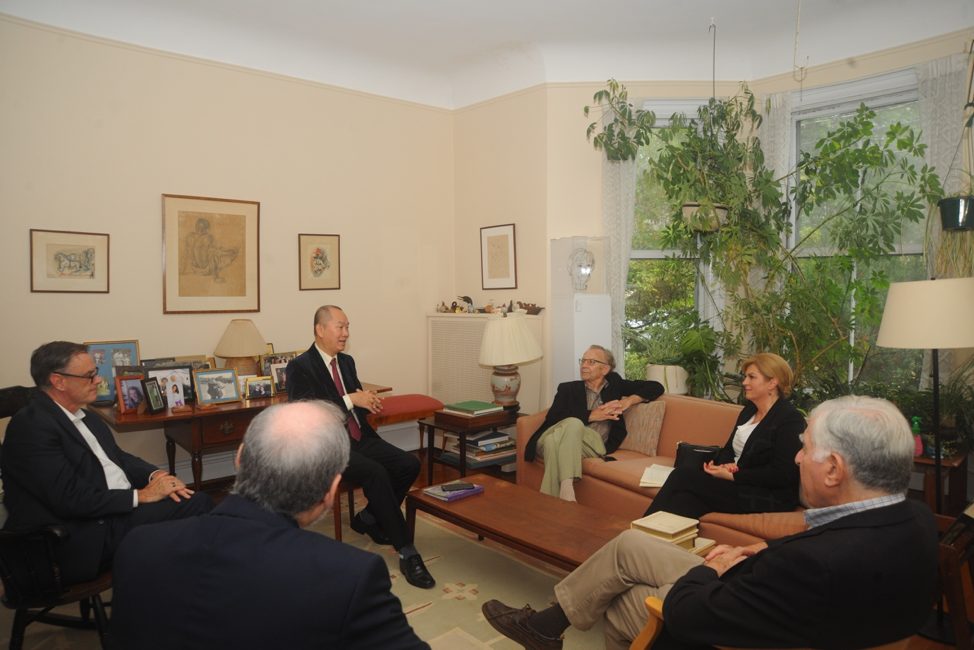
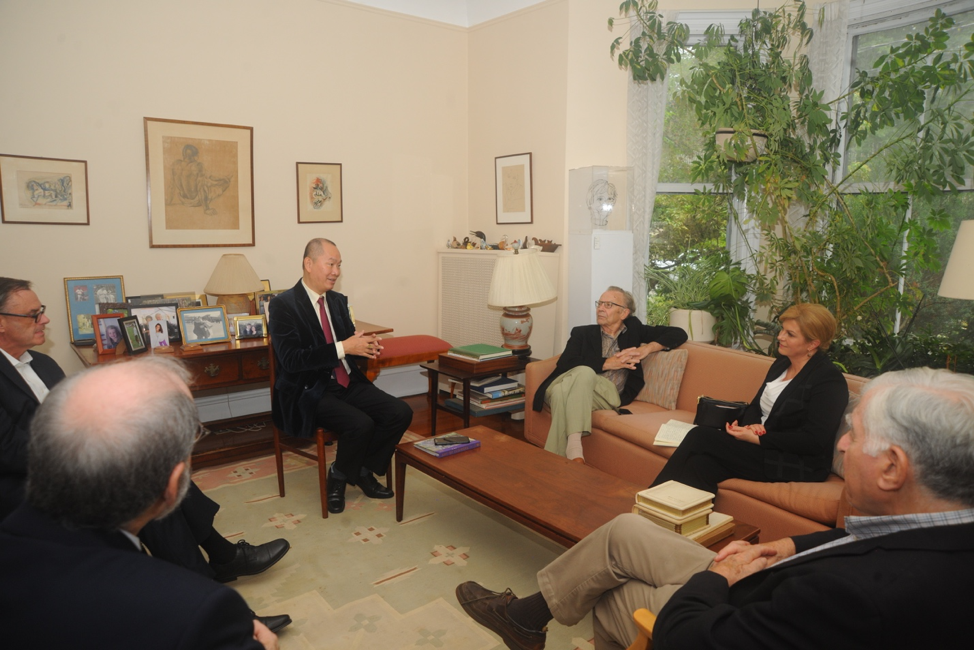
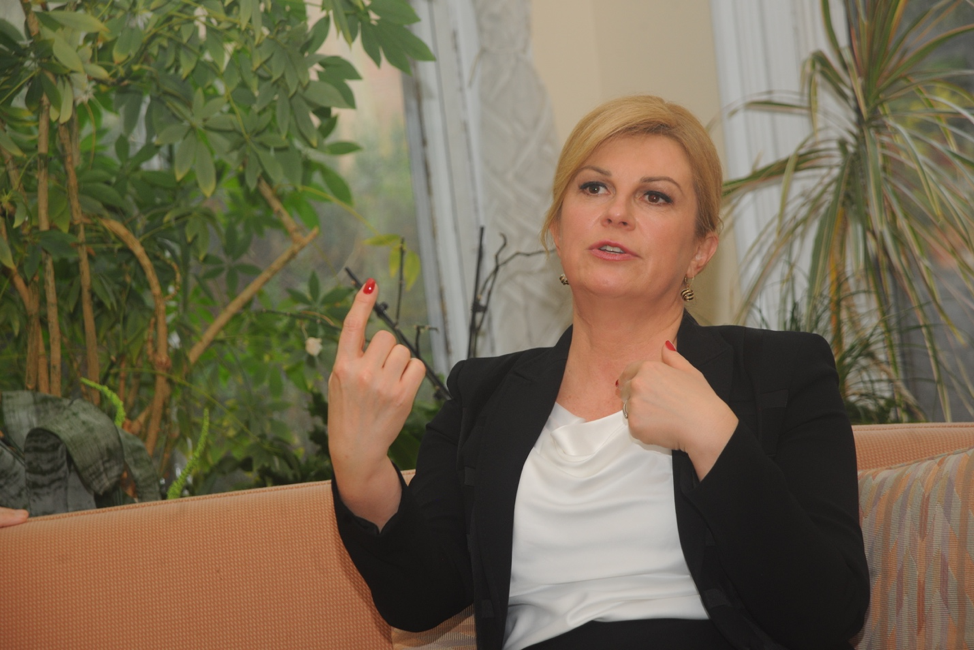
Former President of Croatia visits and discusses with Governor Michael Dukakis and leaders of Boston Global Forum

On September 24, President of Croatia (2015-2020) Kolinda Grabar-Kitarovic, member of Nizami Ganjavi International Center, visited and discussed with Governor Michael Dukakis and leaders of the Boston Global Forum.

President Grabar-Kitarović expressed enthusiasm that the city of Dubrovnik, with the young, open-minded mayor Mato Franković, can be a satellite city of AIWS City. BGF can provide advice for Dubrovnik in building AI infrastructure and legislations, while Dubrovnik can be an ally of the AI International Accord and Law and Global Alliance for Digital Alliance. Governor Michael Dukakis invited President Grabar-Kitarovic to join the initiative of BGF in Global Alliance for Digital Governance and Global Law and Accord on AI and Digital.

This visit of President Grabar-Kitarovic opens a new road for opportunities between Croatia and Boston Global Forum, especially in works to apply AIWS Ecosystem and Community Innovation Economy.

President Kolinda Grabar-Kitarovic gave a keynote speech at the United Nations Centennial Roundtable “Remaking the World – Toward an Age of Global Enlightenment”

On September 24, 2021, HE. Kolinda Grabar-Kitarovic, President of Croatia (2015-2020) gave a keynote speech at the United Nations Centennial Roundtable. Governor Michael Dukakis, co-founder and Chair of the Boston Global Forum (BGF), was moderator, with CEO of BGF Nguyen Anh Tuan, and Harvard Professors Thomas Patterson and David Silbersweig as panelists.

Here are some highlights from her speech:

  • Inequality of access to the internet is in itself a human right issue
  • Many challenges relating to demographics:
    1. Education
    2. Health
    3. Employment
  • Any sort of global accord has to be a “coalition of the willing,” not just of big powers. Small countries with relationships with various superstates are important links/glue/nodes in the network. For example, when two superstates have conflicts, the small countries with good relationships to both contending superstates can resolve the conflicts.
    • Therefore, the AI International Accord and Law can work on regional cooperation as stepping stone towards global cooperation.


The path “Toward an Age of Global Enlightenment” has, at its foundations, six essential anchors upon which to develop and build viable futures for current and all generations to come – here and everywhere.

  • The Political and Social Order: Based on the Social Contract for the Age of Artificial Intelligence supported accountability and responsibility
  • National Law and Global Order: Framed with International Law and Global Accord for Ai and adaptations to the Digital era
  • Economic Activity with Creativity: Built upon innovation by, and for society, community, and individuals: Community Innovation Economy.
  • Dominant Cultural Norms: Tolerance for diversity, mutual support, respect, and recognition of the value of each individual
  • Education Principles: Pursuit of basic science, technology, social sciences, humanities and other knowledge forms, shaping thinking and innovating to articulate a Global Enlightenment Education Program
  • Information & Communication: Open forms of discourse, support for diverse platforms of communication, respect for accuracy with accountability


U.N. urges moratorium on use of AI that imperils human rights

The U.N. human rights chief is calling for a moratorium on the use of artificial intelligence technology that poses a serious risk to human rights, including face-scanning systems that track people in public spaces.

Michelle Bachelet, the U.N. high commissioner for human rights, also said Wednesday that countries should expressly ban AI applications that don’t comply with international human rights law.

Applications that should be prohibited include government “social scoring” systems that judge people based on their behavior and certain AI-based tools that categorize people into clusters such as by ethnicity or gender.

AI-based technologies can be a force for good, but they can also “have negative, even catastrophic, effects if they are used without sufficient regard to how they affect people’s human rights,” Bachelet said in a statement.

Her comments came along with a new U.N. report that examines how countries and businesses have rushed into applying AI systems that affect people’s lives and livelihoods without setting up proper safeguards to prevent discrimination and other harms.

“This is not about not having AI,” Peggy Hicks, the rights office’s director of thematic engagement, told journalists as she presented the report in Geneva. “It’s about recognizing that if AI is going to be used in these human rights — very critical — function areas, that it’s got to be done the right way. And we simply haven’t yet put in place a framework that ensures that happens.”

The article was originally published in the LA Times.

The Boston Global Forum (BGF), in collaboration with the United Nations Centennial Initiative, released a major work entitled Remaking the World – Toward an Age of Global Enlightenment.   More than twenty distinguished leaders, scholars, analysts, and thinkers put forth unprecedented approaches to the challenges before us. These include President of the European Commission Ursula von der Leyen, Governor Michael Dukakis, Father of Internet Vint Cerf, Former Secretary of Defense Ash Carter, Harvard University Professors Joseph Nye and Thomas Patterson, MIT Professors Nazli Choucri and Alex ‘Sandy’ Pentland, and European Parliament Member Eva Kaili.  The BGF introduced core concepts shaping pathbreaking international initiatives, notably, the Social Contract for the AI Age, an AI International Accord, the Global Alliance for Digital Governance, the AI World Society (AIWS) Ecosystem, and AIWS City.
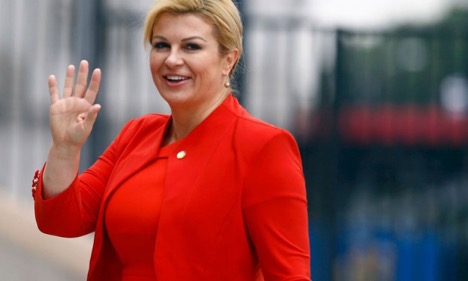
Former President of Croatia, Kolinda Grabar-Kitarović, will present a keynote speech at the Boston Global Forum on September 24

President of Croatia (2015-2020) Kolinda Grabar-Kitarović will visit the Boston Global Forum on September 24, 2021, where she will meet and discuss with Governor Michael Dukakis and leaders of the Boston Global Forum, then attend and give keynote speech at the United Nations Centennial Roundtable “Remaking the World – Toward an Age of Global Enlightenment.”

Time: 10:30 am – 12:00 pm, EST, Friday, September 24, 2021

Venue: Governor Michael Dukakis House, 85 Perry Street, Brookline, MA 02446

Topics for discussion:

  • Building a trusted data and information system in the Age of Global Enlightenment
  • Building a framework for Global Law and Accord on AI and Digital
  • How to make Dubrovnik become a flagship city of the Age of Global Enlightenment

Host: Governor Michael Dukakis, Co-founder and Chair of the Boston Global Forum

Keynote speaker: Kolinda Grabar-Kitarović, President of Croatia (2015 – 2020), Member of the Nizami Ganjavi International Center

Panelists:

Professor Thomas Patterson, Harvard Kennedy School, Co-founder of BGF

Professor David Silbersweig, Harvard, BGF’s Board Member

Nguyen Anh Tuan, Co-founder and CEO of BGF

Agenda

10:30 am: Governor Michael Dukakis welcome President Kolinda Grabar-Kitarovic

10:45 am: Professor Thomas Patterson introduces President Kolinda Grabar-Kitarovic and Governor Michael Dukakis, and introduces the UN Centennial Roundtable

10:50 am: Opening Remarks, Governor Michael Dukakis

10:55 am: Keynote speech, President Kolinda Grabar-Kitarovic

11:10 am: Discussion

12:00 pm: Concluding, Governor Michael Dukakis

12:30 pm: Lunch at OAK Long Bar + Kitchen, Fairmont Copley Plaza

138 St James Avenue, Boston, MA 02116

Remaking the World: Toward an Age of Global Enlightenment

Of the many imperatives to buttress efforts for “Remaking the World” we can now highlight some of the most compelling.  The path “Toward an Age of Global Enlightenment” has, at its foundations, six essential anchors upon which to develop and build viable futures for current and all generations to come – here and everywhere.

  • The Political and Social Order: Based on the Social Contract for the Age of Artificial Intelligence supported accountability and responsibility
  • National Law and Global Order: Framed with International Law and Global Accord for Ai and adaptations to the Digital era
  • Economic Activity with Creativity: Built upon innovation by, and for society, community, and individuals: Community Innovation Economy.
  • Dominant Cultural Norms: Tolerance for diversity, mutual support, respect, and recognition of the value of each individual
  • Education Principles: Pursuit of basic science, technology, social sciences, humanities and other knowledge forms, shaping thinking and innovating to articulate a Global Enlightenment Education Program
  • Information & Communication: Open forms of discourse, support for diverse platforms of communication respect for accuracy with accountability

These anchors supporting the Age of Global Enlightenment are designed to operate at all levels off social organization and aggregation.  These can be seen as generic features of our common future.  We therefore propose:

  • A Practical Model: The AIWS City developed, framed, and implemented as a flagship city for the Age of Global Enlightenment.

About the Boston Global Forum:

The Boston Global Forum (BGF) offers a venue for leaders, strategists, thinkers and innovators to contribute to Remaking the World – Toward an Age of Global Enlightenment.

In 2019, the Boston Global Forum, in collaboration with the United Nations Academic Impact, launched the United Nations Centennial Initiative. It began with the release of a major work titled “Remaking the World – Toward an Age of Global Enlightenment”. More than twenty distinguished leaders, thinkers, strategists, and innovators put forth unprecedented approaches to the challenges that lay before the world. These contributors include President of the European Commission Ursula von der Leyen, Governor Michael Dukakis, Father of Internet Vint Cerf, Former US Secretary of Defense Ash Carter, Harvard University Professors Joseph Nye and Thomas Patterson, MIT Professors Nazli Choucri and Alex ‘Sandy’ Pentland, and MEP Eva Kaili.

The BGF introduced core concepts that are shaping groundbreaking international initiatives, most notably, the Social Contract for the AI Age, AI International Law and Accord, the Global Alliance for Digital Governance, the AI World Society (AIWS) Ecosystem, and the AIWS City.

Co-founders of the Boston Global Forum are Governor Michael Dukakis, Nguyen Anh Tuan, Founder & Editor-in-Chief of VietNamNet (1997-2011), Harvard Professors Thomas Patterson and John Quelch.

“Remaking the World – Toward an Age of Global Enlightenment” at the Riga Conference 2021

The editor and distinguished contributors to the book Remaking the World – Toward an Age of Global Enlightenment will present and discuss significant ideas of the book at the Riga Conference 2021, at the session “Remaking the World – The Second Age of Enlightenment The United Nations 2045”.


Moderator:

Zaneta Ozolina, professor at the Department of Political Science at the University of Latvia and the Director at the Centre for International Politics, Chairwoman of the Latvian Transatlantic Organization.


Speakers:

Professor Thomas Patterson, Harvard Kennedy School

Professor Alex Sandy Pentland, MIT

Paul Nemitz, Director for Fundamental Rights and Union citizenship in the Directorate-General for JUSTICE of the European Commission

Nguyen Anh Tuan, CEO of the Boston Global Forum.


The book “Remaking the World – Toward an Age of Global Enlightenment” is published as publication of the Riga Conference 2021 here: https://www.rigaconference.lv/policy-briefs/