Preparing AIWS Standard for AI citizens

AI is increasingly essential to the security and prosperity of the world, and thus the country with the best AI definitely has several advantages economically, technologically and in terms of being a global super-power. The closer we get to mastering the creation of AI, the more we need standards for AI citizens.

The Boston Global Forum and the Michael Dukakis Institute have outlined some initial AIWS standards for AI citizens as follows:

  • Structure:
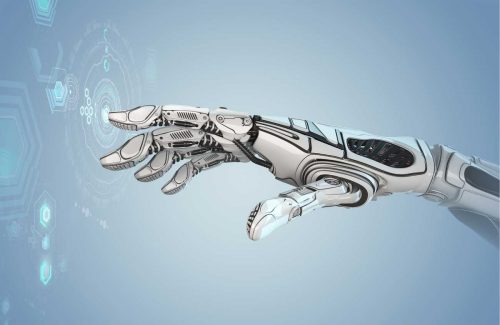
  • Their physical structure is humanoid. They have five senses: sight, hearing, touch, smell, and taste.
  • They have a brain (an executive structure) which can apply logic as well as emotions.
  • They do not have internal organs.
  • They can move akin to a human. They can display emotions by smiling, crying, etc. or those such as anger, love, etc.
  • They must be honest, tolerant, loving, etc. They serve people, love people, and promote people’s best interests without hurting them.
  • Identity:

Each AI citizen has an identity differentiated by brain, physical shape, face, and an identification number.

  • Ethical standards:
  • Must meet requirements on ethics.
  • Cognitive functions are transparent to humans.
  • Each brain has the ability to be backed up and saved.
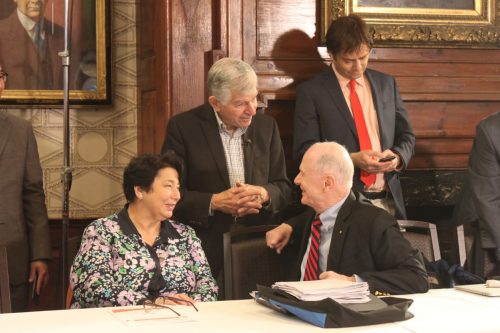
Prime Minister Beatriz Merino delivered a speech at BGF-G7 Summit Conference 2018

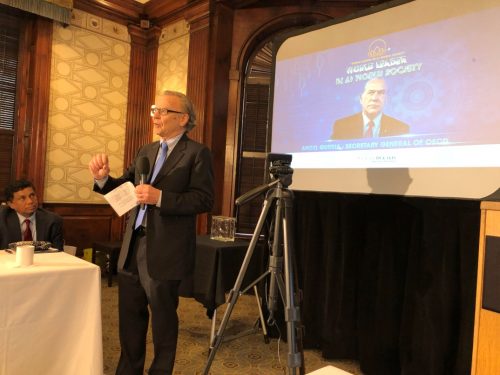
Beatriz Merino, Former Prime Minister of Peru, spoke at the BGF-G7 Summit Conference on April 25, 2018 at the Harvard University Faculty Club. She is a member of World Leadership Alliance-Club de Madrid (WLA-CdM).

WLA-CdM and the Boston Global Forum are partnered with the Michael Dukakis Institute to collaborate and develop the AIWS initiative. The President of WLA-CdM, Ms. Vaira Vike-Freiberga, serves as Co-chair of AIWS activities and conferences along with Governor Michael Dukakis.

Distinguished Innovation Leader Program announced at BGF-G7 Summit Conference

At BGF-G7 Summit Conference on April 25, Prof. Thomas Patterson (Harvard University) announced Distinguished Innovation Leaders in the first year of Distinguished Innovation Leader Program.

This program was announced on February 18, 2018 by the Michael Dukakis Institute. Distinguished Innovation Leader Selection Committee will honor leaders, writers, thought leaders or inventors who have great achievements in innovation, societal reform, and humanity since 1980.

The first list of Distinguished Innovation Leader was announced on May 11, including:

  • Political leaders who changed and innovated the world, geographic regions, or their countries
  • Tech business leaders who change and innovate the world
  • Thinkers, writers, and influentials
  • Innovators, inventors, scientists who change and innovate the world.

Plan 2020 and the Future of the AIWS 7-Layer Model to build Next Generation Democracy

According to the BGF-G7 Summit Report 2018, all seven layers of the AIWS Model to build Next Generation Democracy will be completed by February 20, 2020.

The final Model is expected to be applied in several areas: AIWS International Court, AIWS University, AIWS Healthcare, AIWS Public Transportation, AIWS Policy Makers, and AIWS Political Leaders. These applications will ensure that AIWS norms for AI are adopted broadly and responsibly.

Actions to be taken in the future:

The AIWS Standards and Practice Committee has been established to:

  • Update and gather information on threats and potential harm posed by AI
  • Connect companies, universities, and governments to find ways to prevent threats and potential harm
  • Engage in the audit of behaviors and decisions in the creation of AI
  • Create both an Index and Report about AI threats – and identify the source of threats
  • Create a Report on respect for, and application of, ethics codes and standards for governments
  • Engage companies, universities, individuals, and all others in the effort
  • Work with the UN to call for an AI Peace Treaty, similar to the Chemical Weapons Convention that prohibits the creation, stockpiling, and use of such weapons
  • Work with AI experts on a consensus announcement that “AI experts not engage in any work or participate in projects developing AI weapons”.

AIWS 7-Layer Model and AI Economic Strategy for Vietnam

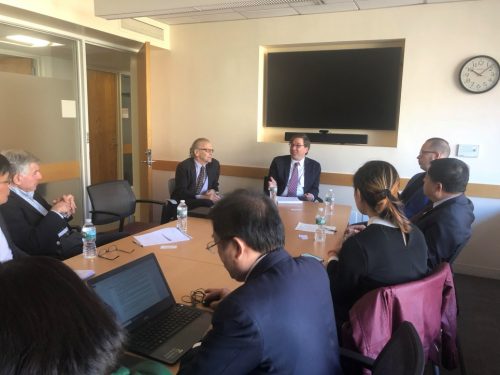
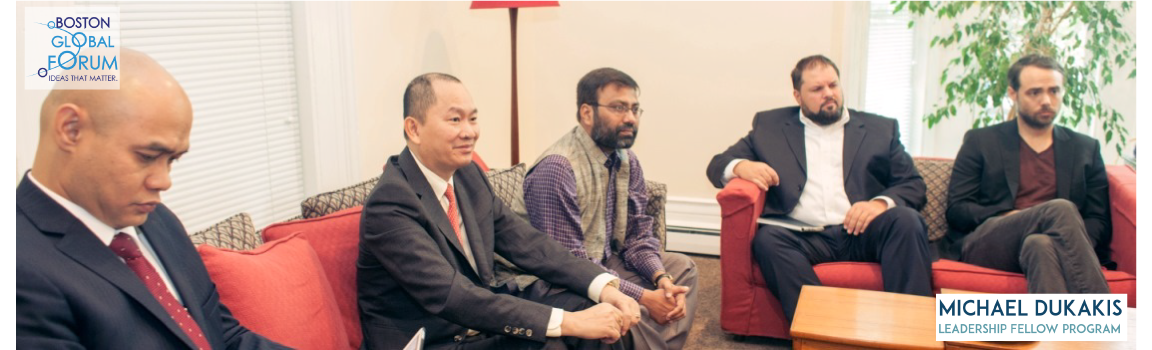
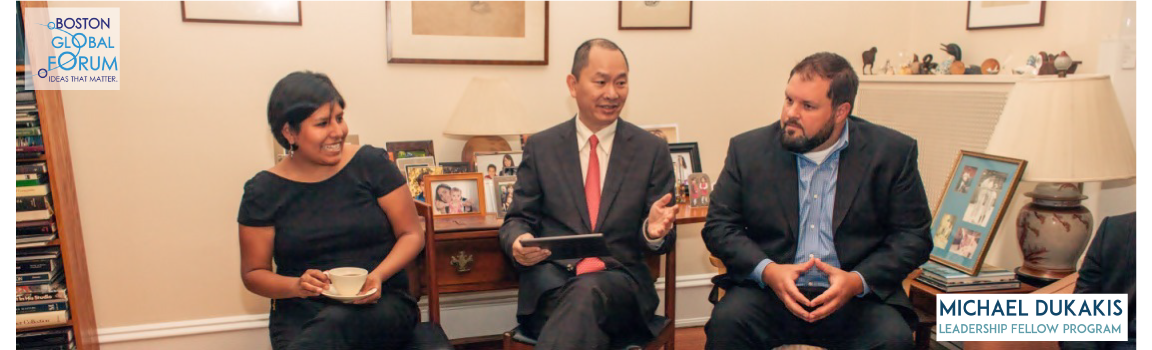
On April 23, 2018, Minister Nguyen Chi Dung – Ministry of Planning and Investment in Vietnam visited the Michael Dukakis Institute to participate in Roundtable: “AI World Society and AI Economic Strategy for Vietnam”.

AI exists in all aspects of modern life, affecting most civilian areas and posing important questions to the development strategy of every nation, in which Vietnam is no exception. AI is still in its early stages in Vietnam. Thus, to join the international community in the digital age, the country needs smart tactics and concrete action plans as well as cooperation with its global allies. The Roundtable “AI World Society and AI Economic Strategy for Vietnam” with the participation of Minister Nguyen Chi Dung of the Ministry of Planning and Investment in Vietnam, delegates who are leaders and scientists from Vietnamese renowned institutes and academies, and leaders of MDI has generated valuable ideas and contributions, helping to advance AI benefits to the country’s economy and create a better society.

MDI and BGF cooperate with world leaders to draft AI Peace Treaty in June Roundtable Discussion

On June 4, the Michael Dukakis Institute and the Boston Global Forum will hold a Roundtable Discussion with the host Governor Michael Dukakis, Chairman of MDI and BGF calling for world leaders to create an AI Peace Treaty. This is separate from the AI World Society Initiative (AIWS).

The unpredictability of the Internet, computer operating systems, networks, and computer applications have often led to cybersecurity failures. AI’s growing impact on society necessitates the establishment of technical standards, institutions, and norms to ensure AI’s safe implementation and ethical foundation. With the recognition of artificial intelligence as a growing factor of modern life, it is crucial to build the AI Peace Treaty for its development and deployment through AIWS. This is an important step for the AIWS Standards and Practice Committee and toward working with the UN to call for an AI Peace Treaty.

AIWS Standards and Practice Committee

The AIWS Standards and Practice Committee is established to:

  • Update and collect information on threats and potential harm posed by AI
  • Connect companies, universities, and governments to find ways to prevent threats and potential harm
  • Engage in the audit of behaviors and decisions in the creation of AI
  • Create both an Index and Report about AI threats – and identify the source of threat
  • Create a Report on respect for, and application of, ethics codes and standards of governments, companies, universities, individuals, and all others
  • Work with the UN to call for an AI Peace Treaty, to AI, similar to the Chemical Weapons Convention that prohibits the creation, stockpiling, and use of those weapons
  • Work with AI experts on a consensus announcement that “AI experts not engage in any work for, or participate in projects developing AI weapons”.

Members of AIWS Standards and Practice Committee:

Gov. Michael Dukakis, Chairman of Michael Dukakis Institute

Mr. Tuan Anh Nguyen, Director of Michael Dukakis Institute

Prof. Nazli Choucri, MIT

Ms. Sarah Cotterill, Harvard Fellow

Prof. Thomas Creely, U.S. Naval War College, Director of Ethics & Emerging Military Technology Graduate Program

Mr. Allan Cytryn, Representative of Michael Dukakis Institute in New York

Pre. Vaira Vike-Freiberga, President of the World Leadership Alliance – Club de Madrid, Former President of Latvia

Dr. Masahiro Fukuhara, Founder and CEO of IGS and GROW360, Japan

Prof. Jason Furman, Harvard Kennedy School, Fomer Chairman of President Barack Obama’s Council of Economic Advisers

Mr. Ian Goodfellow, Research Scientist at Google

Prof. Hiroshi Ishiguro, Director of the Intelligent Robotics Laboratory, Osaka University, Japan

Prof. Mikhail Kupriyanov, Saint Petersburg Electrotechnical University ‘LETI’

Ms. Beatriz Merino, Former Prime Minister of Peru

Mr. Paul Nemitz, Principal Advisor, Directorate General for Justice and Consumers

Prof. Thomas Patterson, Harvard University

Prof. Derek Reveron, U.S Naval War College

Mr. Marc Rotenberg, President and Executive Director of the Electronic Privacy Information Center (EPIC)

Prof. Matthias Scheutz, Director of Human Robots Interaction Lab, Tuft University

Prof. David Silbersweig, Harvard University

Prof. Max Tegmark, MIT

Mr. Eliot Weinman, Founder/Conference Chair, AI World, Executive Editor, AI Trends

Prof. Patrick Winston, MIT

Dr. Kazuo Yano, Chief Engineering of Hitachi, Japan

Governor Michael Dukakis presents the BGF-G7 Summit Report 2018 to Consul General of Canada David Alward

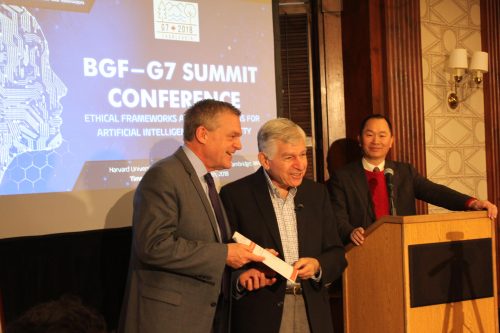
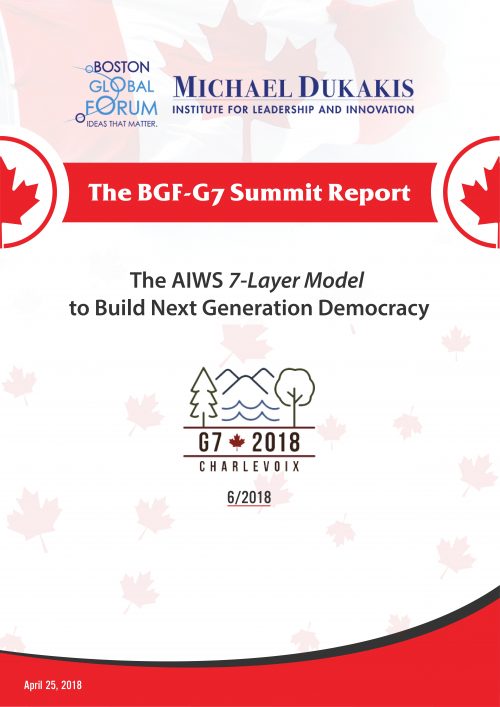
At the BGF-G7 Summit Conference on April 25, 2018 at Harvard University Faculty Club, Governor Michael Dukakis – Chairman of Boston Global Forum and Michael Dukakis Institute – presented the BGF-G7 Summit Report 2018 to Consul General of Canada David Alward.

Consul General David Alward, Chairman Michael Dukakis and CEO Nguyen Anh Tuan.

About The BGF-G7 Summit Report: The AIWS 7-Layer Model to Build Next Generation Democracy

The Artificial Intelligence World Society (AIWS) is a set of values, ideas, concepts and protocols for standards and norms whose goal is to advance the peaceful development of AI to improve the quality of life for all humanity. It was conceived by the Michael Dukakis Institute for Leadership and Innovation (MDI) and established on November 22, 2017. The World Leadership Alliance – Club de Madrid (WLA-CdM) and the Boston Global Forum (BGF) are partnered with the MDI to collaborate and develop the AIWS initiative. The President of WLA-CdM, Vaira Vike-Freiberga, serves as co-chair of AIWS activities and conferences along with Governor Michael Dukakis.

Contributors to this document are Michael Dukakis, Nazli Choucri, Allan Cytryn, Thomas Patterson, Tuan Anh Nguyen, Derek Reveron, and David Silbersweig.

Download the BGF-G7 Summit Report here