




CENTER FOR AI AND DIGITAL POLICY UPDATE – US Moves Forward AI Initiatives with Democratic Values

The United States has continued to promote AI policies that seek to maintain American leadership and to build alliances with other democratic countries. Speaking to the OECD in May, U.S. Chief Technology Officer Michael Kratsios said the OECD AI Principles, “reaffirms a commitment to strengthen public trust, protect civil liberties, and remain true to democratic principles—the principles of freedom, the rule of law, privacy, respect for intellectual property, free, fair, and reciprocal markets, and the inherent dignity of the individual.”

The current US position on AI is comprised of a 2019 Presidential Executive Order, Guidance for Regulation of AI Applications, and the recommendations of a National Security Commission on AI. The Executive Order emphasizes the need to maintain American leadership in Artificial Intelligence, and sets out a range of policies and practices, including funding, research, training, and collaboration. The Executive Order also describes the need protect “civil liberties, privacy, and American values.” The Agency Guidance also underscores the desire to maintain American leadership, and endorses such values as privacy, civil liberties, human rights, the rule of law, and respect for intellectual property. The Agency Guidance outlines 10 principles, including Fairness and Non-Discrimination, Disclosure and Transparency, to promote innovation and growth for AI. The National AI Commission issued an interim report in November 2019, which was criticized for its lack of attention to democratic values. In a more recent report “Key Considerations for Responsible Development and fielding of Artificial Intelligence,” the Commission recommends “Employ[ing] technologies and operational policies that align with privacy preservation, fairness, inclusion, human rights, and [the] law of armed conflict.”

The United States has also backed the Global Partnership on Artificial Intelligence, an international initiative to guide the responsible development and use of AI. The GPAI will bring together leading experts from industry, civil society, governments, and academia to collaborate aross four themes:  Responsible AI, Data Governance, The Future of Work, and Innovation & Commercialization. In a column for the Wall Street Journal Artificial Intelligence Can Serve DemocracyKratsios wrote, “As the world begins to recover from the pandemic, nations face a stark choice about what vision of artificial intelligence will prevail. As Group of Seven nations meet this year under the organization’s U.S. presidency, there is a critical opportunity to shape the evolution of AI in a way that respects fundamental rights and upholds our shared values.”

It is notable the AI policies of the Trump administration build on the earlier AI policy initiatives of the Obama administration. Regardless of the outcome of the November election, the United States is likely to continue to play a leading role in the development of global AI policies, policies that should favor democratic institutions and the rule of law.


Marc Rotenberg, Director

Center for AI and Digital Policy at Michael Dukakis Institute

The Center for AI and Digital Policy, founded in 2020, advises governments on technology policy.

AI invents new ‘recipes’ for potential COVID-19 drugs

As scientists uncover drugs that can treat coronavirus infections, demand will almost certainly outstrip supplies—as is already happening with the antiviral remdesivir. To prevent shortages, researchers have come up with a new way to design synthetic routes to drugs now being tested in some COVID-19 clinical trials, using artificial intelligence (AI) software. The AI-planned new recipes—for 11 medicines so far—could help manufacturers produce medications whose syntheses are tightly held trade secrets. And because the new methods use cheap, readily available starting materials, licensed drug suppliers could quickly ramp up production of any promising therapies.

“If you are going to supply a drug to the world, your starting materials have to be cheap and as available as sugar,” says Danielle Schultz, a chemist at Merck. The new method, posted as a preprint this week, “is really solid,” she says. “I am impressed by the speed at which [the researchers] were able to find new solutions for making existing drugs.”

Patents give pharmaceutical companies the right to be the sole supplier of a new drug in a given country, usually for 20 years. Once a drug goes off patent, other companies can produce and sell it as a generic. The method to make the drug is often secret to discourage competition even after patents expire. But COVID-19 has changed all that, Schultz says. “We are at a time when it’s all hands on deck.”

Only two medicines—remdesivir and dexamethasone—are currently proven to fight COVID-19. That has led to supply shortages for both. On 4 August, attorneys general from 34 U.S. states wrote federal officials, calling remdesivir supplies “dangerously limited,” and urging states be given “march-in rights” to violate owner Gilead Sciences’ patents. Such rights would allow states to work with third-party manufacturers to make additional supplies of the drug.

To prevent future supply crunches, University of Michigan chemist Timothy Cernak and colleagues turned to a commercial drug synthesis AI program called Synthia. The software can help pharmaceutical manufacturers find the most efficient and cost-effective strategy for synthesizing medicines, most of which are fairly complex molecules that can be built in myriad ways—much as an artist can apply brush strokes in infinite combinations to paint the same landscape. “It’s more options than the human mind can comprehend,” Cernak says.

The original article can be found here.

In support of positive AI development for the society, the Michael Dukakis Institute for Leadership and Innovation (MDI) and Boston Global Forum (BGF) established the Artificial Intelligence World Society (AIWS.net) in 2017. According to AIWS.net, AI can be an important technology and a potential tool for COVID-19 prediction. In this effort, MDI and BGF invite participation and collaboration with think tanks, universities, non-profits, firms, and other entities that share its commitment to the constructive and development of full-scale AI for world society.

Live Session: Digital Technologies, Elections and Democracy in times of COVID-19

A video of the session can be found here.

Politics has now caught up with digitalization, but policy is still lagging behind. How can we improve electoral governance in the COVID-19 era? How can we hold electoral processes in the COVID-19 era while maintaining political and electoral rights? Join us in this Online AIWS Roundtable and Club de Madrid Live Session in collaboration with the Boston Global Forum. 

‘Digital Technologies, Elections and Democracy in times of COVID-19’ is an online AIWS Roundtable and Club de Madrid Live Session in collaboration with the Boston Global Forum.

COVID-19 is pushing us into digital democracy. But are we prepared for the digital transformation of political processes and elections? 

Politics are undergoing a process of digital transformation spurred by COVID-19. Cabinet meetings and even parliamentary sessions via videoconference are not a rare sight since the pandemic’s outbreak. Politics has now caught up with digitalization, but policy is still lagging behind.

The pandemic has dealt a blow to our economic and political systems: Elections are no exception. While some administrations have chosen to postpone elections, others have held these under extraordinary circumstances, altering timelines and voting procedures while ensuring free, fair and transparent votings.

How can we streamline electoral processes during COVID-19 without affecting political and electoral rights? How can we improve electoral governance in such a context? Is there a danger in election manipulation and hacking, particularly in countries with poor digital infrastructure?

The Session will be moderated by Milburn Line, Senior Advisor for Policy and Content at the Shared Societies Project of the World Leadership Alliance – Club de Madrid

Join us in this Club de Madrid and AIWS Live Session in collaboration with the Boston Global Forum on ‘Digital Technologies, Elections and Democracy in the times of COVID-19’ on 13 August at 9:00 EST / 15:00 CET to discuss the digitalization of democracy.

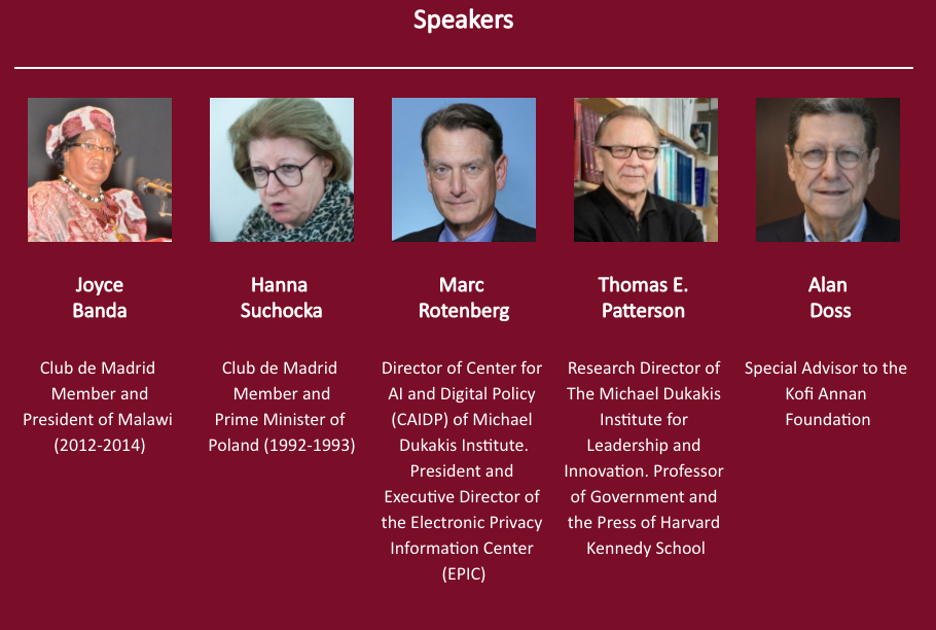
This event is a continuation of the event on August 5, 2020, which was stopped after 35 minutes due to technical problems during Live Session with speakers below:

CENTER FOR AI AND DIGITAL POLICY UPDATE – UNESCO Pursues Humanistic Approach for AI

UNESCO has embarked on a two-year project to develop a global standard for Artificial Intelligence. UNESCO Director General Audrey Azoulay stated, “Artificial intelligence can be a great opportunity to accelerate the achievement of sustainable development goals. But any technological revolution leads to new imbalances that we must anticipate.”

UNESCO recently published a draft Recommendation on the Ethics of Artificial Intelligence. UNESCO stated that the Recommendation “aims for the formulation of ethical values, principles and policy recommendations for the research, design, development, deployment and usage of AI, to make AI systems work for the good of humanity, individuals, societies, and the environment. “The UNESCO draft Recommendation sets out about a dozen principles, five Action Goals, and eleven Policy Actions. Notable among the UNESCO recommendations is the emphasis on Human Dignity, Inclusion, and Diversity. UNESCO also expresses support for Human Oversight, Privacy, Fairness, Transparency and Explainability, Safety and Security, among other goals. Understandably, UNESCO is interested in the scientific, educational, and cultural dimensions of AI, the agency’s program focus.

UNESCO undertook a preliminary public consultation earlier this year and will pursue further consultations with the scientific community, people of diverse cultural backgrounds,  civil society, government and the private sector. UNESCO is well positioned to build on established human rights conventions, including the Universal  Declaration of Human  Rights  (1948),  the UN Convention  on  the Elimination  of  All  Forms  of  Discrimination  against  Women  (1979),  the  UN Convention on the Rights of the Child (1989), and the UN Convention on the Rights of Persons with Disabilities  (2006). UNESCO has also established the Convention on the Protection and Promotion of the Diversity of Cultural Expressions (2005).

Key challenges ahead for UNESCO will include the need to address bias in AI-based systems. It has become increasingly difficult to determine how automated decisions about people are made. The practical consequence can be to reinforce systems of social bias and to create additional barriers to inclusion and diversity. The principle of Transparency and Explainability, already incorporated in the draft Recommendation, will help with this challenge. UNESCO will also need to consider whether the scoring of citizens or the use of AI techniques for mass surveillance are consistent with existing international human rights law or the goal of human dignity. Human rights groups have urged international organizations and national government to establish legal standards for AI systems, warning that ethical standards do not provide a sufficient basis to safeguard fundamental rights

Marc Rotenberg, Director
Center for AI and Digital Policy at Michael Dukakis Institute

The Center for AI and Digital Policy, founded in 2020, advises governments on technology policy.
OpenAI’s new language generator GPT-3

In June 2020, OpenAI launched GPT-3 (generative pre-training) that is the third generation of the artificial intelligence (AI) model to create documents in the form of API beta, which has attracted a great attention from the community. GPT-3 is the most powerful language model ever, but it has also raised some concerns.

As we know, OpenAI is a non-profit company working on Artificial Intelligence, which is behind big names like Peter Thiel, Elon Musk, Reid Hoffman, Marc Benioff, Sam Altman etc. OpenAI vision is to develop an AGI (Artificial General Intelligence) system, which capable of understanding or learning any intellectual task that humans can.

GPT-3 is essentially a machine learning system with an input of 45TB of textual data (trained on). The model has 175 billion parameters (the values that a neural network tries to optimize during training). It is useful to note that the entire English data of the Wikipedia network is only 0.6% of the amount of data used for model training in GPT-3. GPT-3 is known as the most powerful language model ever, far surpassing GPT-2 launched in late 2019 with only 1.5 billion parameters. After being trained, the system can create all kinds of smart text content that are no different from humans like a story, an article, a programming code, a poem, a piece of music, just with data input as a few words or sentences. Besides, GPT-3 can produce information that we cannot distinguish between human or written creation.

In particular, GPT-3 allows searching documents based on the natural language meaning of queries instead of just searching through keywords in Twitter. GPT-3 helps improve chatbot by enabling complex, fast and consistent natural language discussions, as well as covering a range of topics, from space travel to history. GPT-3 also helps to provide better customer service with the ability to quickly search, chat, respond and provide customers with relevant information through analysis and semantic search. Moreover, GPT-3 can create productivity tools that allow you to analyze text into excel spreadsheets, summarize email discussions and expand the content from bullet points.

With the powerful language model, GPT-3 is one step closer to AGI, although not perfect. This system seems closer to passing the Turing test than any other system so far. Previous AI systems worked well in narrow fields like gaming, but in many areas there was still a great distance. GPT-3 shows impressive ability in many areas, it can learn and perform tasks when only a few examples, when not pre-programmed, it can play chess and GO (all However, it is not very good as special programs), it can write code for computer programs, maybe even design machine learning models. With the rapid progress from GPT-2 to GPT-3, who knows what GPT-4 can do? Human-level AGI may still be decades away, but the timeline seems to be shortening.

However, GPT-3 raises some concerns on ethical system for future GPT-3 deployment. Is GPT-3 really intelligent, contextual, or understandable with human-level? It is not easy to answer this question because of complex human language in enormous number of contexts and settings. Besides, there is a concern on how to avoid use of GPT-3 for malicious purposes such as creating more fake news like real, or helping children cheat in their homework or exam. Moreover, the GPT-3 requires intensive computing power and its performance improves with each iteration, which are might be costly for future commercial product deployment.

As our technology evolution, we probably remember bitcoin and block chain technology, when people find that bitcoin mining could consume electrical energy by a small nation. GPT-3 and machine learning may be impressive AI technology, but sooner or later we still need to figure out its impact on the society if any large scale deployment.

In support of positive AI development and ethics for the society, the Michael Dukakis Institute for Leadership and Innovation (MDI) and Boston Global Forum (BGF) established the Artificial Intelligence World Society (AIWS.net) in 2018. AI can be an important tool to serve and strengthen democracy, human rights, and the rule of law. Its misuse could undermine those ideals. In this effort, MDI invites participation and collaboration with think tanks, universities, non-profits, firms, and other entities that share its commitment to the constructive and development of AI.

MIT Professor in History, Theory, and Criticism of Architecture joins the Board of the History of AI

Professor Caroline A. Jones, MIT, has joined the History of AI Board at AIWS.net. She is a Professor in History, Theory, and Criticism of the Architecture Department at MIT.

She wrote a chapter of the book “Possible Minds: 25 Ways of Looking At AI” (2019), whose co-authors are Judea Pearl, Alex Pentland, Max Tegmark, Stuart Russell, and others. She said “Humans must truly understand intelligence to re-create it”, and “As we enshrine computation as the core of smartness, we would be well advised to think of the complexity of our ‘wet’ cognition, which entails a much more distributed notion of intelligence that goes well beyond the sacred cranium and may not even be bounded by our own skin.”

CENTER FOR AI POLICY Update – European Commission Proposes Four Options for Ethical AI

The European Commission recently announced several options for the regulation of Artificial Intelligence. As the Commission has stated, “Artificial intelligence (AI) is a fast-evolving and strategic technology with tremendous opportunities. However, some of its uses pose specific significant risks to the application of various EU rules designed to protect fundamental rights, ensure safety and attribute liability.” Following a public consultation earlier this year, the Commission has now proposed four options in the Inception Impact Assessment:

  • Option 1 – a non-legislative approach that relies on industry self-regulation
  • Option 2 – voluntary labeling schemes to promote trustworthy applications
  • Option 3 – legal standards for applications ranging from biometric identification, high-risk AI, to all AI applications
  • Option 4 – some combination of the above

Speaking at the G-20 summit last year in Japan, Chancellor Angela Merkel had called for the European Commission to propose comprehensive regulation for artificial intelligence. “It will be the job of the next Commission to deliver something so that we have regulation similar to the General Data Protection Regulation that makes it clear that artificial intelligence serves humanity,” she stated. Incoming  Commission President Ursula von der Leyen echoed these views in December 2019, and recommended new rules on Artificial Intelligence that respect human safety and rights.

The European Commission’s work to promote public participation in decisions concerning AI policy should be commended. AI policy will have far-reaching social and economic consequences. Democratic societies make possible the opportunity for the public to help shape these outcomes. At the same time, AI and human rights experts share the views of Chancellor Merkel, President von don Leyen and others. They have endorsed legal standards for AI (Option 3 in the Commission’s framing), warning that ethical guidance and voluntary frameworks alone will not ensure necessary safeguards. The Universal Guidelines for AI  for example, set out 12 standards for AI governance, including several red lines for certain AI applications, such as profiling and scoring by national governments. Many members of the European Union are also members of the OECD, and have previously endorsed the OECD AI Principles, which seek to promote fundamental rights, democratic institutions, and the rule of law.

The Commission will take public comments on the Ethical and Legal Requirements for AI until 10 September 2020. A final report and action is planned for first quarter 2021.


Marc Rotenberg, Director

Center for AI and Digital Policy at Michael Dukakis Institute

“The Center for AI and Digital Policy, founded in 2020, advises governments on technology policy.”

United Nations 2045 Roundtable – Building A Trustworthy Economy

AI World Society (AIWS.net), the Boston Global Forum (BGF), and United Nations (UN) Academic Impact collaborate to organize the United Nations 2045 Roundtable. This is a content of the United Nations 2045 Initiative. Chief of United Nations Academic Impact and Editor-in-Chief of the UN Chronicle Ramu Damodaran will be the moderator of the roundtable. The content of UN Roundtable is an official content of UN Academic Impact and UN Chronicle Magazine; and will be posted on AIWS.net at AIWS Roundtable.

Guest speakers of UN 2045 Roundtable are leaders, distinguished thinkers, and thought leaders that will discuss new ideas, solutions, recommendations, and suggestions to shape a smart, effective, peaceful, and secure world in 2045. The first UN 2045 Roundtable is the UN Charter Day 2045 Roundtable June 26, 2020 with the topic “A New Social Contract in the Age of AI and Intellectual Society”.

On July 24 2020, the United Nations Academic Impact and the Boston Global Forum are very honored to invite Professor Alex Pentland from MIT as a distinguished speaker together with Mr. Ramu Damodaran as an esteemed moderator on the topic “Building A Trustworthy Economy”. Professor Alex Pentland, Faculty Founding Director of MIT Connection Science, Mentor of AI World Society Innovation Network (AIWS.net), and a co-author of the Social Contract 2020. He is one of the most-cited scientists in the world, and Forbes recently declared him one of the “7 most powerful data scientists in the world” along with Google founders and the Chief Technical Officer of the United States.

As we know, today’s financial systems are not trusted by citizens because they are inherently unstable and winner-take-all, so for most people the system offers only failure.  Today, new digital technologies allow the fine-grain feedback needed to build systems that are dramatically more stable, which reward everyone’s contribution to society, and provide everyone with a realistic opportunity to build a good life.

During the keynote presentation, Professor Alex Pentland presented a new term – “the Trustworthy Economy”, which is the new economy, based on data, digital technologies, and Artificial Intelligence (AI). Data becomes more important and is considered as a “new oil” in our current digital society, especially with the development of AI. Data is only valuable in aggregate, and the value depends on the context. However, it also requires data protection for privacy and data management for world society interests. Thus, Professor Alex initiated a new institution as Data Union for digital identity and ownership rights, audit and accountability and criminal system. Data Union could also monitor governments and companies, as well as support local collectives for leading social reform and innovation.

Following to keynote presentation, we have received well-rounded discussions from excellent panelists including Professor Alex Pentland (MIT), Ramu Damodaran (UN), Nguyen Anh Tuan (Co-founder AIWS.net), Bill Ottman (Co-Founder and CEO of Minds.com), Marc Rotenberg (Director of CAIDP, Michael Dukakis Institute), Anders Corr (Principal of Corr Analytics), Marcel Zutter (Chairman of Parsumo Invest), Allan Cytryn (Former CTO of Goldman Sachs), Anders Hjorth Agerskov (Lead Public Sector Specialist, World Bank), Barry Nolan (Senior Adviser to the US Congress), Jeff Saviano (Global Tax Innovation Leader of EY, MIT Connection Science Fellow), Lyndon Haviland (Chair of the Board of Directors for The CUNY Graduate School of Public Health and Health Policy Foundation), Quy Nguyen (a Member of Young Leaders, AIWS.net). During the roundtable, the panelists also shared the opinions and ideas on how to use and manage data for a good purpose because data is complicated and changing, so institution need to control and manage data such as GDPR for privacy data regulation, data audit for avoiding bias and misuse, as well as easy data transfer with the approval. This also requires a collaboration from citizen, corporation, as well as guidelines from government as well as united nation.

The event “Building A Trustworthy Economy” is a successful initiative on Trustworthy Economy and an important contribution for improving life outcomes and better society. The History of AI Initiative considers Trustworthy Economy a History of AI event also. This is very meaningful for the UN 2045 Initiative.

CENTER FOR AI POLICY Update – OECD’s Gurria Underscores AI Fairness at G-20 Meeting

OECD Secretary General Angel Gurria spoke this week at the G-20 Digital Economy Ministers Meeting in Riyadh, Saudi Arabia. Secretary Gurria, addressing the global challenges of the COVID-19 crisis, urged countries to “use digital technologies to build our economies back in a better way: more resilient, inclusive and sustainable.” He also spoke about the need to bridge the digital divide, to shift to smart mobility practices, and to continue work on measurement of the digital economy. And he promoted the OECD AI Principles, which were endorsed last year by G-20 nations at the summit in Osaka,

“As this year’s G20 AI Dialogue showed,” Secretary Gurria said, “AI’s full potential is still to come. To achieve this potential we must advance a human-centred and trustworthy AI, that respects the rule of law, human rights, democratic values and diversity, and that includes appropriate safeguards to ensure a fair and just society. This AI is consistent with the G20 AI Principles you designed and endorsed last year, drawing from the OECD’s AI Principles.”

The OECD has long been at the forefront of global policy for new technology. Beginning with the influential OECD Privacy Guidelines of 1981, the OECD has set out policy frameworks for cryptography, computer security, risk assessment, consumer protection, and more. Although OECD principles are non-binding they have influenced the development of national law and international agreements. The OECD AI Principles, adopted in 2019, seek to promote:

  • Inclusive growth, sustainable development and well-being.
  • Human-centred values and fairness.
  • Transparency and explainability.
  • Robustness, security and safety.

The OECD has also established the OECD AI Policy Observatory to help countries monitor the responsible development of trustworthy AI systems for the benefit of society.

The work of the OECD reflects a powerful commitment to both economic growth and democratic values. In 2018, Secretary Gurria, received the World Leader in AIWS award from the AI World Society at the Boston Global Forum-G7 Summit Conference


Marc Rotenberg, Director

Center for AI and Digital Policy

“The Center for AI and Digital Policy, founded in 2020, advises governments on technology policy.”