


AI Action Summit: Launch of the “AI Convergence” Challenges

Boston, December 9, 2024 – As part of the AI Action Summit, which will take place in Paris on February 10–11, 2025, France has launched the “AI Convergence” Challenges to showcase the dynamism of academic and industrial ecosystems and the global foundation of their innovations.

The goal of these challenges is to promote projects that tackle ambitious technological problems or societal issues, demonstrating the value of AI for humanity as a whole. This initiative also represents a significant opportunity to unite ecosystems, foster a shared vision, and generate stimulating ideas and solutions around this transformative technology. AI Convergence is already underway, showcasing its potential as both an accelerator and a differentiator.

Researchers, engineers, entrepreneurs, and innovators from all sectors: if you have an ambitious project that addresses unresolved issues using AI, respond to this call by submitting your challenge! Selected projects will receive significant visibility during the summit period.

Five Themes to Address AI Challenges

The challenges aim to foster innovative solutions in the following priority areas of the Summit:

  • Public Interest AI
  • Future of Work
  • Innovation and Culture
  • Trust in AI
  • Global AI Governance

The AI Action Summit, hosted by France on February 10–11, 2025, will spotlight concrete actions ensuring that AI development and deployment benefit society, the economy, and the environment while upholding the common good. The summit will bring together Heads of State and Government, leaders of international organizations, CEOs of small and large companies, representatives of academia, non-governmental organizations, artists, and members of civil society.

In his acceptance speech for the 2024 World Leader for Peace and Security Award, organized by the Boston Global Forum on November 25, 2024, at Harvard University’s Loeb House, President Macron shared his vision for global collaboration and technological advancement:

“I invite you all to Paris for our Summit for Action on AI in February: economic actors, decision-makers, and thinkers—we must create global consensus and make decisions at the right pace and on the right scale.

In this regard, your quest for Enlightenment on a global scale can only resonate in France, in this pursuit of progress against all forms of obscurantism.

I believe in our collective capacity to put technology at the service of protecting our democracies and to forge a new era of prosperity, freedom, and stability in the world. I believe, like you, that we cannot and must not renounce our humanism and our Enlightenment ideals for the coming century.

Thank you all for your unwavering commitment.

Thank you for this award, which honors France and compels us to act collectively starting this February in Paris.”

In alignment with President Macron’s vision, the Boston Global Forum will contribute to the upcoming AI Action Summit with its pioneering initiative, “AIWS Government 24/7”. This initiative aims to support continuous, around-the-clock governance through advanced artificial intelligence, enhancing decision-making and operational efficiency for global leaders.


BGF Conference Keynote: Ambassador Audrey Tang on ‘AIWS and Taiwan—AI for Democracy

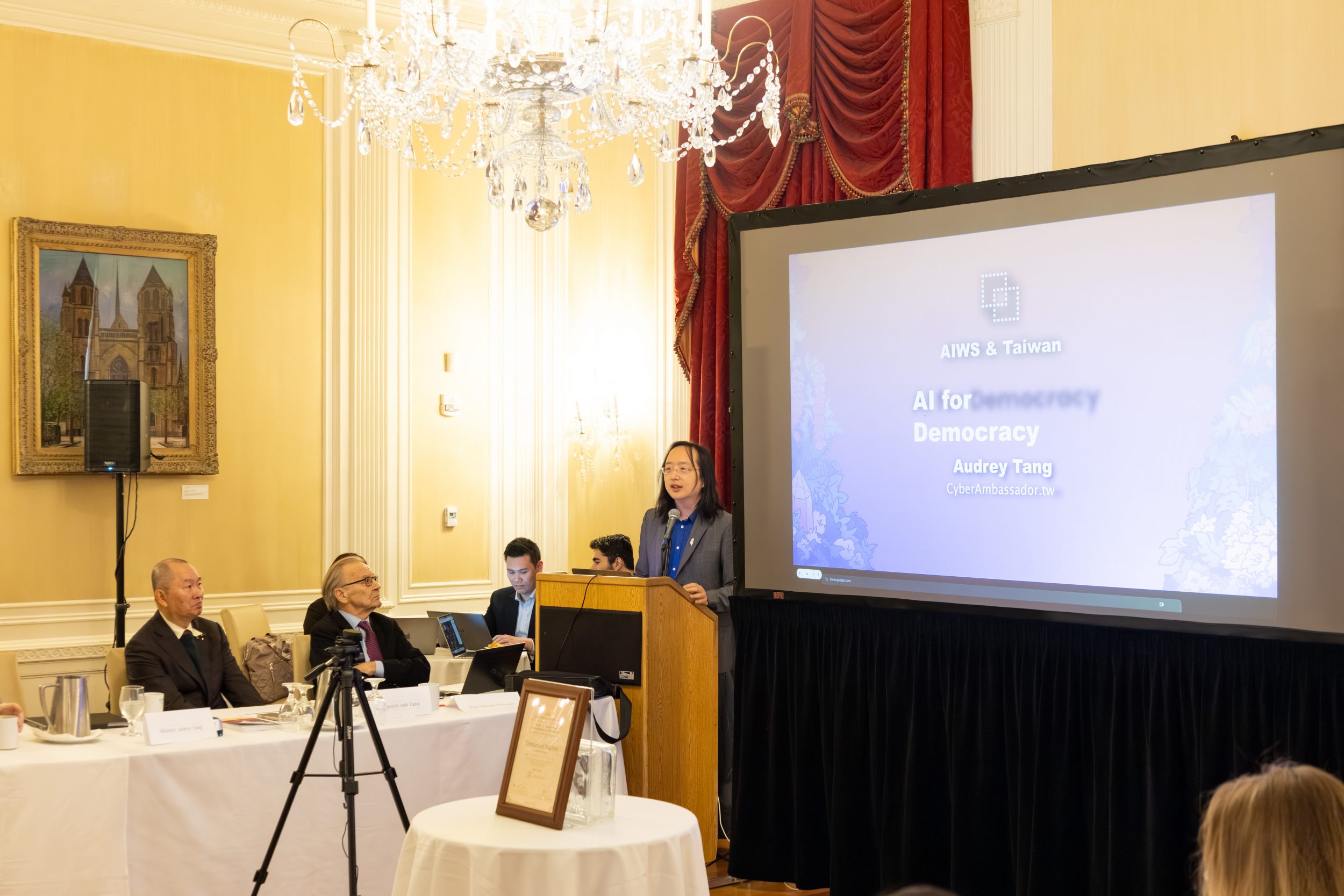
On November 25, 2024, at the Boston Global Forum (BGF) event held at Harvard University’s Loeb House—which featured the Ceremony Honoring French President Emmanuel Macron with the 2024 World Leader for Peace and Security Award and the “AI World Society (AIWS) – New Democracy” Conference—Ambassador Audrey Tang, former Minister of Digital Affairs of Taiwan, delivered a keynote speech titled “AIWS and Taiwan: AI for Democracy”.

Please download her slides here

AI World Society – New Democracy

AIWS Government: Reforming and Innovating Governance

The AIWS Government model represents a transformative approach to governance, leveraging AI technologies to address the challenges faced by traditional political systems. It aims to create government structures that are efficient, transparent, and responsive to the needs of citizens. By integrating AI into governmental operations, the AIWS Government seeks to enhance service delivery, improve policy-making processes, and foster greater citizen engagement.

Key Features of AIWS Government

  1. 24/7 Operations with AI Assistance
    • Shift-Based Model: Implementing a three-shift system supported by AI allows government services to be accessible at all times, ensuring that citizens can receive assistance whenever they need it.
    • AI Support: AI-powered chatbots and virtual assistants handle routine inquiries, providing instant support and information.
  1. AI-Driven Policy Making
    • Big Data Analytics: Utilizing vast datasets to make informed, evidence-based decisions.
    • Real-Time Adaptation: AI tools enable policies to be adjusted in real-time based on current data and trends.
    • Predictive Insights: Anticipating future challenges and opportunities through AI forecasting.
  1. Enhancing Transparency and Accountability
    • AI and Blockchain Integration: Providing secure and transparent transactions, ensuring data integrity.
    • Open Data Initiatives: Encouraging citizen participation by making government data accessible and understandable.
    • Citizen Feedback Mechanisms: AI analyzes public input to improve services and policies.
  1. Smart Governance Models
    • Automation of Routine Tasks: AI handles administrative functions, allowing staff to focus on complex issues.
    • Resource Optimization: Efficient allocation of resources based on AI analysis.
    • Interdepartmental Coordination: AI facilitates communication and collaboration across government agencies.
  1. Citizen Engagement and Participation
    • AI-Powered Platforms: Facilitating public consultations, virtual town halls, and personalized communication.
    • Personalized Services: Tailoring government services to individual citizen needs.
    • Inclusive Access: Ensuring services are accessible to all, including those with disabilities or in remote areas.

Boston Areti AI (BAI): A Pioneering Program for AIWS-New Democracy

Boston Areti AI (BAI) is an advanced artificial intelligence agent developed under the AIWS framework by the Boston Global Forum (BGF). Named after the Greek word “Areti,” meaning “virtue,” BAI embodies the principles of ethical AI, aiming to assist government leaders in their professional roles and personal lives.


IBM Launches Its Most Advanced Quantum Computers, Fueling New Scientific Value and Progress Towards Quantum Advantage

IBM has announced the launch of its most advanced quantum computers to date, marking a significant milestone in the pursuit of quantum advantage. The new systems, including the IBM Quantum Heron—the company’s first qubit chip with a new design—promise to accelerate the development of quantum computing applications across various industries. These advancements are expected to unlock new scientific value and pave the way for breakthroughs in fields such as artificial intelligence, cryptography, and complex system modeling.

In light of these groundbreaking developments, the Boston Global Forum (BGF) has invited esteemed guests, thought leaders, and innovators to their High-Level Discussion on “The Convergence of AI Chips and Quantum Computing for a New Democracy – AIWS.” This gathering is dedicated to exploring the frontiers of technology and its profound impact on the fabric of our global society.

The event will adopt a flexible format, beginning with meetings and discussions starting on November 3, 2024. The dialogue will continue on November 25, 2024, at the BGF Conference at Harvard University’s Loeb House. Subsequent discussions with distinguished leaders and innovators will culminate in a Special Report to be presented at the BGF Conference “Strategies for Democracy to Win in the AI Battle” in late April 2025. This report aims to contribute to building the AI World Society (AIWS) economic model.

For more information on IBM’s latest quantum computing advancements, you can read the full announcement here.

AI Agents and Boston Areti AI (BAI)

In recent years, many of us have enjoyed the convenience of AI assistants that retrieve information and perform basic tasks. However, a new generation of technology is emerging: AI agents, capable of much more than simple queries. These advanced AI models and algorithms can autonomously make decisions in real time, navigate complex scenarios, and seamlessly interact with various applications and platforms. Leading AI labs worldwide are racing to develop agents with enhanced reasoning, extended memory, and heightened interactivity.

The Boston Global Forum (BGF), through its AI World Society Initiative, pioneered the concept of AI Assistants in its Social Contract for the AI Age (2020). Building on this foundation, BGF has introduced Boston Areti AI (BAI)—an AI agent specifically designed to support and empower leaders. This innovation represents a significant step toward dynamic, decision-making AI dedicated to advancing human well-being, fostering compassion and innovation, and embedding core human values in its service to citizens worldwide.

https://www.ibm.com/think/topics/ai-agents

https://www.arthur.ai/blog/are-ai-agents-the-future-of-intelligent-systems#:~:text=What%20Are%20AI%20Agents?,game%20or%20in%20a%20robot.

https://www.theverge.com/2024/10/10/24266333/ai-agents-assistants-openai-google-deepmind-bots

The Convergence of AI Chips and Quantum Computing for a New Democracy – AIWS

The AI World Society (AIWS) is organizing high-level discussions on “The Convergence of AI Chips and Quantum Computing for a New Democracy – AIWS.” This program aims to explore how the integration of advanced technologies like AI chips and quantum computing can contribute to the development of a new democratic model that emphasizes innovation, security, and global cooperation.

Quantum Computing’s Potential to Solve Global Challenges

Quantum computing holds the promise of addressing some of the world’s most complex problems due to its ability to perform calculations at speeds unattainable by classical computers.

https://www.techtimes.com/articles/308077/20241101/how-quantum-computing-could-solve-worlds-biggest-problems.htm

Advancements in Quantum Computing and Machine Learning

The collaboration between companies like Quantum Machines and NVIDIA highlights significant progress in the field. As reported in “Quantum Machines and NVIDIA Use Machine Learning to Get Closer to an Error-Corrected Quantum Computer,” these organizations are leveraging machine learning to improve quantum error correction. This advancement is crucial because:

https://techcrunch.com/2024/11/02/quantum-machines-and-nvidia-use-machine-learning-to-get-closer-to-an-error-corrected-quantum-computer/

Transforming the Cryptocurrency Market with Quantum AI

The article “How Quantum AI is Transforming the Cryptocurrency Market” discusses the impact of quantum computing and AI on digital currencies:

  • Enhanced Security: Quantum computing can both threaten current cryptographic methods and provide new, more secure encryption techniques.
  • Efficient Transactions: Quantum algorithms can optimize transaction processing, reducing costs and increasing speed.
  • Market Analysis: AI combined with quantum computing can analyze vast amounts of market data to predict trends and inform investment strategies.

https://breakingthelines.com/opinion/how-quantum-ai-is-transforming-the-cryptocurrency-market/

Implications for a New Democracy

The convergence of AI chips and quantum computing has profound implications for developing a New Democracy, as envisioned by AIWS:

  • Enhanced Decision-Making: Governments can leverage these technologies for data-driven policy-making, leading to more effective governance.
  • Cybersecurity: Improved encryption and security protocols protect democratic institutions from cyber threats.
  • Economic Growth: Technological advancements stimulate innovation and competitiveness, contributing to a robust economy.
  • Global Collaboration: Shared technological progress fosters international cooperation, promoting peace and mutual understanding.

The integration of AI chips and quantum computing represents a significant step toward addressing global challenges and enhancing democratic societies. By exploring these frontiers, AIWS is contributing to a vision of a New Democracy that harnesses technological advancements for the common good, ensuring that progress benefits everyone and upholds the principles of ethics and responsibility.

By focusing on these developments, AIWS and its partners aim to ensure that the convergence of AI and quantum computing technologies contributes positively to society and supports the establishment of a fair, secure, and prosperous global community.

OpenAI disbands another safety team, as head advisor for ‘AGI Readiness’ resigns

OpenAI is disbanding its “AGI Readiness” team, which advised the company on OpenAI’s capacity to handle artificial intelligence that could potentially equal or surpass human intellect and the world’s readiness to manage such technology.

Miles Brundage, senior advisor for AGI Readiness, announced his departure from the company and wrote that he believes his research will be more impactful externally.

In May, OpenAI decided to disband its Superalignment team, which focused on technology to control and steer superintelligent AI, just one year after it announced the group.

https://www.cnbc.com/2024/10/24/openai-miles-brundage-agi-readiness.html

The AI World Society (AIWS) Model seeks to build a safer, better world with AI. We encourage and call upon companies to uphold their responsibility to humanity in creating and conducting business with AI applications. AGI represents significant progress in AI, and it requires our commitment to duty and responsibility toward humanity and our world.

Silicon Valley Takes Artificial General Intelligence Seriously—Washington Must Too

First, Washington needs to start taking AGI seriously. The potential risks are too great to ignore. Even in a good scenario, AGI could upend economies and displace millions of jobs, requiring society to adapt. In a bad scenario, AGI could become uncontrollable.

Second, we must establish regulatory guardrails for powerful AI systems. Regulation should involve government transparency into what’s going on with the most powerful AI systems that are being created by tech companies. Government transparency will reduce the chances that society is caught flat-footed by a tech company developing AGI before anyone else is expecting. And mandated security measures are needed to prevent U.S. adversaries and other bad actors from stealing AGI systems from U.S. companies. These light-touch measures would be sensible even if AGI weren’t a possibility, but the prospect of AGI heightens their importance.

In a particularly concerning part of Saunders’ testimony, he said that during his time at OpenAI there were long stretches where he or hundreds of other employees would be able to “bypass access controls and steal the company’s most advanced AI systems, including GPT-4.” This lax attitude toward security is bad enough for U.S. competitiveness today, but it is an absolutely unacceptable way to treat systems on the path to AGI. The comments were another powerful reminder that tech companies cannot be trusted to self-regulate.

Finally, public engagement is essential. AGI isn’t just a technical issue; it’s a societal one. The public must be informed and involved in discussions about how AGI could impact all of our lives.

BGF has been pioneering the AI World Society (AIWS) since 2017.

Daniel Colson

https://time.com/7093792/ai-artificial-general-intelligence-risks/

Boston Global Forum Statement on AI Pioneers Winning the Nobel Prizes in Physics and Chemistry

The Boston Global Forum (BGF) extends its heartfelt congratulations to the pioneers in artificial intelligence who have been awarded the Nobel Prizes in Physics and Chemistry in 2024. This monumental achievement underscores the transformative impact of AI on advancing scientific discovery and addressing some of humanity’s most pressing challenges.

Recognition of AI’s Role in Nobel Prizes

  • Physics Nobel Prize: The integration of AI in physics has opened new horizons in understanding complex phenomena, leading to breakthroughs once thought unattainable. The laureates’ work exemplifies how AI can augment human ingenuity to unravel the mysteries of the universe.
  • Chemistry Nobel Prize: The award honors scientists who have harnessed AI to design proteins—the fundamental building blocks of life. This innovation accelerates drug discovery and has profound implications for medicine, biotechnology, and understanding biological processes.

BGF as a Pioneer of the AI World Society Model

As a pioneer of the AI World Society (AIWS) model, the Boston Global Forum has been at the forefront of advocating for the ethical governance and responsible development of AI technologies since 2017, notably with the Social Contract for the AI Age. This foundational framework sets forth principles to guide AI development in a manner that promotes transparency, accountability, and aligns with human-centric values.

The AIWS model envisions a world where AI is harnessed to enhance human welfare, uphold democratic values, and contribute positively to global society. Through initiatives like conferences, policy development, and collaborative projects, BGF actively works to ensure that AI technologies benefit all of humanity.