Could Metasurfaces Be The Next Quantum Information Processors?

Researchers blend theoretical insight and precision experiments to entangle photons on an ultra-thin chip

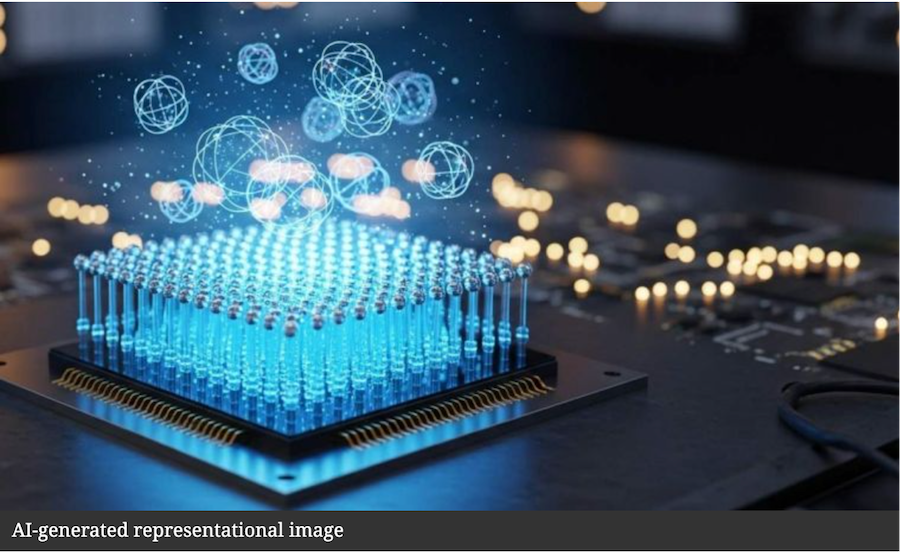
In the race toward practical quantum computers and networks, photons — fundamental particles of light — hold intriguing possibilities as fast carriers of information at room temperature. Photons are typically controlled and coaxed into quantum states via waveguides on extended microchips, or through bulky devices built from lenses, mirrors, and beam splitters. The photons become entangled – enabling them to encode and process quantum information in parallel – through complex networks of these optical components. But such systems are notoriously difficult to scale up due to the large numbers and imperfections of parts required to do any meaningful computation or networking.

Could all those optical components could be collapsed into a single, flat, ultra-thin array of subwavelength elements that control light in the exact same way, but with far fewer fabricated parts?

Optics researchers in the Harvard John A. Paulson School of Engineering and Applied Sciences(SEAS) did just that. The research team led by Federico Capasso, the Robert L. Wallace Professor of Applied Physics and Vinton Hayes Senior Research Fellow in Electrical Engineering, created specially designed metasurfaces — flat devices etched with nanoscale light-manipulating patterns —  to act as ultra-thin upgrades for quantum-optical chips and setups.

Please see full here: https://seas.harvard.edu/news/2025/07/could-metasurfaces-be-next-quantum-information-processors

Operationalizing AI Ethics: From Principles to Practice

In the Shaping Futures section of this week’s BGF Weekly, we spotlight the influential article “Operationalizing AI Ethics Principles” by Dr. Cansu Canca, published in the Communications of the ACM.

Dr. Canca addresses one of the most pressing challenges in AI governance today: how to translate ethical principles into actionable practices within organizations developing and deploying AI. As ethical declarations proliferate, real-world mechanisms to enforce, monitor, and assess AI ethics remain limited. This article outlines pathways to embed ethics directly into AI development lifecycles, ensuring that principles are not just symbolic but operational and measurable.

At the Boston Global Forum (BGF) and within the AI World Society (AIWS), this work resonates deeply with our efforts — from the AIWS 7-Layer Model of AI Ethics to the Boston Finance Accord for AI Governance 24/7 — to build frameworks where ethics guide innovation systematically and transparently.

Dr. Canca’s approach offers valuable insights for leaders, innovators, and policymakers seeking to ensure that AI technologies are developed with accountability, fairness, and societal benefit at their core.

📌 Read the full article:
https://cacm.acm.org/opinion/operationalizing-ai-ethics-principles/

Elon Musk vows to start a new political party after Trump feud. Here’s why that’s harder than it sounds

Elon Musk’s threat to start a third major political party has been met with widespread skepticism, as critics pointed to numerous failed bids over decades to disrupt America’s two-party system.

As billionaire Elon Musk feuds with President Trump over his signature tax and domestic policy legislation, Musk has reupped his calls to launch a new political party — a daunting task even for the wealthiest person on Earth.

Musk first floated launching a third party, dubbed the “America Party,” earlier this month, part of a nasty back-and-forth between the president and the Tesla CEO that marked the likely end of their political alliance. Musk raised the idea again this week as lawmakers raced to send the One Big Beautiful Bill Act to Mr. Trump’s desk — and this time, Musk put a time limit on the plan.

“Only the richest person in the world could make a serious effort at creating a new American political party,” Brett Kappel, a veteran election lawyer, told CBS News.

Navigating 50 different state laws — and federal rules

“Political parties are creatures of the states,” Kappel said.

Each state has different legal rules for recognizing which political parties can appear on the ballot, and those hurdles “range from high to extraordinarily difficult to overcome,” he noted. In some cases, a nascent state party may need to get candidates onto the ballot by submitting large numbers of signatures, and then win a certain percentage of the vote across election cycles.

Please see full here:

https://www.cbsnews.com/news/elon-musk-new-america-political-party-trump-feud-harder-than-it-sounds/

https://www.washingtonpost.com/technology/2025/07/02/elon-musk-third-party-trump/

Setting the Stage for Global Harmony: First Official Discussion on the AIWS Music for Humanity Movement

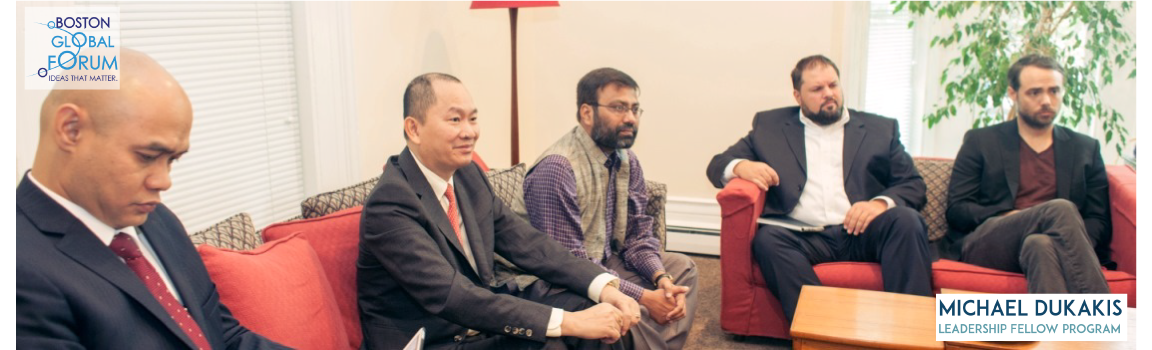
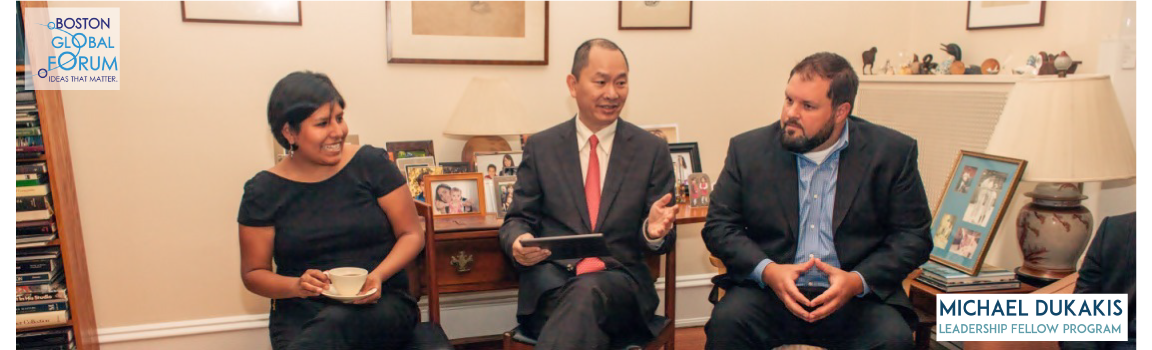
On July 4, 2025, a landmark discussion will officially launch the vibrant AIWS Music for Humanity Movement. Bridging continents and cultures, this inaugural discussion will connect leaders and artists across diverse locations, including Boston, Nha Trang, Tokyo, Lake Como, Paris, and Tromsø (Northern Norway).

At the heart of this global conversation will be Governor Michael Dukakis and Mr. Nguyen Anh Tuan, alongside an esteemed group of musicians and newly appointed Ambassadors for the AIWS Music for Humanity. Their collective dialogue will lay the groundwork for the upcoming AIWS Music for Humanity Forum, exploring how the universal language of music, amplified by the ethical advancements of AI, can foster peace, compassion, and understanding in our world. One key topic for discussion will be precisely how the AIWS Music for Humanity will contribute to shaping a better world in the AI Age. This session marks a pivotal step in harnessing artistic expression to advance the human-centered vision of the AI World Society.

Photonic processor could streamline 6G wireless signal processing

By performing deep learning at the speed of light, this chip could give edge devices new capabilities for real-time data analysis.

As more connected devices demand an increasing amount of bandwidth for tasks like teleworking and cloud computing, it will become extremely challenging to manage the finite amount of wireless spectrum available for all users to share.

Engineers are employing artificial intelligence to dynamically manage the available wireless spectrum, with an eye toward reducing latency and boosting performance. But most AI methods for classifying and processing wireless signals are power-hungry and can’t operate in real-time.

Now, MIT researchers have developed a novel AI hardware accelerator that is specifically designed for wireless signal processing. Their optical processor performs machine-learning computations at the speed of light, classifying wireless signals in a matter of nanoseconds.

The photonic chip is about 100 times faster than the best digital alternative, while converging to about 95 percent accuracy in signal classification. The new hardware accelerator is also scalable and flexible, so it could be used for a variety of high-performance computing applications. At the same time, it is smaller, lighter, cheaper, and more energy-efficient than digital AI hardware accelerators.

The device could be especially useful in future 6G wireless applications, such as cognitive radios that optimize data rates by adapting wireless modulation formats to the changing wireless environment.

Tech billionaires are making a risky bet with humanity’s future

Sam Altman, Jeff Bezos, Elon Musk, and others may have slightly different goals, but their grand visions for the next decade and beyond are remarkably similar.

They include aligning AI with the interests of humanity; creating an artificial superintelligence that will solve all the world’s most pressing problems; merging with that superintelligence to achieve immortality (or something close to it); establishing a permanent, self-­sustaining colony on Mars; and, ultimately, spreading out across the cosmos.

Three features play a central role with powering these visions, says Adam Becker, a science writer and astrophysicist: an unshakable certainty that technology can solve any problem, a belief in the necessity of perpetual growth, and a quasi-religious obsession with transcending our physical and biological limits.

In his timely new book, More Everything Forever: AI Overlords, Space Empires, and Silicon Valley’s Crusade to Control the Fate of Humanity, Becker reveals how these fantastical visions conceal a darker agenda.

https://www.technologyreview.com/2025/06/13/1118198/agi-ai-superintelligence-billionaires/?utm_source=the_download&utm_medium=email&utm_campaign=the_download.unpaid.engagement&utm_term=&utm_content=06-13-2025&mc_cid=ba57858a89&mc_eid=be5202f3c7

Boston Global Forum Announcement:“Amplifying Human Creativity and Problem Solving with AI Through Generative Collective Intelligence”

The Boston Global Forum (BGF) is pleased to introduce a groundbreaking new paper by BGF Board Member Professor Alex Pentland and BGF Contributor Thomas Kehler, titled:

“Amplifying Human Creativity and Problem Solving with AI Through Generative Collective Intelligence”

This insightful work explores how AI—when designed as a facilitator of Generative Collective Intelligence—can significantly enhance human creativity, collaboration, and complex problem-solving. The paper offers a powerful framework for building systems that combine human insight and machine learning to support democratic governance, innovation, and ethical decision-making in the Age of AI.

As part of BGF’s continued mission to shape a human-centered future with AI, we encourage scholars, technologists, and policymakers to engage with this important contribution.

📄 Read the full paper: https://arxiv.org/pdf/2505.19167

📧 For media or academic inquiries: [email protected]

Please see full here:

https://arxiv.org/pdf/2505.19167

Post-CMOS Photonic Integration

Anna Lena Schall-Giesecke

Integrated photonics leveraging CMOS technology could help pioneer the future of sensing and computing.

Photonics is rapidly transforming electronics, opening doors to faster, more energy-efficient and robust systems. At the heart of this transformation is CMOS technology—the backbone of modern electronics. CMOS chips are used in everything from smartphones to supercomputers, thanks to their low power consumption and scalability. Integrating photonics directly onto CMOS circuits takes this a step further by combining the precision of light-based systems with the reliability of CMOS electronics.

Please read full here:

https://www.optica-opn.org/home/articles/volume_36/june_2025/departments/post-cmos_photonic_integration/?src=hpmiddle

AI learns how vision and sound are connected, without human intervention

This new machine-learning model can match corresponding audio and visual data, which could someday help robots interact in the real world.

“We are building AI systems that can process the world like humans do, in terms of having both audio and visual information coming in at once and being able to seamlessly process both modalities. Looking forward, if we can integrate this audio-visual technology into some of the tools we use on a daily basis, like large language models, it could open up a lot of new applications,” says Andrew Rouditchenko, an MIT graduate student and co-author of a paper on this research.

A new approach developed by researchers from MIT and elsewhere improves an AI model’s ability to learn in this same fashion. This could be useful in applications such as journalism and film production, where the model could help with curating multimodal content through automatic video and audio retrieval.

https://news.mit.edu/2025/ai-learns-how-vision-and-sound-are-connected-without-human-intervention-0522