
BGF
Conversations with Michael Dukakis: The Manager and the Chief Political Executive
Conversations with Michael Dukakis: The Manager, Legislators, and Public Officials
Conversations with Michael Dukakis: Ethics and Corruption
Conversation with Michael Dukakis: Assessing and Changing the Organization
Dukakis helps to teach session of HLS Negotiation Workshop
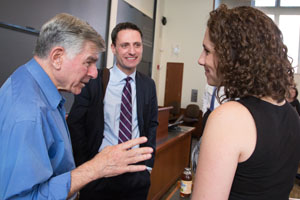
Governor Dukakis with Clinical Professor Robert Bordone ’97 (center), the course’s lead instructor and director of the Harvard Negotiation and Mediation Clinical Program
According to former Massachusetts Governor Michael Dukakis ’60, tackling most public policy challenges begins with the same steps.
“Make a list, create a working group,” Dukakis said. “Bring these folks together. See if you can at least begin by getting agreement on what the problem is. If you do that, you’re halfway to a solution.”
Dukakis, who was the Democratic nominee for president in 1988 and is now a professor of political science at Northeastern University, visited a session of Harvard Law School’s Negotiation Workshop in late April to lead discussion of a case study and answer student questions. Along the way, he shared anecdotes from his time as the longest-serving governor of Massachusetts and ideas about negotiation gleaned from a long career in public life.
The case under discussion came directly from real life: In 1970 a developer in Boston proposed an urban renewal project for the Park Plaza area south of Boston Common. It was a time, recalled Dukakis, when Boston was “angry” and “falling apart.” The city contemplated using its eminent domain power to obtain the land, but numerous neighborhood organizations opposed the demolition of the historical buildings in the area.
What’s a good negotiator to do in a situation like this? Make a list, Dukakis said. This list, he said, should include all of the individuals with an interest in the problem—business community members, representatives from all levels of government, media, private citizens and others.
The key players must then come together, he said—all of them, even the ones who cannot stand each other, “eyeballing each other around the table”—and work to build consensus.
But that’s just the beginning of the process. In the end, Dukakis explained over the course of the class, the Park Plaza proposal collapsed, the result of a failure by the key players to work together properly.
In successful working groups, Dukakis said, trust develops naturally when the parties listen to one another, care about others’ opinions and genuinely believe they are being respected. And at the conclusion of a successful working group, everyone involved should get an equal share of the credit for the result. As a result of such a process, those involved feel a sense of ownership over the project and will be willing to participate in the political legwork that comes next.
Over the course of his governorship, Dukakis said, he initiated and participated in such working groups, which both built trust within the government and tackled substantive policy issues.
During his second governorship (Dukakis first served from 1975 to 1979 and again from 1983 to 1991), he said, the law enforcement community in Massachusetts was internally fractured, with acrimonious relations among the various offices. On the advice of John Kerry, then lieutenant governor of Massachusetts, Dukakis convened a Governor’s Anti-Crime Council, bringing together key individuals in the Massachusetts criminal justice system along with non-law enforcement personnel. With Dukakis as chair and Kerry as vice chair, the council met each month for half a day. Within a year, the council began to do significant work. One member, a civil rights and civil liberties lawyer, approached Dukakis and told him she was worried: After working with the police officers up close, she was beginning to like them.
According to Dukakis, convening the anti-crime council was “one of the best things” he ever did.
At another point during his governorship, when relations between state and local government were acrimonious, Dukakis created an advisory committee made up of 25 local government representatives who met once a month. This committee, too, worked at improving relations among its members, and began to create good policy, he said.
Nevertheless, even a well-designed, good faith process may not always work, Dukakis acknowledged.
“Some cases, you simply have to say: ‘we’ll agree to disagree, and see you on the floor of the legislature,’” he said. “But don’t burn your bridges.”
HLS Clinical Professor Robert Bordone ’97, the course’s lead instructor and director of the Harvard Negotiation and Mediation Clinical Program, agreed.
Throughout his visit, Dukakis humorously took issue with some of the typical vocabulary of negotiation—he dislikes the word “negotiation” itself, believing it connotes a kind of antagonism, and prefers the term “key player” to “stakeholder.” But at core, Bordone said, Dukakis’ advice dovetailed with the lessons of the course.
“Gov. Dukakis’ visit brought home to our students many of the most important lessons for negotiators: the importance of involving all the involved parties, of listening carefully to constituent concerns and of establishing a fair and transparent process,” Bordone commented.
More broadly, Dukakis urged students in the workshop to enter the public sector and use their skills to build consensus around important public policy issues.
“There’s nothing like it,” he said. “To be in a position where you can make a difference in the lives of your fellow citizens is one of the rare privileges of public life.”
The US politician and the aspiration of globalizing Vietnamese businesses
APRIL 15, 2013, BY
In the interview given to VietNamNet, Professor Michael Stanley Dukakis, former U.S. presidential candidate, former Governor of Massachusetts State in the US, now the Professor of some universities in Boston, said he hopes many Vietnamese businessmen would realize that Boston is their second homeland.
The worldly politician is now in Vietnam to attend the 500 fastest growing enterprises (FAST500) report launching ceremony held in Hanoi on April 9, 2013.
Could you please tell us the secrets that helped make Massachusetts a world’s leading high technology center?
Until the day I took the office as the state’s governor for the first time in late 1975, Massachusetts was just a normal industrial state with the second highest unemployment rate in the US.
There were many things to be done to turn Massachusetts into a high technology center. However, there were two main things which were developing the infrastructure and strengthening the education and training so as to attract the high quality labor force to the state to make research and work.
The big advantage that Massachusetts had at that time was that it had big and well known universities in Boston, including Harvard and medical schools, which have been training the high quality labor force not only for the US, but for the whole world as well.
In order to attract talents to Massachusetts, it is necessary to create a high quality living environment for them, while the most important factors are the green atmosphere and the preserved and promoted cultural and historical value.
A report showed that 50 out of every 100 PhDs coming to Boston to follow their studies and research would decide to stay there to continue their works.
In a letter to the Vietnamese businesses in the FAST 500 list, you, as a Member of the Board of Directors of the Boston Culture Fund wrote–that Boston is an ideal place that welcomes Vietnamese businesses. You also wrote that you hope Boston would be the second homeland in the eyes of many Vietnamese businessmen. Could you please elaborate on this?
Boston now is a world’s leading high technology center, where there are a lot of global high technology groups, many good training centers and the high quality labor force.
All these could serve as the firm foundation for Vietnamese businesses to use to turn themselves into global groups.
If so, Boston would be like a nerve center which would carry out the research and development of products and brands for Vietnamese businesses, so that they can reach out to the global market and go back to Boston, which, by that time, would be their second homeland. With the great love to Vietnam, I wish to see this to happen.
At the university where I am working, there are many excellent Vietnamese students, while my neighbor is also a Vietnamese, who is a healthcare expert. I hope there would be many successfulVietnamese businesses in Boston.
Someone asked me why Vietnam, a coffee production power which can make very delicious coffee, still has not become a global brand. This is also a surprise to me. I wish we can cooperate on the matter.
Vietnamese are still very fledgling and weak. Will do you think they be able to develop in Boston?
It’s true that Vietnamese businesses are still young with weak corporate governance skills. Therefore, they have been ineffectively using the resources and have low competitiveness.
So it would be not easy for them to develop their business in Boston. They need to follow the right way to do that, or their efforts would be profitless. As the Director of the Global Boston Forum, I can say that I am willing to help Vietnamese businesses in this issue.
Vietnam always wishes to develop the industries using high technologies. What will it need to do to reach that end?
As I said above, it’s necessary to develop infrastructure and education. I can see many high rise buildings in Hanoi and HCM City. However, the high rise buildings may cause traffic jam and pollution. We don’t do this in Boston, no high rise buildings or highway. The money reserved for such projects could be used to develop other convenient transport means such as subways or tramcars.
Would give some advices to Vietnamese businesses in the context of the Vietnam’s deeper integration into the world?
Trying to obtain bigger market share should not be the most important thing businesses should strive to. The most important thing for them is to improve, upgrade the quality of products and unceasingly create added values. The world has been developing everyday, and Vietnam should not stand outside the development trend.
* Professor Michael Stanley Dukakis was the Governor of Massachusetts for three terms, which recorded the hallmark of his brilliant leadership with “the Massachusetts miracle”. In 1980s, Massachusetts witnessed the strong development on the basis of the high technologies and finance services.
To date, he has always been one of the influential faces in Massachusetts state and the whole US country.
Michael Stanley Dukakis began his first term as Massachusetts’ governor in 1975 and he was re-elected as the state’s governor in 1982 and 1986.
He was the presidential candidate of the Democrats, Bush father’s rival in the race for the White House in 1988.
Tran Thuy
Former Massachusetts Governor Michael Dukakis advises HSPH students on public sector leadership
November 28, 2011 — “Don’t let anybody tell you that you can’t make a difference in public service,” former Massachusetts Governor Michael Dukakis told an audience of HSPH students. Dukakis came to HSPH on November 17, 2011, as part of the ongoing “Decision-Making: Voices From the Field” speaker series, which provides students with the opportunity to engage with leaders in a variety of fields.
Dukakis made an impassioned argument for the role of government policy in improving people’s lives. He recalled growing up in the Boston suburb of Brookline at a time when the national high school dropout and infant mortality rates were much higher and Boston was “dirty, angry, and declining.” Dukakis told the students, “The fact that things are better now has a lot to do with people like you who decided they wanted something better and worked like hell to achieve it.”
Anyone going into public service must “have passion for the job,” Dukakis said. “You’ve got to care deeply. If you don’t, forget it.” He offered students a number of career tips: Work to master the complex political environment; involve key players, including constituents and advocacy groups, in policymaking discussions from the beginning; develop skills as coalition builders and communicators; learn to work with the media; and prioritize a happy home life no matter how busy the day.
Effectively framing an issue in a way that connects with the public is crucial, Dukakis said. He blamed the political problems facing implementation of the health care reform law on a failure by the White House and the Democrats in Congress to effectively communicate its benefits. From the beginning, they should have been talking about providing working people and their families with decent, affordable health care, he said.
Dukakis praised HSPH’s John McDonough, who was sitting in the audience, as someone who knows how to get things done in the public sector. McDonough, director of the HSPH Center for Public Health Leadership, worked with Dukakis as a member of the Massachusetts House of Representatives, where he co-chaired the Joint Committee on Health Care. Later, he served as Executive Director of Health Care For All, Massachusetts’ leading consumer health advocacy organization, where he played a key role in passage and implementation of the 2006 Massachusetts health reform law.
Dukakis on a New Quest
Ex-presidential candidate says he is on a mission to energize young political scientists at UCLA and other campuses, where there is a resurgence of interest in public policy.
February 03, 1999|KENNETH R. WEISS | TIMES EDUCATION WRITER
Walking across the UCLA campus, Michael Dukakis attracts no notice. No flashes of recognition spread across the youthful faces. No knowing looks.
He slips into a meeting of student activists for a quick chat and poses a question to the assembled students: “How old were you when I ran for president?”
“Eight,” one student answers.
“Nine,” says another.
“If you don’t know who I am, you are not alone,” says the former Massachusetts governor. “I was walking through the [Westwood] Village and a guy ran up to me said, ‘It’s so good to meet you, Gov. Deukmejian.’ ”
Dukakis is teaching at UCLA again this winter. Although apathy reigns supreme on campus, junior political scientists jam into his public policy classes.
Who better, after all, to teach them about public policy than the biggest policy wonk of them all?
And so Dukakis hardly seems to care that his place in history–getting trounced by George Bush 11 years ago–has slipped out of the minds of most college students.
For he is on a new political quest, to convince America’s youth that “public policy is a noble profession,” as he told his students on the first day of class.
“My mission in life is to energize people,” Dukakis said. “I think guys like me, after we have wrapped up our political careers, ought to be missionaries for the calling.”
His message, as spin doctors might say, resonates with a growing audience. UCLA’s three-year-old School of Public Policy and Social Research is in a growth spurt, as are other public policy schools, attracting students hungry for solutions after years of frustration with political bickering, crisis management and government gridlock.
Pepperdine has launched a public policy school, and Dukakis drew an overflow crowd last month to its 520-capacity theater with a lecture: “Surprise! This Is a Great Time for Public Service.”
USC is erecting a building for its public policy school, a merger of its urban planning and public administration programs. Undergraduate enrollment has grown sevenfold since 1994.
“The West Coast used to be devoid of the programs,” said Erik Devereux, director of the Assn. for Public Policy Analysis and Management in Washington, D.C. “Now they’re sprouting all over the place.”
Any surging appeal of policy studies seems to run contrary to student opinion surveys, which show that interest in politics and current affairs is at an all-time low.
Yet for the first time in many years, anti-government rhetoric has subsided in both Washington and Sacramento, as “mend-it-don’t-end-it” Democrats have taken the top jobs.
Even the notorious government-bashers in Congress have toned down their rhetoric. The turning point came after the bombing of the federal building in Oklahoma City, when conservatives drew criticism for stirring up militia violence with their heated language. There also appear to be more jobs for policy wonks, not just in government but also in the private sector, to do policy analyses under government contract.
All this has made public policy careers more appealing to students drawn to politics.
“Most of us are sick of watching nothing get done,” said UCLA senior David Esselman. The political science major wants to join Al Gore’s presidential campaign when he graduates.
For now, Esselman–who fought for a seat into Dukakis’ class–jots down every acronym: MTA, AFDC, MWD, FDA. He drinks in every word Dukakis utters about state water policy, overburdened highways and aging infrastructure.
“California politicians never have any guts, they never stand up? Is that it?” Dukakis asks the class. “Or is it more difficult to tackle these problems these days?”
Co-teaching the class, professor Daniel J. Mitchell handles most of the logistics. Dukakis is more the public policy cheerleader, a role that spills outside the classroom during the three months he’s here.
Dukakis, a full-time political science professor at Northeastern University in Boston, teaches there in the fall, spring and summer. That leaves the winter term open for him to come to UCLA, as he has done for four years. It gets him and wife Kitty out of the New England winters and closer to their son, who lives in Santa Monica, and daughter in San Francisco.
UCLA Chancellor Albert Carnesale calls Dukakis an “enormous asset” on campus, not only for bringing his experience into the classroom, but also for serving as a mentor.
Indeed, a steady stream of students stop by to visit him.
Unlike most professors at the research university, he settles into his office in the morning and makes himself available all day. “I think this publishing thing is out of control,” Dukakis said. “These kids need us.”
His door is always open. He answers his own phone.
“It tripped me out when I first called him,” said Jennifer Chadorchi, a junior in political science. “He said, ‘How can I help you?’ I said I wanted to come see him and he said, ‘Come over right now.’ ”
“Can you imagine a student who is 18 or 19, to walk straight into his office, with no security or nothing?”
Dukakis wound up writing a letter of recommendation for Chadorchi, landing her an internship this summer in the White House.
As a favor to one of his students, Dukakis treks across campus to address the group of activists. He praises the 60 students for their volunteer work and encourages them to do more.
“You have a chance to make a difference, not sit on the sidelines and moan and groan about it,” he tells them. “I hope some of you will even run for office. Who was I? A son of immigrants. Funny name. And yet . . . ”