Boston Global Forum report: Cybersecurity 2016

(BGF) – With the exponential growth of the information economy since the 1990s, cyber-security has become a top priority for governments and industry world-wide. The Boston Global Forum’s Report on Cyber Security 2016, released in the Global Cybersecurity Day which was held on December 12 at Harvard Faculty Club, predicts major cyber-security issues for 2016.

While cyber-security measures continue to evolve positively, cyber-threats from crime, terrorism, militarization, espionage, and censorship will continue or worsen in 2016. Conflict over cybersecurity will increase between the West, and criminals and states from which cyber-threats emanate, including terrorists, China, Russia, Iran, North Korea, India, Pakistan, Brazil, Argentina, and many developing countries. Increasing technical sophistication and vulnerabilities in critical infrastructure, military systems, industrial control systems, the internet of things (IoT), machine-to-machine (M2M) communications, and mobile platforms will increase opportunities for states, criminals, and thrill-seekers to discover zero-day vulnerabilities and benefit from cyber tactics. Individualized encryption and the use of crypto-currencies such as bitcoin will continue to facilitate anonymous crime and terrorism, and thereby complicate the cyber-security landscape in 2016. Secure backdoors for legitimate governance and additional regulation of crypto-currencies is necessary…

Click BGF-Report.CyberSecurity2016-v.-12-12-12-2015 for the full detail of report.


Boston Global Forum report: “Chinese Disputes in the South China Sea: Risks and Solutions for The Asia-Pacific”

(October 19, 2015) – Boston Global Forum has announced its publication of report on risks and solution initiatives for disputes in the South China Sea after a series of international conferences on the issue with notable experts in international affairs, who are scholars, policy makers, and journalists.

The report’s focuses are concentrated on threats that China is deploying against the United States, Philippines, Malaysia, Brunei, Indonesia, Vietnam, and Taiwan in the South China Sea. China’s influence-seeking efforts in the South China Sea are obvious. China uses its most advanced military techniques in support of these activities, and the resulting instability extends beyond Southeast Asia. China’s investment in cyber-weapon, artificial intelligence, drones, naval vessels, and its shrinking of Asian military distances through long-range weaponry, and most noteworthy, the construction of artificial island military air fields are threatening regional stability.

The report also proposes three solutions to these disputes in the South China, based on the Boston Global Forum’s Framework for Peace and Security in the Pacific Sea. The first is ratification of the international law, in particular, the United Nations Convention on the Law of the Sea (UNCLOS). The second is proposal of the joint development or win-win solution, which is the China’s favored solutions with the Phillipines and Vietnam, in which they would be allowed to develop the oil and gas resources within their 200-mile EEZs, but only with the agreement of, and revenue sharing with, China. However, acquiescing to China’s claim of rights to revenue sharing would reward their modus operandi of making valuable claims and then attempting to bully smaller nations into acceptance. This is not in the spirit of international law, and weakens the law of the sea and its future applicability.

The third solution calls for strengthened alliance network in Asia in order to halt China’s actions. Such alliance, as the report suggests, would be called the Pacific Security Alliance (PSA). The PSA should include United States, Japan, Australia, South Korea, Vietnam, Philippines, and others who wish to join. China can also be invited if it is ready to prove with its speech and actions a commitment to international norms, standards, and regulations to keep peace and security in the Pacific region.

Mission of the PSA is to lead joint patrols in the South China Sea, if and to the extent that the Permanent Court of Arbitration does not solve the dispute. Joint international patrols will be crucial to operationalizing peace and security in the Pacific.

Read the full report here: BGF-Report-16-10-2015-official

Framework for Peace and Security in the Pacific: A Boston Global Forum report

(February 2015) – During the past year, the Boston Global Forum (BGF) held a series of online international conferences led by Governor Michael Dukakis and Professor Joseph Nye to address the problem of peace and security in the Pacific. The conferences focused on the tensions between China, the Philippines, Vietnam and Japan over claims to the South and East China seas. Conference participants included leading officials, scholars and policy analysts such as former Australia Prime Minister Kevin Rudd, Professor Ezra Vogel, President of  Club de Madrid Vaira Vike-Freiberga, Robert Kaplan, David Sangers, Deputy Assistant Secretary of U.S. Department of State Bureau of East Asian and Pacific Affairs Michael Fuchs, and many others who have studied, written, lectured and published on the issue. 

The report on the issue is officially released in February 2015, which identifies three major aspects: (1) Threats to Peace and Security in the Pacific; (2) Principles for creating Peace and Security in the Pacific; and (3) Policies to promote Peace and Security in the Pacific. 

Below is the full report.

———————

This report is derived from Boston Global Forum (BGF) conferences. A range of views, some conflicting, were expressed by conference participants. Accordingly, the viewpoints expressed in this report are those of BGF and should not be attributed to individual participants.

Introduction

During the past year, the Boston Global Forum (BGF) held a series of online international conferences to address the problem of peace and security in the Pacific. The conferences focused on the tensions between China, the Philippines, Vietnam and Japan over claims to the South and East China seas. Conference participants included leading officials, scholars and policy analysts who have studied, written, lectured and published on the issue. A list of conference participants is appended to this report.

 Threats to Peace and Security in the Pacific

Since the 1980s, the Pacific area has been peaceful compared to the previous decades, which were marked by the Vietnam wars (1946-1975) and the Korean War (1950-1953).

Nevertheless,  the Pacific region has not been free of conflict and the past few years have witnessed provocations in the South and East China Seas. These areas have strategic importance in terms of oil, gas, fish, and shipping. According to the Energy Information Administration (EIA), the seas under dispute are laden with vast quantities of natural gas and oil resources—some 11 billion barrels of oil and 190 trillion cubic feet of natural gas.[1] These waters also carry half of all global oil shipments and are vitally important to regional economies and the global economy. [2]

In the past few years, these waters have been a flashpoint.  China’s economy is heavily dependent on exports, and Beijing sees control of sea lanes as a key to continuing growth. China’s aggressive claims to territory in the East and South China Seas also have a larger geopolitical goal—reducing U.S. influence in the region. The United States has largely used its influence to promote democracy, human rights, open seas, and market economies in Asia—objectives that are at odds with China’s strategic regional objectives. China has largely used its influence to secure control of natural resources and assert influence over the internal politics of its weaker neighbors.

Despite President Obama’s “pivot to Asia,” China appears to see the United States in a retreat from Asia, illustrated by it loss of military basing rights in the Philippines, resulting in the closing of Clark Air Force Base in 1991 and Subic Bay Naval Base in 1992. Although the Seventh Fleet subsequently moved to Singapore, its base there is less close to China.

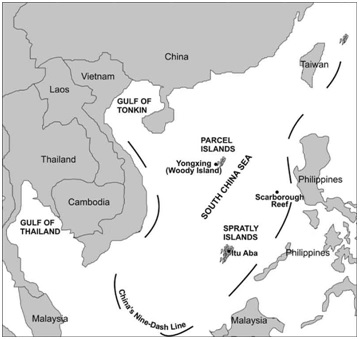
China has used its air and naval forces and even large militarized fishing boats to encroach upon and threaten its neighbors over shoals, islands, undersea oil fields, and fishing grounds. China claims these possessions as within its historical “nine-dash line,”which traverses the maritime territory of Japan, Vietnam, the Philippines, Brunei and Malaysia.
report 1

In 2012, China sent marine surveillance ships to surround Scarborough Shoal, 123 miles from the strategic port of Subic Bay and within Philippines’s 200-mile exclusive economic zone (EEZ). The Philippines sent naval boats to oppose the capture of Scarborough, but backed off to pursue a legal strategy instead.[3] Three years later, China still controls Scarborough Shoal.

In 2013, China used its air force to claim an Air Defense Zone (ADZ) over the seas recognized in international law as belonging to Japan. China announced that any aircraft in the zone would have to comply with ADZ composed of its regulations and restrictions, including a requirement that all flights through the region notify Chinese aeronautical authorities. Japan protested China’s actions, and the United States soon thereafter flew nuclear-capable bombers through the ADZ without notifying Beijing. The ADZ includes the Senkaku Islands, which Japan has controlled since 1895. China has contested Japan’s ownership of the island,[4] a dispute that escalated when Tokyo’s governor announced he would use public money to purchase the uninhabited islands from their private Japanese owner.[5]  Although the islands are too small to support human life, Japan has argued that under the UN Convention on the Law of the Sea (UNCLOS), it should have an EEZ in the surrounding waters, which contain oil and gas reserves.

Please click BGF-Report-on-Framework-for-Peace-and-Security to read or download the whole report.

The Ethics Code of Conduct for Cyber Peace and Security (ECCC) version 1.0

(September 23, 2015) –  Boston Global Forum (BGF) is developing an Ethics Code of Conduct for Cyber Peace and Security (ECCC) that prescribes Internet behaviors.

A draft version of that code, ECCC Version 1.0, is conceived and developed by BGF’s CEO Nguyen Anh Tuan. The draft also received contributions from from cyber security observers and experts.

The ECCC Version 1.0 expressed ideas and viewpoints which are co-authored by:

  • Governor Michael Dukakis, Co-Founder, and Chairman of Boston Global Forum
  • Nguyen Anh Tuan, Co-Founder, and CEO of Boston Global Forum
  • Professor Thomas Patterson, Co-Founder, and Member of Board of Directors, Boston Global Forum
  • Professor John Quelch, Co-Founder, and Member of Board of Directors, Boston Global Forum
  • Professor Carlos Alberto Torres, Member of Board of Thinkers, Boston Global Forum

The ECCC Version 1.0 is now open for discussion and contribution by Members of Boston Global Forum’s Young Leaders Network for Peace and Security. It also welcomes contribution of other individuals and groups to make a complete version of ECCC for a more safer and healthy cyber world.

Members of Young Leaders Network for Peace and Security (YLNP ), and Michael Dukakis Leadership Fellows will contribute to develop next versions of ECCC.

BGF invites suggestions for amending and strengthening ECCC Version 1.0 for the purpose of preparing a new version, ECCC Version 2.0, by December 2015

_______________

THE ETHICS CODE OF CONDUCT FOR CYBER PEACE AND SECURITY (ECCC)

Version 1.0

The Boston Global Forum’s Ethics Code of Conduct for Cyber Peace and Security (ECCC) encompasses the following behaviors in all Internet communication, relationships and transactions.

Net Citizens: Ethics Code of Conduct for Cyber Peace and Security

Behavior toward others:

  • Be honest
  • Show respect
  • Avoid disreputable acts, and denounce those of others
  • Do not think or act involve with cyber terrorism.

Behavior towards information:

  • Assess its reliability before accepting it
  • Do not distribute unreliable or erroneous information

Behavior in discussions:

  • Do not endorse other’s comments when information has not been verified
  • Do not post negative comments on people’s private lives
  • Do not share or comment on unverified or unreliable defamatory claims about brands, organizations, or public figures
  • Be constructive, respective, and encouraging in comments

 Policy Makers: Ethics Code of Conduct for Cyber Peace and Security

  • Do not establish, support, or endorse policies harmful to the Cyberspace environment
  • Do not unfairly criticize institutions, organizations, and brands
  • Do not unfairly criticize political opponents or other countries as using unverified, unreliable information etc.
  • Do not engage at any level in cyber spying, whether the target is an individual, firm, institution, or country
  • Do not engage in taking or disseminating private personal information
  • Do not engage or support in any form of cyber wars.

 IT Engineers: Ethics Code of Conduct for Cyber Peace and Security

  • Develop products to enhance cybersecurity
  • Do not create or distribute Internet viruses
  • Do not launch denial-of-service (DoS) attacks
  • Do not attack, disable, or steal information resources
  • Do not blackmail or otherwise threaten any person or organization
  • Do not deliberately create gaps in Internet security, and report any that are discovered
  • Do not use and distribute private information about individuals or organizations
  • Do not engage or assist in any form of cyberterrorism

Business Firms and Business Leaders: Ethics Code of Conduct for Cyber Peace and Security

  • Take steps to secure company information
  • Do not unfairly attack other companies
  • Do not attack other governments
  • Do not use products or systems that operate counter to a free and open Internet
  • Do not invest in products or systems that go against the humane values of a free and open Internet.

 Educators, Influencers/Institutions: Ethics Code of Conduct for Cyber Peace and Security

  • Do not disseminate or support negative opinions, doctrines that discourage the implementation of Cyber security measures
  • Educate and lead global citizens to support and execute ECCC
  • Propose solutions to build awareness of the value of ECCC and encourage its implementation
  • Foster public opinions that against bad behaviors such as theft of private data and information for distribution on the Internet.
  • Encourage those who use the Internet for purposes that contribute to a better life for all of mankind.
  • Create honors and awards to recognize outstanding individuals who contribute greatly for a secure and safe Cyberspace environment.

Download ECCC-Sep-2015 for the document.

Mikko Hypponen Presentation at BGF-G7 Summit Initiative Conference: The Digital Battle

Mikko Hypponen – Chief Research Officer, F-Secure – presented five types of computer hackers and how he tracks them and their Internet crimes.

They are:

White hat hackers who help corporations and government agencies identify and eliminate vulnerabilities,

Hactivists who break into computer systems as a form of protest,

Organized crime, which is motivated by greed and responsible for some 400,000 daily attacks,

Governments that engage in espionage, considered acceptable Internet behavior while hacking foreign corporations to steal intellectual property is frowned upon, and

Extremists, such as ISIS, the use the internet to cause harm as well as to recruit sympathizers.

Remarks by Governor Michael Dukakis honoring Vietnam Prime Minister Nguyen Tan Dung in the Global Cybersecurity Day

(BGF) – Vietnam Prime Minister Nguyen Tuan Dung was awarded the World Leader in Peace, Security and Development in the Global Cybersecurity Day event which was held on December 12, 2015 at Harvard Faculty Club.

The award is presented to individuals who have outstanding contributions to peace and security in their country and in the world.

In his congratulatory letter to PM Nguyen Tan Dung, dated December 8, Governor Michael Dukakis, former US presidential candidate, President of the Boston Global Forum, wrote: “The Boston Global Forum is an organization with the aim of gathering academic and government leaders around the world to work together to solve important international issues. Honoring you with this award, we recognize your exemplary leadership in your country and the region.”

Remarks by Governor Michael Dukakis honoring Prime Minister Shinzo Abe in the Global Cybersecurity Day

(BGF) – Japan’s Prime Minister Shinzo Abe was named the World Leader in Cybersecurity for his “exemplary leadership and contributions in promoting cybersecurity in Japan and Asia” in the Global Cybersecurity Day event which was held on December 12 at Harvard Faculty Club.

Watch the Governor Dukakis’ remarks here:

Mr. Tsutomu Himeno, Consulate-General of Japan in Boston, expressed his thank you on behalf of Prime Minister Abe and said that the award is a great encouragement.

Read the full remarks by Governor Michael Dukakis in honoring PM Abe’s achievements below:

I am pleased to announce the recipient of this year’s World Leader in Cybersecurity Award—Prime Minister Shinzo Abe.

The World Leader in Cybersecurity Award is given to individuals who contribute significantly to the advancement of cybersecurity.

Prime Minister Abe has worked tirelessly to make cybersecurity a priority in Japan and in the international community. Japan’s private sector particularly was still lagging in its cybersecurity efforts.

Recognizing the problem, and looking ahead to next year’s G7 Summit, which will be held in Japan, and the 2020 Tokyo Olympics, Prime Minister Abe has made cybersecurity a top policy priority.

Under his leadership, Japan recently held the “Cyber3 Conference” in partnership with the World Economic Forum (WEF). The Prime Minister has initiated and led the creation cabinet-level office to oversee national policy and promote international cooperation, in accordance with the Cybersecurity Basic Act enacted a year ago. And this year, the Prime Minister announced Japan’s Cybersecurity Strategy, a far- reaching plan to strengthen public-private efforts in the cybersecurity efforts. In the strategy, Japan announced an ambitious diplomatic initiative focusing on international rules and inter-governmental capacity building.

Prime Minister Abe has also exerted regional leadership in cybersecurity, engaging in capacity building through the cooperation between Japan and the Association of Southeast Asian Nations (ASEAN).

These and other efforts have put Prime Minister Abe in the forefront among world leaders in advancing the cause of cybersecurity. The Boston Global Forum is honored to present recognize him as a World Leader in Cybersecurity Award.