The Introduction of AI World Government Conference 2019

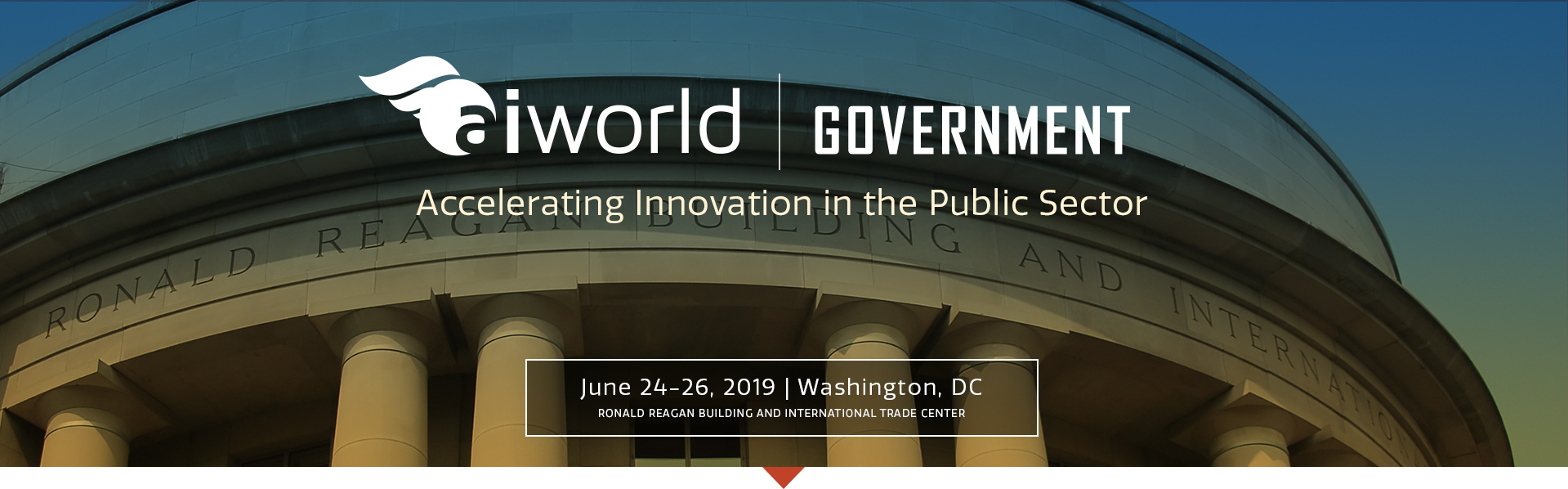
On December 12, 2018 at Global Cybersecurity Day Symposium, Eliot Weinman – GM & Founder of AI World, Executive Editor of AI Trends, announced the future cooperation between AI World and Michael Dukakis Institute for Leadership and Innovation – Boston Global Forum (MDI-BGF) to form the strategic alliance to host AI World Government Conference & Expo. The event will be held on June 24-26, 2019 at the Ronald Reagan International Trade Center in Washington, DC.

At the Symposium, Eliot Weinman, Founder of AI World mentioned the problems of ethics, security, privacy have exploded for all the obvious reasons just until recently, especially for public sectors since he has been working in AI for 20-25 years. He emphasized that this requires a call for action. For that reason, together with Governor Michael Dukakis, Chairman of MDI and Mr. Tuan Nguyen, CEO of MDI, he has decided to organize an event in Washington DC in June 24 to 26, with two thirds of which will be an AI event for the government.

AI World Government Conference & Expo is expected to provide a forum to educate and inform public sector agencies (federal, state, and local governments) and its supply chain on the many benefits of deploying AI technologies. These agencies are like public and private “enterprises”, which AI World is established and known for. The government application of AI is already in its early adoption period and has been deployed in a wide variety of applications that have shown benefits. As AI continues to evolve at a rapid pace, the next generation of deployment will enable government agencies to:

  • Provide better and enhanced services to its constituents
  • Increase productivity and reduce costs
  • Accelerate the overall digital transformation efforts underway throughout government agencies

AI World Government is also the backdrop for shaping the discussion around ethics, safety, and regulatory requirements for machine learning, deep learning, computer vision, image and pattern recognition, and emerging intelligent automation solutions.

In the event, the Michael Dukakis Institute for Leadership and Innovation (MDI) will present a half-day special program to gather global political leaders and major research institutions for discussion of the requirements to address AI ethics issues.

For more information, updates and useful links, please visit the official website of AI World Government 2019: http://www.aiworldgov.com/

Final Statement from the Imperial Springs International Forum

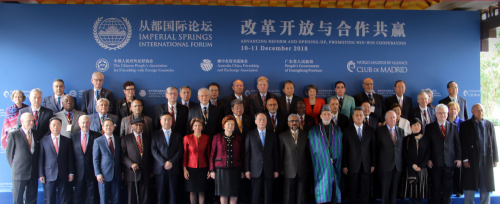
On the occasion of the 40th anniversary of China’s opening up and reform process, The 2018 Imperial Springs International Forum (ISIF) under the theme of “Advancing Reform and Opening-Up, Promoting Win-Win Cooperation” took place in Guangdong on December 10-11th with the participation of Vice-President of the People’s Republic of China, Wang Qishan and around 80 prominent leaders, distinguished experts from over the world.

The Imperial Springs International Forum has become an important platform for dialogue between China and the rest of the world, where leaders and experts constructively exchange views, contributing to improved global governance since 2014. It was jointly organized by the Chinese People’s Association for Friendship with Foreign Countries (CPAFFC), the People´s Government of Guangdong Province, the Australia China Friendship Association (ACFEA), and the World Leadership Alliance – Club de Madrid.

The 2018 forum concentrates on discussing interconnected topics including China’s new policies and its contribution to the world especially the Belt and Road Initiative (BRI) as well as sharing the view of building a community of shared societies, based on shared interests and shared responsibility to craft a shared future for humankind. The forum also found that protectionism and isolationist tendencies must be rejected in the context of the 21st century.

At the same time, noting that the interests of countries around the world are deeply intertwined nowadays, the forum was committed to work on a global system which uphold inclusive rules-based global governance architecture to promote peace and security, foster innovation and technological development to contribute to global trade and focus on international cooperation to achieve balanced development and prosperity with the aim to effectively implement the UN Agenda 2030 to “leave no one behind”.

President Sauli Niinistö of Finland is honored as World Leader for Peace and Cybersecurity at Harvard University

The World Leader for Peace and Cybersecurity Award for 2018

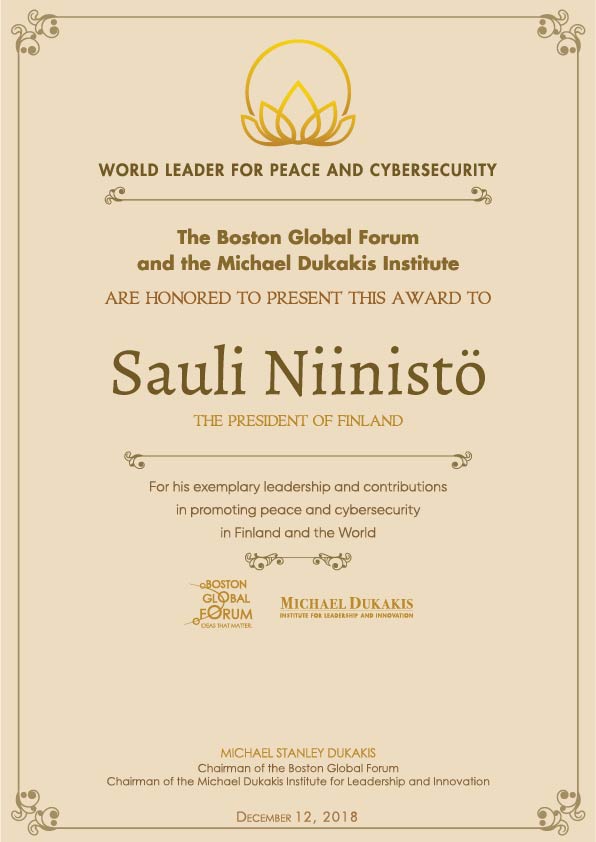
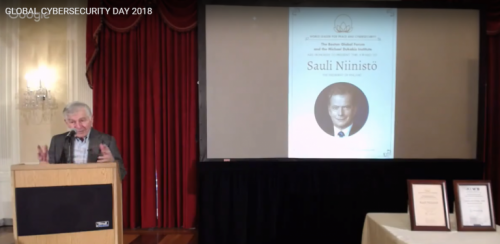
President Sauli Niinistö – President of the Republic of Finland received the World Leader for Peace and Cybersecurity Award from the Boston Global Forum (BGF) and the Michael Dukakis Institute for Leadership and Innovation (MDI). He was honored during Global Cybersecurity Day, which is observed on December 12 each year.

The goal of Global Cybersecurity Day is to inspire the shared responsibility of the world’s citizens to protect the Internet’s safety and transparency. This year’s conference revolved around the theme “AI solutions solve disinformation“. During the discussion, experts explored the current state of cybersecurity and the threat posed by disinformation, anonymous sources and fake news as well as the role AI can play as an effective defense mechanism against these threats to truth and the principles of democracy.

Former Massachusetts Governor Michael Dukakis, Chairman and Co-founder of BGF & MDI, moderated this year’s event.

President Niinistö was presented with the World Leader for Peace and Cybersecurity Award for his leadership role in establishing Finland as a vital member of the world community and his support of The European Centre of Excellence for Countering Hybrid Threats. In this role, he has fostered the understanding of, and solutions to the numerous threats we face from political forces, economic instability, military intervention, civil unrest, climate change, and unsafe Internet practices.

In a video message presented at the Global Cybersecurity Day Symposium, President Niinistö expressed his honor to receive this award and emphasized the importance of cooperation between nations to tackle the issues related to ongoing cyberthreats. “To increase national cybersecurity, all nations need to do their upmost to increase awareness among their citizens in all sectors of society. In cyberspace, we need to strengthen our cooperation between nations and rules over international borders,” said President Niinistö.

He said that he hopes the establishment of an intergovernmental think tank— The European Centre of Excellence for Countering Hybrid Threats—will make our society more secure. In conclusion he also highlighted the role of women in the era of rapid technological development. “Unlocking their full potential is crucial for our success as an international community. We should educate and advocate more young women to become active in this field. It will make us better prepared to profit from the immense opportunity that the digital era affords us.”

To guarantee the interoperability among different frameworks and approaches of governments, given the conditions of uncertainty and complexity in the AI ecosystem, Boston Global Forum – Michael Dukakis Institute for Leadership and Innovation (BGF-MDI) published AIWS Report on AI Ethics and proposed the model for Government AIWS Ethics and Practices Index. Also, BGF-MDI cooperated with AI World to form a strategic alliance host of the AI World Government Conference & Expo, on June 24 to 26, 2019, Washington, D.C.

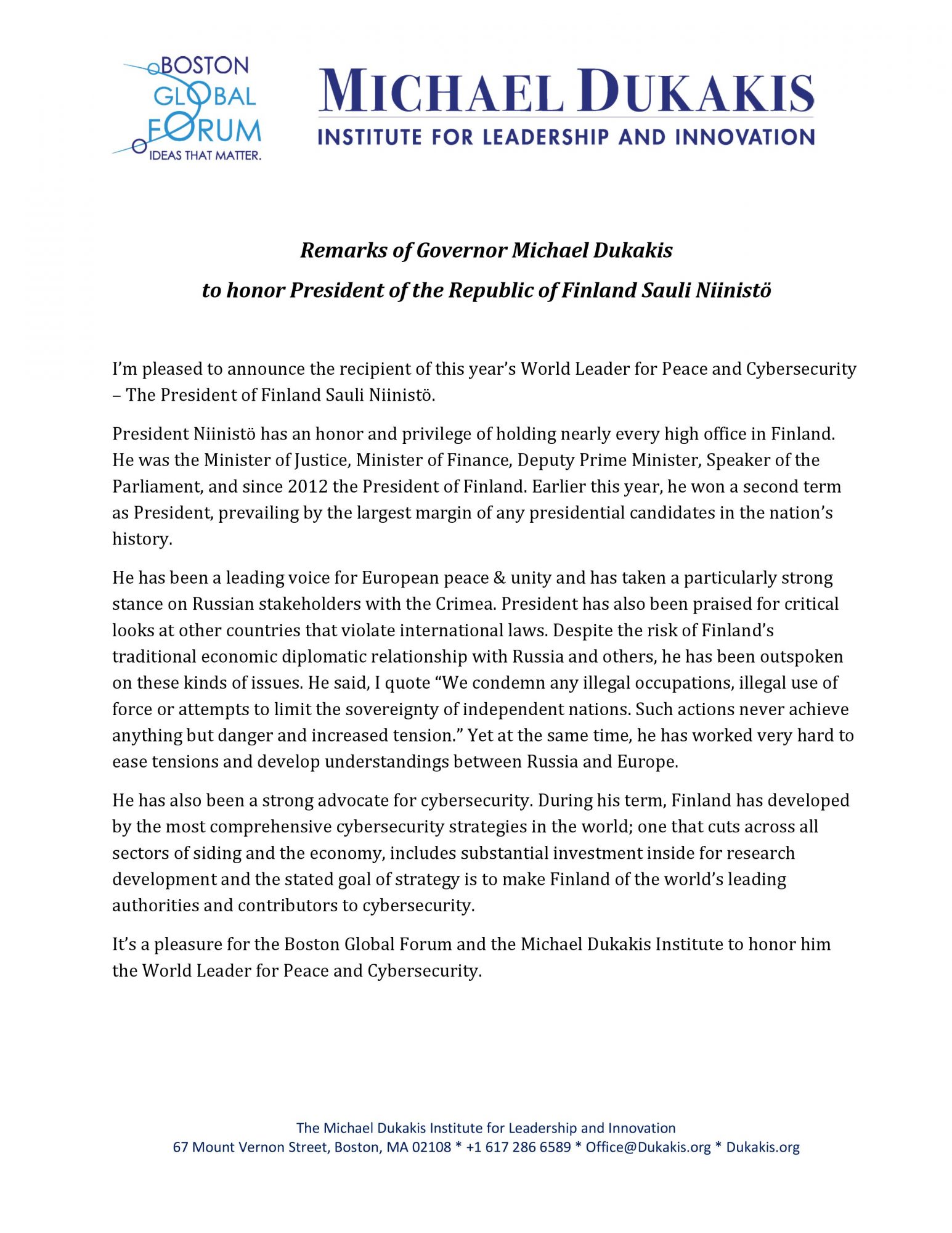
Remarks of Governor Michael Dukakis honoring President of the Republic of Finland Sauli Niinistö

View the video message of President of the Republic of Finland Sauli Niinistö to Global Cybersecurity Day Symposium

AI World Society Distinguished Lecture

On December 12, 2018, Michael Dukakis Insitute for Leadership and Innovation (MDI) honored Rt. Hon. Liam Byrne MP, Member of Parliament for Birmingham, Hodge Hill, Shadow Digital Minister, Chair of the All-Party Parliamentary Group on Inclusive Growth, as the first AI World Society Distinguished Lecture. Rt. Hon. Byrne sent a lecture. 
“Governor Dukakis, Mr President and Minister Taro Kono, friends and colleagues.

Let me apologise at once for speaking to you virtually.

Believe me, I am there with you in spirit!

Given the turmoil of our capital today, I am yearning for the calm of your campus!


It’s a campus I remember with great love.

My days at Harvard were some of the happiest days of my life.


I was newly married to Sarah, and around our nest on Cambridge Street, the dot.com boom seemed to be changing the very laws of economics; the rules of business; the norms of society.


But revolutions are rarely predictable;


And we did not predict the profound change that was coming in the balance of power between nation and nation, and between rich and poor;

Thirty years ago years ago I remember standing in the pouring rain in a Harvard car-park pleading with a professor for a place on the course in Building Information Age Businesses,

Now I’m speaking to you about how to tame that business power.


As a student, it felt it was an era of change.

As a politician, I now know it is change of era.

What our powers of prophecy failed to foresee, was that this information age

Was also an age of American hyper-power

And an age profoundly shaped by thirty years of liberal economics.

Most of us didn’t actually believe that it was the end of history; but lots found the idea pretty seductive.

In fact, history simply turned.


And the question we face in this new era, was spelt out for me by a very senior editor at our Financial Times:

‘Is this new age, he asked, ‘set to become more “Hobbesian” than “Rawlsian”?

‘Will we change the rules to fairly distribute the benefits and burdens of this new age, or will the world resemble a nightmare of ‘all against all’?

Speaking to a Harvard audience, I thought I’d better explain how John Rawls can win the day!


Let me explain the challenge before offering a few answers.

After victory in the Cold War, we faced the challenge of winning the peace.

America/NATO was the world’s only hyper-power – but this Age of Asymmetry was bound to provoke the rise of insurgency.

And so it proved.


From Al-Qaeda to ‘active measures’, malign actors have sought to use digital technology to radicalise, to terrorise, to paralyse: exploiting technology to sow discord, to inflame two sides of any argument, in short, to divide and so rule.

But the second challenge is not foreign but domestic.

It is the rise of new super-giants in our economy, companies so big that they can bend market outcomes – and bend them towards inequality.

Inequality which is the rocket-fuel of the populism that our enemies seek to inflame.


Joseph Schumpeter, another Harvard thinker, predicted this.

Everyone remembers his description of creative destruction.

But everyone forgets corollary: the destruction of competition.

And that is what we see across the digital economy.

A rise of Technolopolies – the superstar firms – which, as economists like David Autor have explained, drive down labour’s share of national income.

Put together the Age of Insurgency and the Age of Technopoly, and we do indeed have the makings of a Hobbsian world.


WHAT WOULD RAWLS SAY?

I don’t think the status quo can last. It is simply too unstable.

But, nor do we want, even if we could have it, a Chinese approach of central state control.

We have to find a middle way and in this, John Rawls should be our guide.

Rawls used a brilliant idea – the idea of an “overlapping consensus” to describe the way we can construct the law of people and crystallise rights equal to each.

It’s this overlapping consensus that we need today.


A new consensus we should enshrine in Rights for the digital age.

A Bill of Digital Rights.

A 34th Amendment, perhaps, to your Constitution.

And a new Convention for our Council of Europe.

The content of this Novus Carta should reflect the different roles we play in life – as citizens, as workers, as consumers, as parents, as children.


But let’s start with our basic rights as citizens;

Because here we face the most dangerous paradox;

The social networks built to nurture sweet-talk have become

The echo-chambers of hate speech

As humans, we love to connect; but we fear to be different.


So those who want to play the part of a digital Mephistopheles and entice us into supporting an agenda of not building bridges, but walls, don’t have to work that hard.

And countries like Russia understand this.

Their ‘dark social playbook’ connecting hackers, fake news sites, troll farms and dark money pumping round ads on Facebook targeted with pyscho-graphic precision courtesy of firms like Cambridge Analytica, takes apart old defences of democracy because the laws we have in place are so outdated.

So let’s update them.


Here in the UK we’re looking hard at ideas like:

The Feinstein Bill creating obligations to notify authorities of glorification or conspiracy to commit terrorism;

Or Germany’s NetzDG law which seems to be working in controlling hate speech.

Or Senator Warner’s proposed a duty on platforms to clearly and conspicuously label bots to protect consumers, and to stop bots amplifying disinformation, plus a duty to determine origin of posts and/or accounts – a crucial step in ensuring that bad actors are not allowed to abuse free speech in the arena of our democracy.

As citizens, we bear the right to be fully informed: and that needs enshrining for the digital age.


Second, as workers, we face both the biggest opportunity and the biggest threat to our livelihoods for decades.

Automation will be affect some 1.2 billion of the world’s 3.2 billion workers.

It would be naive to think that won’t be disruptive.


Our challenge here is what I’ve called the Harry Bridges Test.

The legendary president of the American dockers’ union won his spurs organising in 1934 – but it was the mechanisation of the Sixties that provoked him to ask: how do we win for his members “a piece of the machine”.

The challenge, said Bridges, was how to get the machines working for the workers and not against them.

That’s our test today.

Without rights to a genuine minimum Living Wage, a right to retraining, and a right to algorithmic justice, to stop the automated discrimination of hiring, firing and managing in the work-place, we will never create the ‘project hope’ we need for the future of automation.


Third, in the marketplace for consumers, we need to act now to protect freedom of choice by protecting the reality of competition.

In many parts of the economy, especially in the digital world, competition is moving from theory to fantasy.

And this is part of a larger trend.

The founding father of economics, Adam Smith, had a lot to say about the dangers of monopoly;

‘People of the same trade’ wrote Adam Smith ‘seldom meet together, even for merriment and diversion, but the conversation ends in a conspiracy against the public, or in some contrivance to raise prices’.


Well this summer, the IMF revealed just how extensive that contrivance has become.

The rising levels of market concentration across advanced economies is pushing up price mark-ups across advanced economies – by an average of over 40% since the 1980’s.

That’s a sign, competitive forces are waning.

We shouldn’t be surprised.


As I learned at the Harvard Business School, we don’t train corporate-chieftains to protect competition; we train them – and reward them – for destroying it.

Well I remember Michael Porter teaching me ‘The essence of strategy formulation is coping with competition.[1]

And now technology is being used systematically to destroy competition.

The world’s largest 2,500 companies now account for over 90% of global total and corporate investment in research and development.

The top 500 companies account 82% of the spend.


Many are now using this spend to create data monopolies to lock in their customers for the future.

Yet today’s competition rules don’t touch this.

Facebook has bought 69 companies since 2007.

When it bought WhatsApp, the deal turnover, some $13 billion, was too small to trigger merger control.

But buying WhatsApp, allowed Facebook to acquire a treasure trove of data on WhatsApp’s 1 billion users to add to its pile.

The risk of data-monopolies is not today a trigger for merger control.

But it should be.


Fourth, as parents, we have rights to honour, because we have duties to honour; duties to our children.

That means we have duties to safeguard our children online, where they now spend so much of their time. And who happen to make up a third of online users.

The Founders did not intend rights of free speech to undermine the healthy instruction of children.

Legislating in this field is rightly, difficult. But if we owe a duty of care to our children, why don’t social media firms.

If I built a physical arena and filled it with people, I’d be asked to manage a host of safety regulations.

Not so, in the virtual arena, where we’re seen suicide “games” spreading around social media platforms, like the “blue whale challenge”.


This dangerous “game” goads vulnerable teens into challenges, which start off as innocuous but steadily escalate into acts of self-harm.

Despite Instagram’s awareness of the “challenge” shared across its platform, the “game” has been linked to over a hundred teenage deaths in Russia, with evidence of the game spreading to the UK and India.

It’s time, therefore, that we imposed the same duties of care on social media firms bu asking them to set out the harms they know they risk creating, and inspecting them on taking appropriate steps to ameliorate those threats.

We should insist that the rights of children don’t stop at their screens; the rights of children have a digital dimensions; the right to informed use; the right to be safe, and crucially for the future, the right not simply to literacy, but digital literacy.


Finally: rights should be matched by responsibility.

Changes in technology always bring new responsibilities for many.

When Michael Faraday demonstrated electricity to Prime Minister William Gladstone, Gladstone struggled to make sense of it.

“But after all what use is it?” he asked

The exasperated scientist paused for thought.

“Well sir” replied Faraday, there is every probability that you will soon be able to tax it.”

Technology giants might like to move fast and break things. But someone has to put society back together again.

And that isn’t free. It’s expensive. Which is why we need these firms to start paying their taxes.


Conclusion

Governor, let me conclude, by acknowledging that I know that many of the changes I propose here will provoke cries of rage amongst Big Tech.

But rights, as Madison, knew are not always immutable.

They must evolve and change as society makes progress.

As Madison noted in the Federalist paper, some rights result from the nature of our life together, our compact together for living together.


Trial by jury for instance was never a natural right, but a right resulting from a;

 ‘social compact which regulates the action of the community…[as] essential to secure the liberty of the people as any one of the pre-existent rights of nature’.

Of all the lessons I learned at Harvard, perhaps the most important was the power of enterprise to change the world for good.


In my own study of the change-makers who built our economy, one lesson stands out: entrepreneurs change history by inventing the future.

But if we want the future to be a place of hope and opportunity for all, then we have to remember that the task of politicians to shape the market to fit society; not let the market dictate the shape of society.

That is why lawmakers and changemakers must now join forces together to reshape those wise constraints that make us free.

I hope John Rawls would approve.”

From website of The Rt. Hon. Liam Byrne, MP

https://liambyrne.co.uk/ai-world-society-distinguished-lecture/

⇒ Read full Byrne’s lecture here.

Agenda of Global Cybersecurity Day, December 12, 2018 at Harvard

GLOBAL CYBERSECURITY DAY 2018

Artificial Intelligence in the Age of Disinformation and Fake News

♦ ♦ ♦ ♦ ♦

TIME: 8:30 am – Noon, Wednesday, December 12, 2018

VENUE: Loeb House, Harvard University – 17 Quincy Street, Cambridge, MA 02138

MODERATOR: Governor Michael Dukakis, Chairman of Boston Global Forum (BGF) and Michael Dukakis Institute (MDI), former Governor of Massachusetts

AGENDA:

  • Introduction by Professor Thomas Patterson, Harvard
  • Opening Remarks by Governor Michael Dukakis, Chairman of BGF and MDI
  • Global Cybersecurity Day 2018
  • Announce Recipient and Present Awards for 2018: World Leader for Peace and Cybersecurity – President Sauli Niinistö, President of the Republic of Finland

         Remarks of Governor Michael Dukakis

         Keynote address of President Sauli Niinistö

         Speech of Minister Taro Kono, Ministry of Foreign Affairs of Japan

  • Conference Theme: AI solutions solve disinformation

          The AIWS Distinguished Lecture, Rt. Hon. Liam Byrne MP, the Member of Parliament for Birmingham, Hodge Hill, Shadow Digital Minister, chair of the All-Party Parliamentary Group on Inclusive Growth

          Presentation Cam Hickey, Information Disorder Lab, Shorenstein Center for Media, Politics and Public Policy, Kennedy School of Government, Harvard University

          Presentation Professor Pradeep K. Atrey, Co-Director, Albany Lab for Privacy and Security, University at Albany, State University of New York

          Presentation Professor Thomas Creely, U.S. Naval War College

  • Discussion moderated by Governor Michael Dukakis
  • Introduction about AI World Government Conference 2019 by Eliot Weinman, GM & Founder of AI World, Executive Editor of AI Trends
  • Closing Remarks by Governor Michael Dukakis

♦ ♦ ♦ ♦ ♦

Full agenda and our speakers and discussants, please download AGENDA Global Cybersecurity Day 2018

Boston Global Forum – Michael Dukakis Institute and the Strategic Alliance AI World will organize the AI World Government Conference & Expo 2019

On December 4 in Boston, Boston Global Forum – Michael Dukakis Institute for Leadership and Innovation (BGF-MDI) announced forming a Strategic Alliance Host of the AI World Government Conference & Expo with AI World. The event will take place on June 24 to 26, 2019 in Washington, D.C.

After the cooperation in the AI World Conference & Expo took place in early December, on December 4, the announcement of further partnership with BGF-MDI was made by Eliot Weinman, GM and Founder of AI World, and Executive Editor of AI Trends.

“We are pleased to continue our collaboration with the Michael Dukakis Institute for Leadership and Innovation and their Boston Global Forum in the jointly-organized conference with the same topic – AI World Government taking place on June 24, 2019,” said Weinman.

Nguyen Anh Tuan, CEO of BGF and Director of MDI, “We have several activities already underway at AI World 2018 and will continue our strategic alliance for all AI World 2019 events. We will present an AI-Government model at AI World Government.”

AI World Government Conference & Expo is developed to inform policy makers, and government’s staffs of the potential application of AI technologies. Introducing the government application of AI in its early adoption and benefits for instance:

  • Provide better and enhanced services to its constituents
  • Increase productivity and reduce costs;
  • Accelerate the overall digital transformation efforts underway throughout government agencies;
  • And introduce the AI-Government.

Concepts of AIWS 7-Layer Model and AI-Government

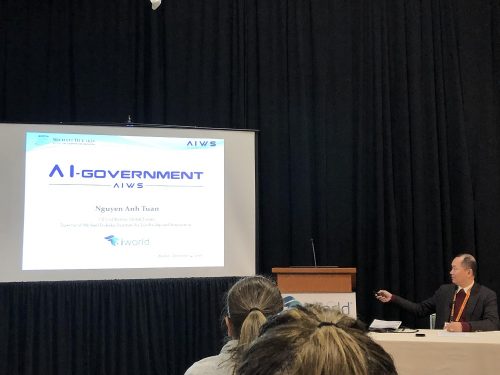
On December 4, Mr. Nguyen Anh Tuan, Director of Michael Dukakis Institute for Leadership and Innovation (MDI), CEO of Boston Global Forum (BGF), had the honor of being a lead speaker of the “AI in Government” at in the AI World Conference & Expo. He put emphasis on the importance of AI ethics and introduced his organizations’ outstanding initiatives: The AIWS 7-Layer Model and the AI-Government.

The Artificial Intelligence World Society (AIWS) is a set of values, ideas, concepts and protocols for standards and norms whose goal is to advance the peaceful development of AI to improve the quality of life for all humanity. It was conceived and established by MDI on November 22, 2017.

AIWS has developed the AIWS 7-Layer Model. This model establishes a set of norms and best practices for the development, management, and uses of AI so that this technology is safe, humane, and beneficial to society.

In addition to AIWS’s approach to AI ethics, he also introduced the concept of AI-Government which is a component of the AIWS. E-Government is the use of communication and information technology for improving the performance of public sector agencies. AI-Government transcends E-Government by applying AI to assist decision making for all critical public sector functions – notably provision of public services, performance of civic functions, and evaluation of public officials. The core of AI-Government is the National Decision making and Data Center (NDMD). NDMD collects, stores, analyzes, and applies massive amounts of data relevant to the provision of public services and the evaluation of public programs and officials. It does not replace governance by humans or human decisional processes but guides and informs them, while providing an objective basis for service provision and evaluation.

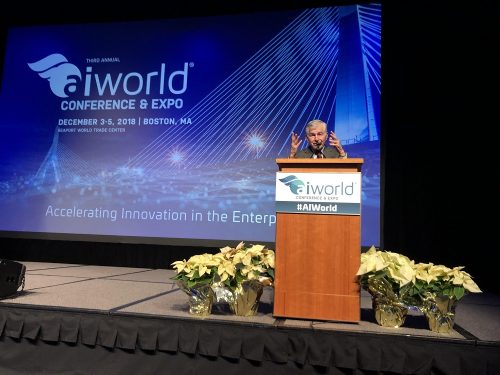
Governor Michael Dukakis made an opening speech at the AI World Conference and Expo 2018

In early December 2018, Governor Michael Dukakis, Chairman of Boston Global Forum (BGF) and Michael Dukakis Institute for Leadership and Innovation (MDI), co-founder of the AIWS Initiative, emphasized our responsibility in creating a better world using AI. He made an opening speech at the AI World Conference and Expo.

MDI is collaborating with AI World to publish some reports and programs on AI-Government, including AIWS Index and AIWS Products. It is a valuable opportunity for leaders and executives who seek knowledge of innovative implementations of AI in the enterprise through case studies and peer networking.

And at the AI World Conference and Expo 2018 launched by AI World, Governor Michael Dukakis, Chairman of BGF and MDI, made an honorary opening speech. The opening remarks highlighted the human’s mission in developing and creating AI to make our future brighter. At the conference, he also introduced the AIWS Report on ethics practice of major governments in the field of AI, including G7 countries and EU.

According to Eliot Weinman, GM & Founder of AI World, and Executive Editor of AI Trends, “Former Governor Michael Dukakis has been an innovative global visionary for decades. For the past several years BGF has conferred with government, research and technology experts to develop a framework for governments around the world to develop the proper AI ethics regulations. As a result, this morning, the Boston Global Forum released its AI World Society Report on AI Ethics, which includes its Government AIWS Ethics and Practices Index”. He also looks forward to cooperating with BGF and MDI in the next joint event AI World Government Conference & Expo held in 2019.