

Professor Jason Furman on the future of work: How can US workforce competes with AI

In June 2018, Prof. Jason Furman, Chairman of the Council of Economic Advisers of President Barack Obama, was invited to a talk at EmTech. “It’s where tech, business, and culture converge, and where you gain access to the most innovative people and companies in the world. It examines the most significant news on emerging technologies.” He discussed the situation of the labour force in the upcoming future as workers will be replaced with automated machines.
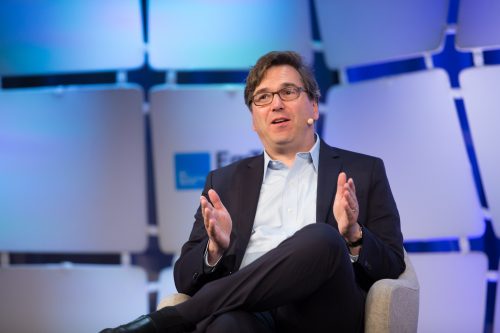
Furman discussed issues around the increasingly automated workforce—for example, whether machines are helping people earn more or whether they are acting as a substitute for our skills, such that people work less. When comes to the rise of AI, there are many possible outcomes in the realms of education, capital, wealth, etc.

It would be a waste of resources to try to predict the future that might happen and come up with a policy to deal with all the myriad possibilities. People should be working on policies for this moment to prepare for the future instead of only policies for AI. To be able to compete with machines, we could enhance skills which will be difficult to replace with AI—such as empathy, judgement, interpersonal relationships, and management.

In addition, in terms of developing a strategy for AI, ethical issues, cybersecurity and assuring machines are going to be for the good of human should be concerned. Overall, we need to prepare people to get into jobs and to be ready for the age of technological advancements.

Recently, Professor Jason Furman also took part in a conversation with Vietnamese CEOs in Vietnam CEO Summit 2018, discussing and recommending AI strategy for Vietnam’s economy. He became a member of MDI’s AIWS Standards and Practice Committee to contribute to the development of AI for good purposes.
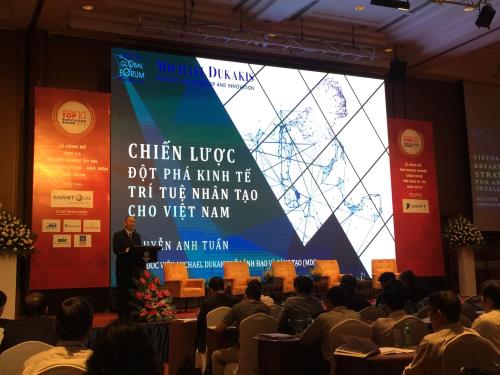

AI breakthrough strategy for Vietnam is presented in Hanoi by Prof. Jason Furman and Director Nguyen Anh Tuan

On July 25, 2018 in Hanoi, Prof. Jason Furman – Harvard Kennedy School, Chairman of the Council of Economic Advisers of President Barack Obama and Mr. Nguyen Anh Tuan – Director of The Michael Dukakis Institute for Leadership and Innovation (MDI) presented their strategy for Vietnam to become a pioneer in the Age of AI.

The strategy includes specific measures for Vietnam such as: attracting funding from international organizations, nation-states, influential leaders; establishing AI-Governance; creating an AI Innovation Zone to produce advanced products and service for Vietnam and international markets; capitalizing on proximity to China’s, one of the world’s leading nations in AI,

This strategy embraces the ambitious goal for Vietnam to become an advanced leader in AI in Southeast Asia. There are still many obstacles, but if Vietnam is to become an advanced AI nation, they must be overcome.

Atheism’s unpopularity is proven by AI

An international team of computer scientists, philosophers, religion scholars, and others is building computer models that can assist in carrying out experiments on policy making by creating virtual people to adopt with the policy.

In politics, it is difficult to tell whether a policy works out, when the decision is made. The only thing can be done is hope that it will be a success, if it isn’t, it cannot be undone. Now, the scenario is possible with the help of AI.

Over the past three years, Boston’s Center for Mind and Culture, and the Virginia Modeling, Analysis, and Simulation Center, as well as the University of Agder have been running a project on AI assessor. Experiments of religion-based policy are available with the Modeling Religion Project. It involves computer models populated with virtual people, or “agents”. The agents mimic the attributes and beliefs of a real country’s population by using data collected from that country.In addition, they are also trained on a set of social-science rules about how people tend to interact under various circumstances. The project gives politicians an assessment tool for policy making options in order to come up with the most decision.

Despite its usefulnes, it is the social problem the reserchers aim to deal with, as a mistake could lead to unintended consequence. It I, therefore, it is necessary to work on this with transparency and speak out about inherent ethical risks. This is in accordance with  the first layer’s issue in the AIWS 7-layer model for AI ethical standards—its design and performance must be sufficiently transparent.

Google has released a tool kit that simplifies programming quantum computer

Google has created Cirq, a software that lets developers create algorithms without needing a background in quantum physics.

According to MIT Technology Review’s article, quantum computers are at the beginning stage of this technology. In fact, it is a real challenge to program its circuits because of its distinct features. Instead of using standard digital bits which represent either 0 or 1, quantum computers are based on “qubits” which can be in both 0 and 1 due to superposition. Moreover, they remain in their delicate quantum state for no longer than the blink of an eye.

Cirq is an open-source initiative that allows programmers to access and modify its capability. Google created it based on TensorFlow open source which facilitates machine-learning software. Quantum algorithms can be created on simulators that can help build software that will run on a wide range of real machines in the future. Many other tech companies are taking this approach and developing initiatives to help developers build a code for quantum machines, but Google has put itself in the forefront of developing power quantum processors such as the Bristlecone chip, which hold the record for number of qubits.

Wit the current fast pace of technology, it should be kept in mind that the technology itself is not the achievement, what matters is how it benefits humankind.. It is necessary to have a certain set of moral standards in developing an advanced technology, the AIWS initiative with ethical standards in order to ensure every invention is for the benefit of humanity.

AI attack is not likely to happen

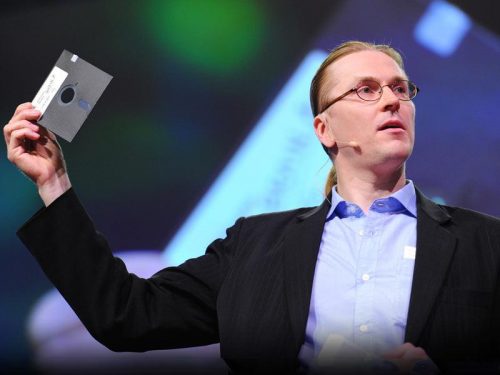
“There is no likelihood that cyberattack will happen in the near future”, said Mikko Hypponen, Chief Research Officer of F-Secure.

As reported by Computer Weekly, Mr. Hypponen, a researcher in machine learning-based security for several years, denied the AI’s ability to carry out attacks in the near future. His company F-secure, a Finnish cybersecurity and privacy company, conducted research to understand the potential of automating malware analysis with algorithms to differetiate malicious and non-malicious programs, Eevntually they failed due to the vast quantities of malware samples they tried to exmine.

“The algorithms also had to be able to determine when they were not able to tell if a program was malicious or non-malicious and to refer that to a security analyst instead, who could then improve the algorithm to be able to deal with similar situations in future.” said Mr. Hypponen.

Moreover, machine learning specialists and AI programmers tend to seek a well-paid job instead of committing crimes. Hence, criminals using machine learning will be way off in the future. However, if AI platforms become less complex, it is likely that criminals are going to exploit thm at some point.

Mr. Hypponen, a global security expert, has worked at F-Secure since 1991. In 2015, he also was honored as the Practitioner in Cybersecurity Award by BGF.

Mistrust toward Democratic Institutions is found in Western Europe

Collaborating with Pew Research Center and the IE School of International Relations, the WLA-CdM hosted an event where a finding of Pew Research Center was published  on political attitudes in Western Europe.

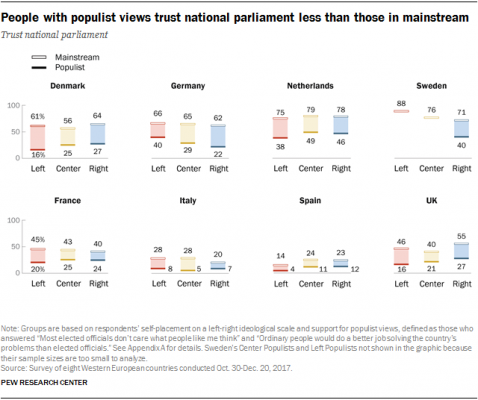
In late 2017, a poll was conducted in eight countries of Western Europe; Germany, France, Italy, Spain, UK, Denmark, the Netherlands and Sweden. Where a trend toward disenchantment with politic was found. The poll underscored how populist parties are tapping into the frustration toward the establishment, according to WLA-CdM’s article, trust in democratic institution is low in countries such as the UK, Spain, France and Italy.

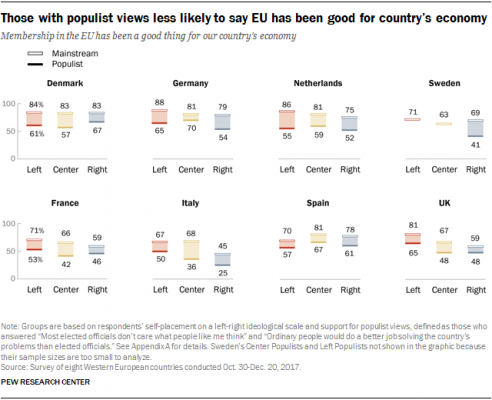
It can be seen that citizens with populist views didn’t perceive much economic benefit from being a member of the EU. The reasons for this is the increasing divergence between rural and urban environments, making it clear that democracies are not doing enough for many of their citizens, especially those who are behind in technology.

The WLA-CdM also plays the role of  partner with BGF and MDI in developing the AIWS 7-layer model for AI’s development.

Vietnam CEO Summit 2018: The Age of the AI Economy and Vietnamese Enterprises

On July 25, Vietnam CEO Summit 2018 took place in Hanoi with the theme “The Age of AI Economy and Vietnamese Enterpriseshad the objective of giving the leading CEOs in Vietnam a glimpse of the current trend in technology advancement as well as management tools and methods to make the most of the opportunities offered by AI.

Vietnam CEO Summit is an annual event for enterprise executives held by Vietnam Report Jsc. and VietNamNet newspaper. At this year’s Summit, the leading experts in the field of AI and economics presented their  recommendations for Vietnamese participants.

The keynote speakers were: Prof. Jason Furman – Harvard Kennedy School and Chairman of the Council of Economic Advisers of President Barack Obama, Mr. Le Quang Manh – Deputy Minister of Ministry of Planning and Investment in Vietnam, Mr. Nguyen Anh Tuan – Director of MDI and CEO of BGF, Dr. Kazuo Yano – Chief Engineer at Hitachi, Ltd., Dr. Masahiro Fukihara – Founder and CEO of Institution for a Global Society, Mr. Duong Tri Thanh – CEO of Vietnam Airlines, with over 300 experts, scholars and leaders. Among them, there are four members of MDI’s AIWS Standards and Practice Committee including: Prof. Jason Furman, Mr. Nguyen Anh Tuan, Dr. Kazuo Yano and Dr. Masahiro Fukuhara.

During the Summit, Prof. Jason Furman and Mr. Nguyen Anh Tuan presented a report and the breakthrough strategy for AI economy. Prof. Jason Furman gave a speech on the US – China Trade War and implications for Vietnam. Dr. Kazuo Yano discussed AI for Enterprises and Dr. Masahiro Fukuhara delivered a speech on the application of AI for human resource development.

In addition, business leaders in Vietnam held two discussions with speakers and other guests of the Summit about AI for business, and opportunities as well as challenges for Vietnam.

The leapfrogging strategy in AI for Vietnam

Professor Nazli Choucri, Professor of MIT and Board of Director’s member of The Michael Dukakis Institute for Leadership and Innovation (MDI), delivered a speech on AI strategy for Vietnam on ThoiDaiAi.net – an AI information portal in Vietnam.

“This is the time to think seriously about the leapfrogging, the leapfrogging technology leapfrogging strategy in the area of AI.

 AI is the future already here, it is the future now. And a leapfrogging strategy for the future means a strategy to place Vietnam at the forefront of its peer countries maybe of the world as the whole in the area of AI. AI for particular applications and AI for government and AI for governance, AI for capturing the value added that the country’s population is producing, is creating and the like. Vietnam is very fortunate in having a very disciplined labor force and labor force may well be ready to be motivated, to be given incentives, to be given a global challenge. And the challenge is to put Vietnam at the forefront of the world capability on AI.

This is not impossible, this is very well within the acceptable possibility at this point but it requires commitment, it requires a continuity, it requires developing incentives and rewards for those that are committed and those would really work hard on the leapfrogging strategy in AI. We know that they need to be appreciate, rewarded. Here is the case where rewarding them would help the nation as the whole. __ has done some statistical work comparing where Vietnam stands in the labour, in the capability on the technology side and on the human capacity size in the cyber domain… just cyber related capability. Vietnam ranks among the 20 top countries in the world, not the first, not the second, but in the group, which means the foundation are there and they have to be accelerated. The challenge is to appreciate that most people think that AI is science-fiction, it is really not science- fiction. It’s day-to-day in advancing industrial countries, there is no reason why Vietnam could not have its own existed skill-base enhanced.

You don’t need a miracle, what you need is simply a strategy, a strategy that is anchor in people, in the support, and the facilities that people can have, and the reward. I am a great believer in rewarding good performance and making it known that you are appreciated, etc. Many areas where Vietnam push its capability on AI could have enormous benefits that are not understood and appreciated. Look at what we are saying now, we are saying it needs investment in human, investment in the willingness and desire of individuals to participate in the strategy to develop those capabilities. We are not asking the students or the young people to put a man on the moon. It is quite a contrary asking to have poor technology that is used to put people on the moon so to speak. In the old days, to __ us for purposes of national well-being, it is a 21st century vision, the developments of the past centuries were fine because it created strategies for hardware developed, bridges, buildings, roads, etc. But it neglected the brain, and the capability provided by cyberspace, access to cyberspace.

I would suggest, I do wish, they wish to be known as a Prime Minister who put Vietnam on AI map, put Vietnam in the path of global leadership in particular area and I am convinced that it can be done.

Thank you.”

AI innovators opposed to autonomous killer weapons

In the annual International Joint Conference on AI on July 18, AI innovators agreed to a pledge against weaponizing technologies introduced by the Future of Life Institute.

According to National Public Radio’s article, a recent demonstration in France of an autonomous tank frightened scientists in the field of AI.  Autonomous weapons may not draw the same fear as a killer robot (e.g., “the Terminator”) but weapons that function without human surveillance can be a threat. During the International Joint Conference on AI, top scientific minds came together to call for a “law against lethal autonomous weapons”.

The pledge stated that “we will neither participate in nor support the development, manufacture, trade or use of lethal autonomous weapons”. The pledge was signed by Elon Musk, Founder of Tesla and Space X. Demis Hassabis and Mustafa Suleyman, Google DeepMind’s co-founders, and people among 170 organization and 2,400 individuals.

The pledge plays a role of an encouragement to global governments to take legal action to ban further development of this kind of technology.

At the same time, MDI is also working on an AI Peace Treaty including challenges for AI peace, AI weapons, the role of the UNs, OECD countries and top AI corporations in maintaining peaceful uses of AI.