

Patrick Winston

Member of AIWS Standards and Practice Committee, Michael Dukakis Institute

Ford Professor of Artificial Intelligence and Computer Science, MIT

Patrick H. Winston is Ford Professor of Artificial Intelligence and Computer Science at the Massachusetts Institute of Technology. He has been with CSAIL and before that the MIT Artificial Intelligence Laboratory since 1967. He joined the faculty in 1970, and he was the Director of the Artificial Intelligence Laboratory from 1972 to 1997.

Professor Winston is particularly involved in the study of how vision, language, and motor faculties account for intelligence. He also works on applications of Artificial Intelligence that are enabled by learning, precedent-based reasoning, and common-sense problem solving.

Professor Winston is chairman and cofounder of Ascent Technology, Inc., a company that produces sophisticated scheduling, resource allocation, and schedule recovery applications, enabled by AI technology, and in use throughout the world in major airports and the Department of Defense.

Professor Winston was a member of the Naval Research Advisory Committee (NRAC) (1985-1990, 1994-2000) for which he served as Chair from 1997 to 2000. During his service on NRAC, he chaired several studies, including a study of how the Navy can best exploit the next generation of computer resources and a study of technology for reduced manning. Professor Winston is also a past president of the American Association for Artificial Intelligence.

Professor Winston is working on a major new research and educational effort, the Human Intelligence Enterprise, which will bring together and focus research from several fields, including Computer Science, Systems Neuroscience, Cognitive Science, and Linguistics.

“Professor Patrick Winston passed away on July 19, 2019.”

Kazuo Yano

Member of AIWS Standards and Practice Committee, Michael Dukakis Institute

Chief Engineering of Hitachi, Ltd.

Kazuo Yano received the B. S., M. S., and Ph. D degrees from Waseda University, Japan, in 1982, 1984, 1993, respectively. From 1991 to 1992 he was a Visiting Scientist at the Arizona State University.

He is now a Fellow, Corporate Officer, Hitachi Ltd.

He is Known for the pioneering works in semiconductor field, such as the world-first room- temperature single-electron memories in 1993. In 2003, he has pioneered the measurement and analysis of social big data.

The wearable sensor for this purpose has been introduced in a Harvard Business Review. He has succeeded quantifying the happiness, which has been used in more than 30 companies.

His recent work is on the multi-purpose artificial intelligence, which has been applied to over 60 cases.

He has applied over 350 patents and his papers are cited by over 2500 papers. His book, “The New Invisible Hand,” is cited as one of top-10 business books in Japan in 2014.

He received 1994 IEEE Paul Rappaport Award, 1996 IEEE Lewis Winner Award, 1998 IEEE Jack Raper Award, Kujin Award from Hitachi Henjinkai in 1995, 2007 MBE Erice Prize, the Best Paper Award of International Conference on ASE/IEEE Social Informatics 2012. He is a Fellow of the IEEE.

Lessons for people in the 21st century by Bari Weiss

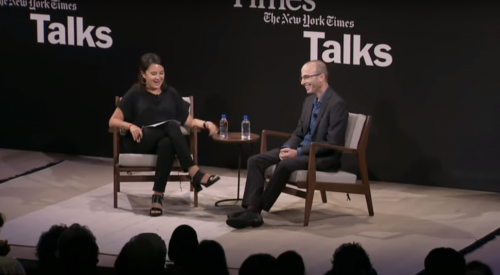
Recently, an Op-Ed staff editor and writer at New York Times was invited to a talk with Yuval Noah Harari, philosopher and international author of “Sapiens” and “Homo Deus” to discuss the vision of his latest work “21 lessons for the 21st Century” surrounding the future of humankind.

In the vision, humankind is going to let machines and robots take over and do tasks while humans live as “gods”.

Until that time, many problems have arisen in AI development; while nuclear weapons and arms races can be prevented, an AI weapon such as “killer robots” can be created secretly by a nation without the attention of others. It is difficult to tell when a new AI is being developed and whether it might cause danger. A certain level of trust needs to be built between nations on a global level.

In this interview, academic Yuval Harari engages in a broad-ranging discussion about human nature and the human condition, past, present and future. A number of his points underscore the importance of the AIWS initiative. He points out that recent advances in science suggest that humans don’t technically have full free will, that humans learn from stories, that stories don’t necessarily correspond to reality in which people suffer, that there are now techniques to “hack” the human mind and influence behavior, and that the development of AI (while offering many wonderful possibilities) sets the stage for manipulation and outcomes that are difficult to predict.  Therefore, he concludes, there is a pressing need for efforts to oversee the ethical development of artificial intelligence, and that these efforts have to be global to be effective. AIWS is well positioned to continue to play a facilitating role in this important context.

Video: https://www.timestalks.com/talks/yuval-noah-harari/

Google introduced its first bilingual AI assistant

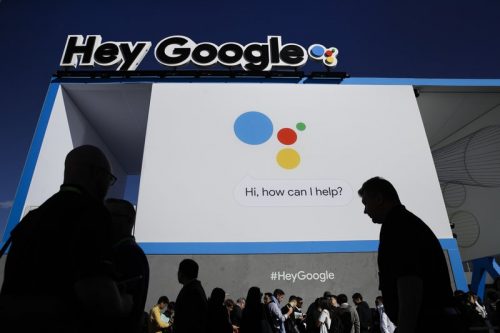
Google released the latest AI assistant which different from its competiors such as Apple’s Siri or Microsoft’s Cortana in the ability to switch simultaneously between two languages.

Nearly seven months after its announcement in February this year, the newest version of Google Assistant was launched last week with the capability to process and respond in two different languages on the fly.It is responsive to whichever language of the last message, there are currently a few languages which the assistant is programmed with: English, French, Spanish, German, Japanese and Italian. It is now available on Android phones and Google speakers.

According to Google AI Blog, it took years to teach the AI to be bilingual. It is extremely challenging to figure out the speech recognition step for two languages at the same time and coming up with the response for what has been heard. The application could help expand Google’s market to other country outside of U.S.

In fact, the tool could collect the voice of users and store the user’s data, which could violate people’s privacy and security. It is essential for Google to be transparent about how the data will be stored and used. Every system controlled by AI could potentially be harmful to humans. To ensure AI’s future, MDI has developed the AIWS Initiative – the AIWS 7-layer model for AI ethical standards.

“Quantum Hegemony? China’s Ambitions and the Challenge to U.S. Innovation Dominance”

On September 14, 2018, “Quantum Hegemony? China’s Ambitions and the Challenge to U.S. Innovation Dominance” will take place from 12:00 p.m. to 1:30 p.m. in Washington D.C. The event launched by CNAS Report will publish the report on technology development.

According to CNAS, a report was carried out by Elsa B. Kania and John K. Costello on China’s quantum science. China is considered the power house of quantum science due to its track record of advances in quantum technologies which consists of quantum cryptography, communications, and computing, as well as reports of progress in quantum radar, sensing, imaging, metrology, and navigation. Its achievement was displayed in its world first quantum satellite launched in August 2016.

In response to China’ advances, U.S needs to put effort in its current advantages in technologies to maintain its position as a leader in the innovation.

It can be seen that national pride has encouraged competition between countries, making such non-stop pace of technology development but it should be kept in mind that these advances only matter if it is for the good of human kind. There are organizations such as the Michael Dukakis Institute for Leadership and Innovation is established to secure our future with its initiatives which provide a moral framework for technology’s innovations, especially in the field of AI.

AI can speculate an area’s obesity level from its infrastructure

An AI algorithm is developed to estimate a city’s obesity rate by analyzing satellite images of its buildings.


A research group at the University of Washington analyzed images from Google Maps of four cities in U.S (Los Angeles, California; Memphis, Tennessee; San Antonio, Texas; and Seattle, Washington) to draw out the prediction for the rate of obesity–an alarming health issue in this country.

The team found the relationship between an area’s built environment and its neighborhood’s health issues by using neural networks. The images of the urban areas provide health indicators to the neighborhood ass the presence of parks, highways, green streets and housing types can be associated with the people’s physical activity according to a research published by JAMA Network Open.

Moreover, the algorithm can use neural networks to automate the extraction of features of infrastructure from satellite images. This study can possibly result in adjustment in infrastructure  to encourage physical movement and increase people’s health.

How blockchain affects creative industries positively?

Blockchain could be a trusted ledger as every action is transparent to everyone. In some creative industries, it can act as a platform for the intellectual property.

Many people have known of blockchain and how it works as a technology developed for the cryptocurrency Bitcoin. In terms of creative industries, it can help define one artist’s work to protect their intellectual property rights.

Recently, organizations and new intermediaries such as Youtube and Spotify have inserted themselves into the value chain between artists and audiences. As a result, artists receive less revenue from their work. In addition, their pieces of art are shared, advertised, priced. This problem can be tackled by blockchain.

There are five features of blockchain that can address these issues:

Feature 1: Enable smart contracts.

Blockchain can host “smart contracts” to ensure author’s digital rights and allocate revenue share to team that help creating the work.

Feature 2: Establish transparent peer-to-peer transactions.

As all of the transactions for creative work are transparent and accessible by all. This will allow the value of the product to be acknowledged.

Feature 3: Promote efficient and dynamic pricing

If blockchain serves as a platform, the demand for the artist’s work can be tracked, pricing would be more dynamic and controllable to the artist without going through web of intermediaries.

Feature 4: Allow “micrometering” or “micromonetizing”

By using blockchain, snippets – added info in form of code, text… could be made available for a certain cost. “This allow users to support content creator of their choice to reduce unwanted ads” said Mike Belshe- Cofounder of BitGo.

Feature 5: Establish a reputation system

Blockchain enables users and creator of creative content to verify one another, enhance the collaboration and behavior, collaboration not fulfilling the contract will be recorded.

In general, blockchain technology has a great potential to create a reliable accountability and transparency leading to efficiency for both artist and consumers.

WLA-CdM launched a new project on Information and Integrity and the Future of Democracy

The political influences of WLA-CdM’s members can be used to guide future actions in the political field with a new project on Information Integrity and the Future of Democracy.

WLA-CdM has been developing the Next Generation Democracy project which addresses the main factors affecting democracy of the world, which were new technology and social media. Guy Verhofstadt, former Belgian Prime Minister and Member of WLA-CdM, wrote an op-ed on Project Syndicate. He put emphasis on the threat of information integrity and social media shaping people’s political view.

To tackle this problematic situation, WLA-CdM launched a new project on Information Integrity and the Future of Democracy, with a purpose to engage in the discussion with stakeholders and WLA-CdM’s members to come up with recommendations to guide people in the area.

“In a world where an algorithm determines all outcomes, politics no longer exists,” said Guy Verhofstadt, “There is no time to lose. The world needs a new Internet, and Europe needs a new digital strategy – one that is not simply copy-pasted from the American model.”

The Roundtable on Global Governance for Information Integrity (take place on September 27, 2018 in Riga, Latvia) is the first activity of this new project. The event is organized under the cooperation of Latvian Ministry of Foreign Affairs and WLA-CdM, in consultation with the Lavitan Association of Political Science and the NATO Strategic Communications Center of Excellence. Mr. Nguyen Anh Tuan, Director of MDI, will attend the panel discussion of this event.

Germany will launch an agency on cyber-defense

In August 2018, Chancellor Angela Merkel’s government announced that Germany will invest €200 million in 5-year time on an agency to develop cyber capabilities.

Chancellor Angela Merkel is Germany’s first female chancellor and one of the leading figures of the European Union, since the 2005 national elections. She was also titled the World Leader for Peace, Security, and Development by MDI. She showed her interests in many fields including cybersecurity.

According to The Politico, her government will establish an agency following the model of U.S. Pentagon Research agency DARPA. The agency will come into operation by the end of 2018.  The new Agency for Innovation in Cybersecurity is created to combat cyberthreats as many security agencies have prepared cyber capabilities such as hacking software from enterprises outside of Europe.

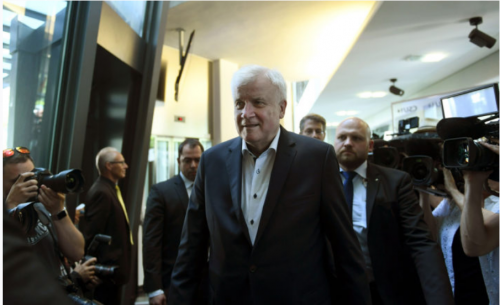
“We cannot just sit around watching sensitive information technology of high security relevance being controlled by third countries,” said Interior Minister Horst Seehofer.

At the same time, Chancellor Angela Merkel’s government is going to launch another agency on disruptive innovation for civil applications stated by Research Minister Anja Karliczek.