

Prof. Thomas Patterson will present the AI World Society – G7 Summit Initiative at AI World Government in Washington DC

On behalf of the group of authors of AIWS-G7 Summit Initative, professor Thomas Patterson, Harvard University, Board Member of the Boston Global Forum will present the AI World Society – G7 Summit Initiative, including AI-Government and AI-Citizen, at AI World Government on June 24, 2019 at Ronald Reagan International and Trade Building in Washington DC.
More details of the event can be found here.

Key messages of the AIWS-G7 Summit Initiative is:

Although Artificial Intelligence can be a destructive technology and has the risk of concentrating power and subordinating individual interest to machine-derived decisions, it also holds out the promise of improved governance and empowered citizens. For that promise to be realized, the Boston Global Forum believes that there needs to be a deliberate effort to work AI into the governing process in a way that enhances governance while strengthening citizenship, supporting democracy, and upholding fundamental individual rights and the rule of law.

In this brief, we have outlined a vision of how that can happen: AI-Government and AI-Citizen. The AIWS Model we propose envisions a society where innovation, creativity and dedication, democracy, individual rights and the rule of law are recognized and promoted, where AI is used to assist and improve government decision-making to make progress towards a more socially inclusive and just society in which citizens have a larger voice in their governing. We urge the G-7 countries to assume leadership on these issues.


 

When AI Becomes an Everyday Technology

The evolution of Artificial Intelligence (AI) has been a rich tale of exploration since its origins in the 1950’s, with the last decade providing an especially dramatic chapter of breakthrough innovations.

In 2019, we find ourselves at the start of this new chapter. AI has undergone a remarkable refinement in recent years, as barriers to entry have fallen and a wide range of products, services, resources, and best practices have emerged. As our focus shifts — finally — from AI itself to the impact that AI can have on your business, the question is no longer how this technology works, but what it can do for you.

In other words, we’re entering the age of deployed AI. Deployed AI is about more than engineering — it’s about a shared vision. Engineering expertise will always play a role in AI. Three fundamental characteristics of deployed AI can be seen in action. First, they identify a long-unsolved problem or unrealized opportunity. Next, they’re solved in a way that simply wouldn’t be possible without AI. Finally, they demonstrate that AI has a role to play in just about every industry, whether tech-focused or not.

This importance of deployed AI is also supported and promoted by AI World Society (AIWS) to develop AI with a better transparency and useful implementation with a holistic approach including data sets, algorithms, intended impacts, goals and purpose.


Artificial Intelligence in Life Sciences – Vendor Landscape and Use-Cases

Life sciences companies are likely to begin experimenting further with Artificial Intelligence (AI) in their workflows in the coming years, but they face challenges in AI adoption due to strict regulations. Machine learning has a “black box” problem, meaning that it’s many cases impossible to know how a machine learning algorithm comes to its conclusions.

An AI application that detects cancer, for example, may not be able to show an oncologist how it determined the presence of cancer in a patient’s body. As a result, if the oncologist used the application to diagnose a patient, they wouldn’t be able to explain to the patient what makes them sure they have cancer.

At this moment, life sciences companies are mostly using AI for research and development, drug discovery, and sales and marketing. According to Michael Dukakis Institute for Leadership and Innovation (MDI), AI can be a potential tool and a promising technology in life sciences for medical diagnosis to help people achieve well-being and happiness.

Facebook’s Libra: Three things we don’t know about the digital currency

Facebook just announced a new cryptocurrency, the Libra Coin. In May, Facebook registered Libra Networks LLC in Geneva. The Libra White Paper has finally been released. This launch is a big event, but so much about it remains unsettled. This week’s MIT Technology Review gives us a brief review of the high-profile Libra coin.

The Libra coin runs on the Libra blockchain. The vision is to realize the promise of “the internet of money”, a unified financial ecosystem enabling “a simple global currency and financial infrastructure that empowers billions of people”, including many that are left out of today’s financial system.

Sound familiar? Is it just like another cryptocurrency, like Bitcoin. Not really. Unlike Bitcoin, the Libra coin is a stable coin  “fully backed with a basket of bank deposits and treasuries from high-quality central banks,” according to the white paper.  The Libra blockchain is a permissioned network, governed by the Libra Association with “validator nodes” operated by 28 firms who have invested heavily in the project.

So it is not really fully democratic and decentralized, is it? No worry. Eventually it will be. “Our ambition is for Libra network to become permissionless,” according to Libra’s technical description.  “The challenge is that as of today we do not believe that there is a proven solution … through a permissionless network.” We will see.

Facebook chose not to use proof of work. It wants Libra coin to eventually use proof of stake: the more stake (investment in the coin), the more power to decide consensus. Intuitively, by being heavy investors, the validator nodes are locked into their stake and stand to lose it if they misbehave. But the transition from proof of work to proof of stake and from permissioned to permissionless as the model for the blockchain will take time. Think Ethereum, which has been struggling to reach this end. If Facebook can be the first to realize this, the impact will be great.

But, the biggest question is, why Facebook? According to Facebook, the $10 million buy-in will not get the validating firms access to transaction data. And so, what is the incentive for entities to join as validating nodes? The answer remains unclear.

With billions of people on earth are using Facebook and we can project that at least hundreds of millions of people would be using Libra coin. Although we remain to be in a wait and see state, the AI World Society supports this project. This will strengthen a society where people will increasingly trust decentralized forms of governance.


AI WORLD SOCIETY DISTINGUISHED LECTURE NAMED AS UNITED NATIONS ACADEMIC IMPACT CHARTER DAY LECTURE

The Boston Global Forum (BGF) and the Michael Dukakis Institute (MDI) for Leadership and Innovation organize the AI World Society (AIWS) Distinguished Lecture to honor people who have made outstanding contributions in AI that are associated with fostering a set of norms and best practices for the development, management, and uses of AI so that this technology is safe, humane, and beneficial to society.

The AIWS Distinguished Lectures focus on the ideas and visions of the honorees that brought them to their current position of achievement and highlight actions need to help shape a better world the future. The lectures are retained as part of the historical records at AIWS House, published in an e-book and featured in a special section of the Shaping Futures Magazine. BGF and MDI promote work on a 7-layer model for AI and society [https://bostonglobalforum.org/wp-content/uploads/The-BGF-G7-Summit-Report.pdf].

This time, Dr. David Bray’s future-focused AI World Society Distinguished Lecture has been named as United Nations Academic Impact Charter Day Lecture.

The Lecture will be held at the United Nations Headquarters in New York City on United Nations Charter Day June 26th, 2019 by the Boston Global Forum and United Nations Academic Impact (UNAI). Dr. David Bray will deliver this keynote address on “Artificial Intelligence, the Internet and the Future of Data: Where Will We Be in 2045?”. He will focus on looking towards 2045: rapid technological change, global questions of governance, and the future of human co-existence.”

Dr. Bray’s keynote address will explore of how advances in the Internet, artificial intelligence, and data technologies transform communities and societies. By 2045, the United Nations will be 100 years old and this distinguished lecture will consider what possible changes will have occurred in the world and human societies by then.

Maher Nasser, Director of the Outreach Division of United Nations, is the moderator

Dr. Bray’s talk will be followed by reflections of discussants and a larger conversation with the audience. The invited discussants include:

  • Fabrizio Hochschild, United Nations Under Secretary-General and Special Adviser on the Preparations for the Commemoration of the Seventy-Fifth Anniversary of the United Nations
  • David Silbersweig, Stanley Cobb Professor of Psychiatry at Harvard Medical School
  • Nam Pham, Department of Business Development and International Trade, Massachusetts Government.
  • Mariko Gakiya , Harvard T.H. Chan School of Public Health

Dr. David Bray to attend as moderator at AI World Government Summit 2019

David Bray, PhD, Executive Director, People-Centered Internet Coalition; Senior Fellow, Institute for Human-Machine Cognition, Member of AI World Society Standards and Practice Committee, AI World Society Distinguished Lecturer will serve as Moderator at the AI World Government Summit in the morning June 24, 2019 at Ronald Reagan Building and International Trade Center., Washington DC.

AI World Government provides a comprehensive three-day forum to educate and inform public sector agencies on the strategic and tactical benefits of deploying AI and cognitive technologies. With AI technology at the forefront of our everyday lives, data-driven government services are now possible from federal, state, and local agencies. AI World Government gathers leaders from across government, technology innovation, business, and research to present the state of the practice and state of the technology to assist the public sector in leveraging advanced intelligent technologies to enhance government services.

AI IMPACT ON A GREEN PLANET

Last week, AIWS Weekly wrote about the potential of Grover, an AI program to detect fake news. This is possible by recognizing the trace or signature that is left as artifacts of the AI, such as OpenAI’s GPT-2 text generator, that produces the fake text. These programs are examples of the AI machines that require computationally intensive training of very large neural networks. These “energy-guzzling” machines may fuel global warming.

It is suggested that the carbon footprint of training a single AI could be five times the lifetime emissions of an average car; New Scientist reported. “From an energy perspective, and from a carbon reduction perspective, we should be thinking about designing the services and making sure the algorithms are efficient as possible,” says Chris Priest at the University of Bristol. Big firms, in the like of Amazon and Google, are already taking major steps for more uses of renewable energy in training their AIs.

Not long ago, we heard similar criticisms, albeit not the same target. “Bitcoin will burn the planet down”. Déjà vu. As we are heading toward a green future, living in a green economy, no matter what advances a technology could offer, it seems to always be “it is energy efficiency, stupid.”

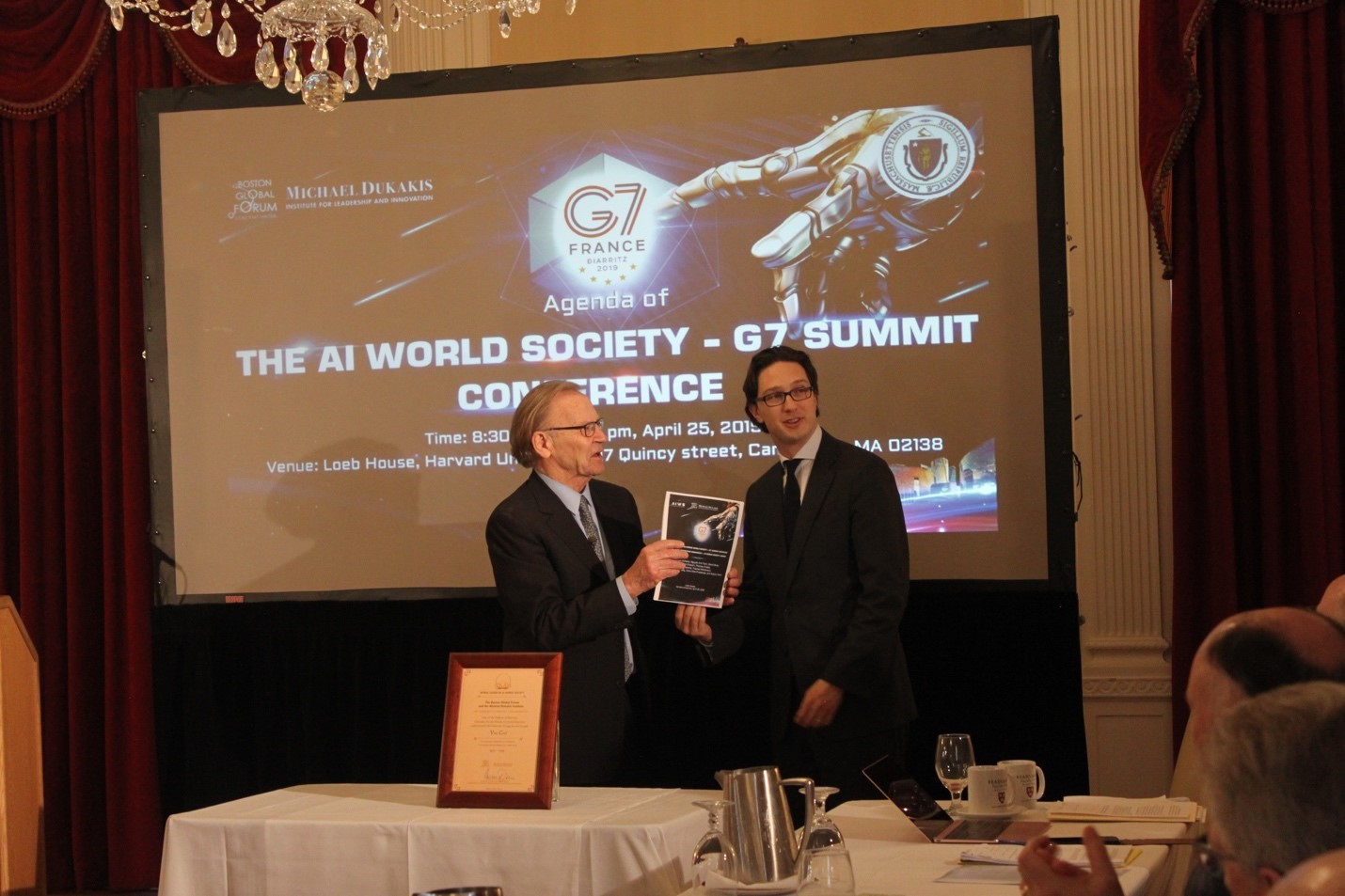
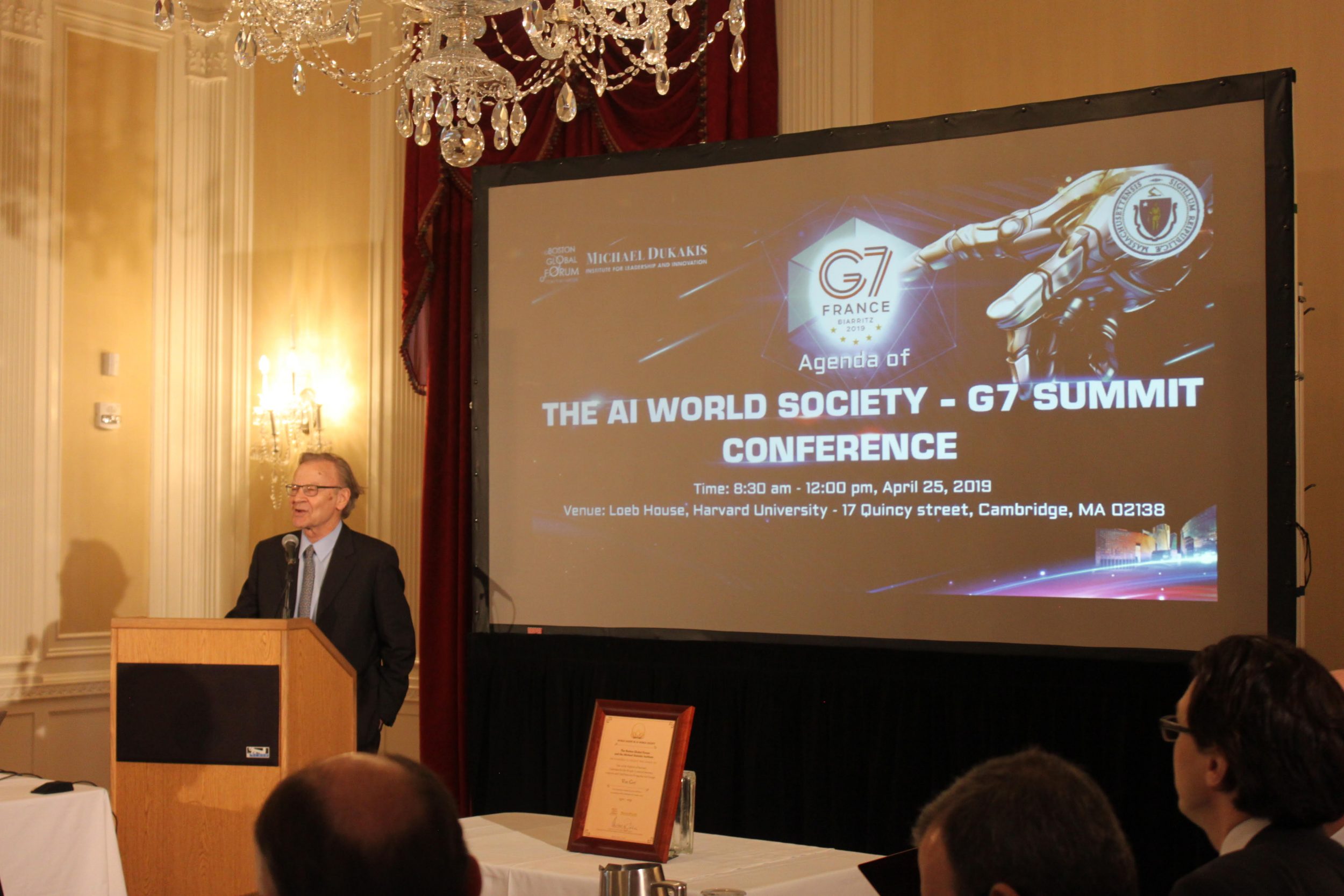
Professor Thomas Patterson presents the AI World Society-G7 Summit Initiative to the French Government, the host country of G7 Summit 2019, at AIWS-G7 Summit Conference on April 25, 2019 at Loeb House, Harvard University.

Breakthrough research demonstrates AI can predict a psychotic break

A trio of researchers have developed an experimental machine learning method that allows artificial intelligence (AI) to listen for the early whispers of psychotic break that humans can’t hear. The team, consisting of Neguine Rezaii of Harvard Medical School and Emory School of Medicine, and Elaine Walker and Philipp Wolff from Emory University’s Department of Psychology, set out to see if there was any way to use language as an indicator of impending latent onset psychosis.

They developed a machine learning method that looks for specific indicators long thought associated with psychosis, especially schizophrenia. The team then spent two years observing study volunteers, a significant portion of whom ended up demonstrating psychotic break (the first experience of a fully psychotic episode).

Those who suffer from psychosis have always cried out for help, we’ve just never had the right tools to understand exactly what they’re saying. This AI breakthrough has also been recognized by AI World Society (AIWS) to apply AI research in medical science, as well as bring a huge benefit to human well-being and happiness in general.


The Amazing Ways Hitachi Uses Artificial Intelligence And Machine Learning

Since its founding in 1910, Japanese company Hitachi has been at the forefront of innovation with a philosophy to contribute to society through “the development of superior, original technology and products.”

Announced in 2015, H is Hitachi’s solution for a generalized Artificial Intelligence (AI) technology that can be applied to many applications rather than just built for a specific application. H supports a wide range of applications and can generate hypotheses from the data itself and select the best options given to it by humans.

Hitachi has used its artificial intelligence expertise to fight cyberbullying in Japanese schools, to develop new service platform businesses, and to understand and make decisions based on demand fluctuations and kaizen activities in the workplace. By using AI to generate logical dialogue in Japanese, the technology also helps support enterprise decision-making for global companies.

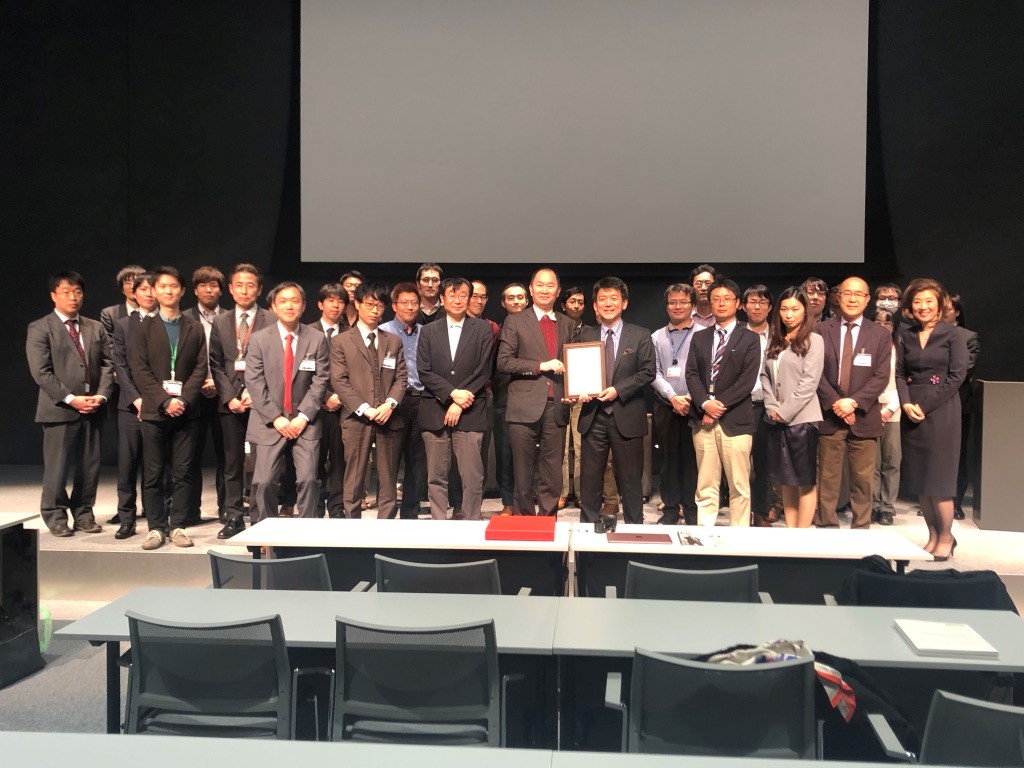
To recognize Hitachi contribution on AI World Society, Michael Dukakis Institute for Leadership and Innovation (MDI) also honored Dr. Kazuo Yano, Hitachi corporate officer and Fellow, as an AIWS Distinguished Lecturer and a Member of AI World Society Standards and Practice Committee in 2019.